Grading Scales Explained: Types, Conversions, and Best Practices
Explore the most common grading scales — letter grades, percentage, pass/fail, ECTS, and proficiency-based — and learn how to choose and convert between them.
Grading scales are the backbone of every educational system, translating complex student performance into a standardized language that transcripts, employers, and institutions can understand. Whether your school uses letters, percentages, or proficiency levels, the grading scale you choose shapes how students perceive their work and how fairly achievement is communicated.
What Is a Grading Scale?
A grading scale is a predefined system that maps student performance to a set of scores, letters, numbers, or descriptive levels. It defines the boundaries between grade categories and provides a common reference point for interpreting what a particular grade means.
Grading scales serve two distinct functions:
- Measurement: Quantifying student performance on an assignment or course
- Communication: Conveying that measurement to students, parents, institutions, and employers in a universally understood format
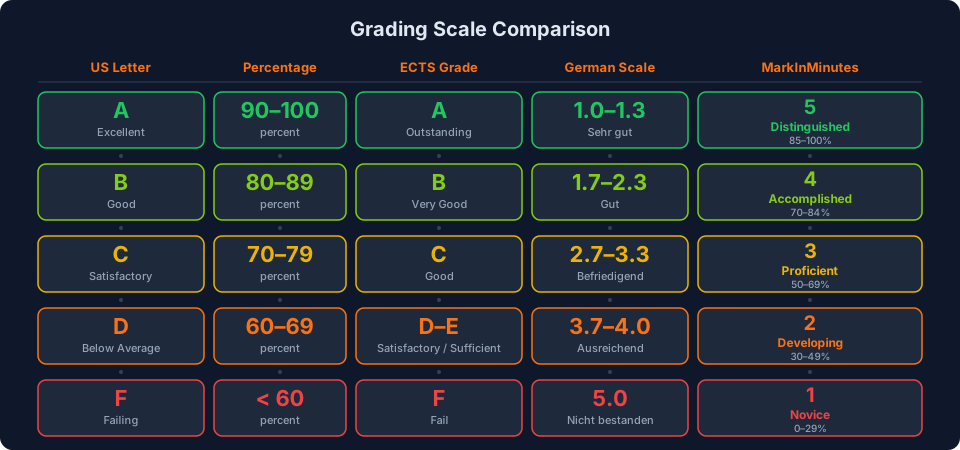
The choice of grading scale directly affects how achievement is perceived. A student who scores 72% might receive a C in the United States, a "good" (2.3) in Germany, or a B under the ECTS grading system — the same level of mastery, communicated very differently.
Why Grading Scales Matter
Grading scales matter because they define the stakes. The boundaries between an A and a B, or between pass and fail, are not inherent truths — they are design decisions that affect student motivation, GPA calculations, scholarship eligibility, and graduate school admissions.
For educators, selecting the right grading scale:
- Aligns assessment with teaching philosophy (mastery vs. ranking)
- Determines the granularity of feedback (grade descriptors)
- Affects how rubric scores translate to final marks
- Impacts criterion-referenced versus norm-referenced interpretation
For students, the grading scale:
- Sets expectations about what counts as "passing" or "excelling"
- Affects GPA and academic standing calculations
- Determines credit transfer compatibility across institutions
Types of Grading Scales
Letter Grade Scale (A–F)
The most familiar system in North American education. Typically maps to a 4.0 GPA scale.
| Letter | GPA | Percentage Range | Description |
|---|---|---|---|
| A | 4.0 | 90–100% | Excellent |
| B | 3.0 | 80–89% | Good |
| C | 2.0 | 70–79% | Satisfactory |
| D | 1.0 | 60–69% | Below Average |
| F | 0.0 | Below 60% | Failing |
Variations: Many institutions add plus/minus modifiers (A-, B+) for finer granularity, expanding the scale to 12 or 13 levels.
Percentage Scale
Grades are expressed as a number from 0 to 100. This scale offers maximum granularity but can create false precision — the difference between 87% and 88% is rarely meaningful, yet it may affect a student's letter grade.
Common in: K–12 education, standardized testing, and many university courses worldwide.
Pass/Fail (Binary)
A two-level scale where students either meet the standard or do not. This scale removes competitive pressure and is often used for:
- Clinical rotations and internships
- Elective or enrichment courses
- Graduate thesis defenses
- Courses during extraordinary circumstances (e.g., pandemic grading policies)
Drawback: Provides no differentiation among students who pass, making it unsuitable for competitive selection.
German Grading Scale (1–5)
Used across German-speaking universities, with 1.0 being the best and 5.0 as failing.
| Grade | Description | Approximate ECTS |
|---|---|---|
| 1.0–1.5 | Very Good (Sehr gut) | A |
| 1.6–2.5 | Good (Gut) | B |
| 2.6–3.5 | Satisfactory (Befriedigend) | C–D |
| 3.6–4.0 | Sufficient (Ausreichend) | E |
| 4.1–5.0 | Fail (Nicht bestanden) | F |
Note: German grades are awarded in increments of 0.3 or 0.7 (e.g., 1.0, 1.3, 1.7, 2.0, 2.3, 2.7, 3.0, 3.3, 3.7, 4.0, 5.0). The ECTS mapping varies by institution — some universities publish finer-grained conversion tables.
ECTS Grade Scale (A–F)
The ECTS grading system is designed for credit transfer across European institutions under the Bologna Process. Grades A through E are passing, with F as failing. Unlike the US system, ECTS grades were originally defined by statistical distribution within a cohort.
Proficiency-Based Scale
A proficiency-based (or standards-based) grading scale evaluates students against defined competency levels rather than points or percentages. Common labels include "Beginning," "Developing," "Proficient," and "Advanced."
Growing adoption: Many K–12 districts and progressive higher education programs are moving toward proficiency scales because they focus on what students know and can do rather than on accumulating points.
Grading Scales in Practice
Choosing the Right Scale
The best grading scale depends on your assessment goals:
| Goal | Recommended Scale |
|---|---|
| Maximize feedback granularity | Analytic rubric + proficiency scale |
| Simplify high-stakes decisions | Pass/fail |
| Comply with institutional policy | Letter grade or percentage |
| Enable European credit transfer | ECTS |
| Focus on mastery, not ranking | Proficiency-based |
Converting Between Scales
Grade conversion is one of the most contentious topics in academic administration. There is no universal formula because grading cultures differ. A "B" at one institution may represent stronger performance than an "A" at another.
Best practices for conversion:
- Use official institutional equivalency tables rather than ad hoc calculations
- Consider grade distributions, not just boundary percentages
- Document your conversion method for transparency and appeals
- Recognize that precision is limited — converting a German 2.3 to an exact US GPA point involves judgment
How MarkInMinutes Implements Grading Scales
Proficiency-Based Scoring with Flexible Conversion
MarkInMinutes uses a 5-level proficiency scale — Novice, Developing, Proficient, Accomplished, and Distinguished — with 11 scoring notches that provide granular differentiation within each level. This proficiency-based approach means grades reflect mastery of defined criteria, not arbitrary percentage cutoffs. The platform then converts proficiency scores to ECTS grades (A–F) and German marks (1.0–5.0) automatically, so institutions get grades in the format their systems require while preserving the richness of criterion-referenced feedback.
Related Concepts
Grading scales work in concert with several other assessment concepts. The ECTS grading system provides the European standard for cross-border grade comparability. A proficiency scale defines what performance looks like at each level within a scale, while grade descriptors provide the narrative detail behind each level. How you interpret grades — whether against fixed standards or against peers — depends on whether you use criterion-referenced assessment. And the rubric is the tool that bridges the gap between scale levels and actual student work.
Frequently Asked Questions
What is the most common grading scale?
The letter grade scale (A–F) is the most widely recognized, particularly in North America. However, percentage-based grading is the most commonly used worldwide, and proficiency-based scales are growing rapidly in adoption across K–12 and competency-based programs.
Can you convert grades between different scales accurately?
Approximate conversions are possible using institutional equivalency tables, but exact conversions are inherently imprecise because grading cultures, grade distributions, and assessment standards differ across institutions and countries. Always document your conversion methodology.
Why are some schools moving away from traditional grading scales?
Many educators argue that traditional percentage and letter grade scales emphasize point accumulation over learning. Proficiency-based and standards-based scales focus on demonstrating mastery of specific skills and knowledge, which better supports formative assessment, reduces grade inflation, and aligns assessment with clearly defined learning goals.
Sehen Sie diese Konzepte in Aktion
MarkInMinutes wendet diese Bewertungsprinzipien automatisch an. Laden Sie eine Abgabe hoch und erhalten Sie evidenzbasiertes Feedback in Minuten.
Verwandte Begriffe
Criterion-Referenced Assessment
Criterion-referenced assessment measures student performance against predetermined standards and learning objectives rather than comparing students to each other.
ECTS Grading System
The ECTS grading system is a European framework that standardizes academic credits and grade scales to enable transparent credit transfer across universities.
Grade Descriptors
Grade descriptors are written statements that define the characteristics and qualities of student work at each performance level on a grading scale, providing a shared reference for what distinguishes one grade from another.
Proficiency Scale
A proficiency scale is a structured set of performance levels that describe increasing degrees of mastery, used to evaluate student competency rather than assign percentage scores.
Rubric
A rubric is a scoring guide that defines criteria and performance levels used to evaluate student work consistently and transparently.