Standards-Based Grading: A Complete Guide for Educators
Understand standards-based grading (SBG) — its core principles, how it differs from traditional grading, implementation strategies, and why it leads to more equitable assessment.
Standards-based grading (SBG) is one of the most significant shifts in assessment philosophy of the past two decades. Instead of asking "how many points did this student earn?", SBG asks "what does this student know and what can they do?" That single question reframes grading from a bookkeeping exercise into a meaningful communication of learning — and it changes everything about how we design assessments, report progress, and support students.
What Is Standards-Based Grading?
Standards-based grading is an assessment system in which student grades reflect their level of mastery on clearly defined learning standards, rather than an accumulation of points from diverse activities like homework completion, class participation, and extra credit. In SBG, a student's grade answers one question: has this student demonstrated proficiency in the skills and knowledge outlined in the course standards?
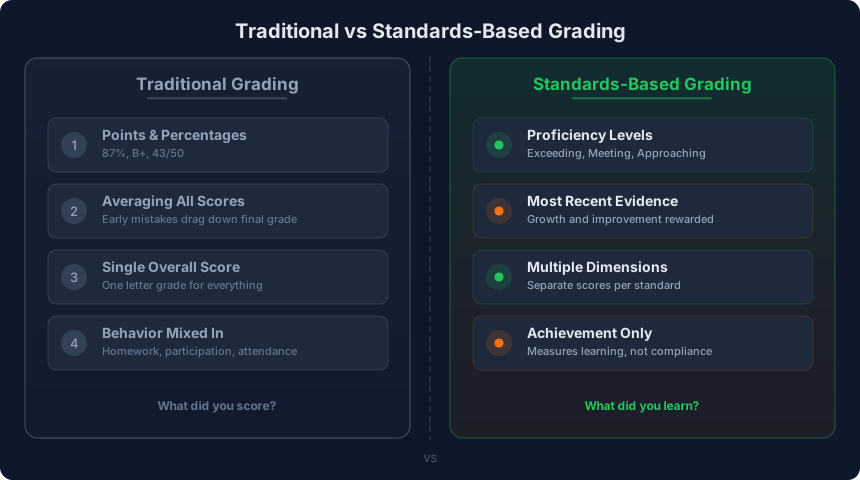
Unlike traditional grading, where a student's final mark is a mathematical average of every scored activity, SBG separates academic achievement from behavioral factors. Homework is practice, not a grade determinant. Attendance and effort are reported separately. And a student who struggles early but masters the material by the end of the term is not permanently penalized by early low scores.
Why Standards-Based Grading Matters
Traditional grading systems conflate many things into a single grade: knowledge, effort, compliance, timeliness, and sometimes even behavior. A student can earn an A without mastering core content (through extra credit and homework completion) or fail despite understanding the material (due to late penalties and missed assignments). This makes traditional grades unreliable indicators of what students actually know.
For educators, SBG:
- Aligns grading directly with learning outcomes and curriculum standards
- Makes grade descriptors meaningful by tying them to defined competencies
- Provides clearer data for instructional decision-making
- Reduces grade disputes by making criteria transparent and standards-based
- Supports equitable grading by removing penalties for behavioral factors
For students, SBG:
- Communicates exactly which skills have been mastered and which need work
- Encourages a growth mindset by allowing reassessment and revision
- Removes the anxiety of "point chasing" and grade calculation gaming
- Makes feedback actionable — students know precisely what to improve
Core Principles of Standards-Based Grading
1. Grades Reflect Learning Standards Only
Academic grades report only on mastery of defined standards. Behavioral factors — attendance, participation, effort, timeliness — are reported separately if at all. This separation ensures that a grade of "Proficient" actually means proficient, not "showed up regularly and turned things in on time."
2. Most Recent Evidence Takes Precedence
In traditional grading, an early zero haunts a student's average all semester. In SBG, the most recent demonstration of mastery carries the most weight. If a student fails the first quiz but aces the final assessment, they have demonstrated mastery — and their grade should reflect that.
3. Reassessment Is Expected, Not Optional
SBG systems build in opportunities for students to demonstrate mastery after additional learning. This is not "retaking a test for a better grade" — it is the pedagogical principle that learning happens at different rates, and the grade should reflect what was learned, not when it was learned.
4. A Proficiency Scale Replaces Percentages
Instead of 0–100 point scales, SBG typically uses a proficiency scale with four to five levels (such as Beginning, Developing, Proficient, and Advanced). These scales communicate learning status in clear, descriptive terms rather than arbitrary numbers.
SBG vs. Traditional Grading
| Feature | Traditional Grading | Standards-Based Grading |
|---|---|---|
| What's measured | Points earned across all activities | Mastery of defined standards |
| Grade calculation | Weighted average of all scores | Most consistent, recent evidence |
| Homework | Graded for accuracy and completion | Practice; feedback only, not graded |
| Late penalties | Reduce grade (e.g., -10% per day) | No penalty; focus on learning |
| Extra credit | Available to inflate grades | Not applicable |
| Behavior/effort | Often included in grade | Reported separately |
| Reassessment | Rarely allowed | Built into the system |
| Zero scores | Mathematically devastating | Not used; "insufficient evidence" instead |
| Reporting | Single letter/percentage | Per-standard proficiency levels |
Implementing Standards-Based Grading
Step 1: Define Clear Standards
Start with the learning standards for your course. These might come from national frameworks, accreditation bodies, or department-level learning outcomes. Each standard should be specific enough to assess and broad enough to represent a meaningful skill.
Step 2: Design a Proficiency Scale
Create a proficiency scale that describes what performance looks like at each level for each standard. Effective grade descriptors use concrete, observable language — not comparative terms like "better" or "more."
Step 3: Align Assessments to Standards
Every assessment should explicitly map to one or more standards. Use criterion-referenced assessment practices where scoring is based on mastery of defined criteria, not on comparison to other students.
Step 4: Separate Formative and Summative
Formative assessments (practice, drafts, homework) provide feedback but do not count toward the final grade. Summative assessments (demonstrations, projects, exams) provide the evidence of mastery that determines proficiency levels.
Step 5: Communicate the System
Explain the system to students, parents, and administrators. The biggest barrier to SBG adoption is often misunderstanding — stakeholders accustomed to traditional grading need to understand why a 3 on a 4-point scale is not the same as a 75%.
Common Challenges and Solutions
"Parents don't understand the scale." Solution: Provide clear conversion guidelines and emphasize that the proficiency scale communicates more, not less, than a letter grade.
"How do I report to a traditional transcript?" Solution: Establish a transparent conversion from proficiency levels to institutional letter grades (e.g., Proficient = B, Advanced = A). Many institutions have adopted dual-reporting systems.
"Reassessment is too much work." Solution: Reassessments do not need to be full retakes. Targeted evidence of mastery (a brief demonstration, a revised section, a focused problem set) can serve as reassessment evidence.
"Students won't do homework if it's not graded." Solution: This is a feature, not a bug. Students who only work for points were never learning for understanding. SBG shifts motivation from compliance to mastery — and research consistently shows that ungraded practice with feedback produces better learning outcomes.
How MarkInMinutes Implements Standards-Based Grading
Proficiency Scale Architecture Is Inherently Standards-Based
MarkInMinutes is built on standards-based grading principles from the ground up. Every grading profile uses a proficiency scale — Novice, Developing, Proficient, Accomplished, and Distinguished — with calibration anchors that define observable performance criteria at each level. Dimensions map directly to learning standards, and evidence-based scoring ensures that grades reflect demonstrated mastery, not point accumulation. The platform's AI grading applies the same criteria consistently to every submission, eliminating the drift toward leniency or severity that undermines standards-based systems in manual grading.
Related Concepts
Standards-based grading connects closely with several assessment frameworks. The proficiency scale provides the levels used to report mastery. Grade descriptors define what performance looks like at each level. Mastery learning is the instructional philosophy that underpins SBG's emphasis on eventual mastery over speed of learning. Criterion-referenced assessment is the measurement approach that evaluates students against standards rather than peers. And understanding the difference between formative and summative assessment is essential for correctly implementing SBG's practice-vs.-evidence distinction.
Frequently Asked Questions
Does standards-based grading work in higher education?
Yes, though adoption is slower than in K–12. Many college instructors use "specifications grading" or "ungrading" — variants of SBG adapted for higher education. The principles are the same: define standards, assess mastery, allow revision, separate behavior from achievement.
How do you handle a student who never reaches proficiency?
In SBG, a student who has not yet demonstrated proficiency receives a grade that reflects their current level (e.g., "Developing"). This is more honest and useful than a D or F, which tells the student they failed but not what they still need to learn. The feedback loop in SBG provides clear next steps rather than a dead end.
Is standards-based grading the same as competency-based education?
They share core principles — both focus on demonstrated mastery rather than seat time — but they differ in scope. SBG is a grading and reporting system used within traditional course structures. Competency-based education (CBE) is a broader educational model that also affects pacing, credit structures, and program design. SBG can exist within a traditional semester; CBE often does not.
Sehen Sie diese Konzepte in Aktion
MarkInMinutes wendet diese Bewertungsprinzipien automatisch an. Laden Sie eine Abgabe hoch und erhalten Sie evidenzbasiertes Feedback in Minuten.
Verwandte Begriffe
Criterion-Referenced Assessment
Criterion-referenced assessment measures student performance against predetermined standards and learning objectives rather than comparing students to each other.
Formative vs Summative Assessment
Formative assessment monitors student learning during instruction to provide ongoing feedback, while summative assessment evaluates achievement at the end of a learning period.
Grade Descriptors
Grade descriptors are written statements that define the characteristics and qualities of student work at each performance level on a grading scale, providing a shared reference for what distinguishes one grade from another.
Mastery Learning
Mastery learning is an instructional strategy in which students must demonstrate proficiency on a learning unit before advancing, using iterative cycles of instruction, assessment, feedback, and corrective teaching.
Proficiency Scale
A proficiency scale is a structured set of performance levels that describe increasing degrees of mastery, used to evaluate student competency rather than assign percentage scores.