AI Grading: How Artificial Intelligence Is Transforming Assessment
Explore how AI grading works, its capabilities and limitations, ethical considerations, and how human-in-the-loop systems ensure fair, consistent assessment.
AI grading has moved from experimental curiosity to practical reality. As large language models and machine learning systems have matured, educational institutions worldwide are exploring how artificial intelligence can support—or even lead—the assessment process. For educators navigating this shift, understanding what AI grading can and cannot do is critical to making informed decisions about adoption.
What Is AI Grading?
AI grading refers to the use of artificial intelligence systems to evaluate student work, assign scores, and generate feedback. Unlike simple auto-grading tools that check answers against a key (such as multiple-choice scanners), modern AI grading systems can assess open-ended work: essays, research papers, code submissions, short-answer responses, and even creative projects.
These systems typically work by analyzing student submissions against predefined grading criteria or a rubric, identifying relevant evidence in the work, and mapping that evidence to performance levels. The most sophisticated implementations go beyond simple pattern matching to evaluate argumentation quality, evidence use, structural coherence, and domain-specific accuracy.
Why AI Grading Matters
The assessment bottleneck is one of education's most persistent problems. A single professor teaching a 200-student course faces hundreds of hours of grading each semester. This creates pressure to simplify assignments, delay feedback, or rely on teaching assistants with varying levels of expertise.
Scale Without Sacrificing Quality
AI grading can evaluate large volumes of student work while maintaining consistent application of criteria. Unlike human graders, AI systems do not experience fatigue, time pressure, or order effects that degrade scoring accuracy over a grading session.
Faster Feedback Loops
Speed matters in education. Research consistently shows that feedback delivered promptly—while students still remember their thinking process—is far more effective than feedback returned weeks later. AI grading can compress turnaround from weeks to hours or even minutes.
Consistency Across Evaluators
One of the largest challenges in large courses or multi-section classes is maintaining inter-rater reliability. Different graders interpret criteria differently. AI systems can apply the same standards uniformly — though as recent benchmark data shows, not all AI tools achieve this consistency equally. The architecture of the AI system matters enormously.
How AI Grading Works
Modern AI grading systems vary significantly in their architecture, but most follow a general pipeline:
1. Rubric Ingestion
The system receives a structured rubric with dimensions, criteria, and performance levels. This rubric serves as the evaluation framework—the AI does not invent its own standards.
2. Submission Analysis
The AI reads the student's work and identifies relevant passages, arguments, evidence, structural elements, and potential errors. Advanced systems perform multiple analysis passes, each focused on different aspects of quality.
3. Evidence Extraction
Following evidence-based grading principles, the system extracts specific quotes and references from the submission that relate to each rubric dimension. This creates a transparent link between the student's work and the assigned scores.
4. Scoring and Calibration
The system maps collected evidence to performance levels using the rubric's grade descriptors. Calibration against anchor examples helps ensure scores align with instructor expectations.
5. Feedback Generation
Beyond scores, AI systems can generate constructive feedback that references specific parts of the student's work and suggests concrete improvements.
Capabilities and Maturity
Understanding AI grading's current strengths—and where the technology is still maturing—is essential for informed adoption.
| Capability | Current State | How Advanced Systems Address This |
|---|---|---|
| Evaluating writing structure and coherence | Strong | Multi-pass analysis with dedicated structural review |
| Checking factual accuracy against specified sources | Strong | Dedicated fact-checking agents that verify claims against rubric-defined source materials, with confidence scoring |
| Assessing argument quality and evidence use | Strong | Evidence extraction mapped to rubric criteria with citation trails |
| Detecting errors in code, math, or technical work | Strong (domain-specific) | Structured error taxonomies with severity classification |
| Evaluating creativity and originality | Emerging | Holistic review layers that assess cross-dimension qualities beyond checklist scoring |
| Understanding cultural context and nuance | Emerging | Rubric-anchored evaluation that scores against defined criteria rather than stylistic expectations |
| Applying rubric criteria consistently | Strong | Adversarial review pipelines that challenge and verify every score |
| Generating actionable, specific feedback | Strong | Structured coaching plans with before/after examples and skill gap analysis |
Important Caveat: Reliability Is Context-Dependent
AI grading reliability varies by task type, rubric specificity, and subject domain. Well-structured rubrics with clear, observable criteria in domains like argumentative writing or code review yield the strongest results. More open-ended or creative tasks, or those requiring deep domain expertise, benefit from heavier human oversight. Similarly, when AI systems "fact-check" student work, they verify claims against specified source materials and rubric-defined expectations — not against an omniscient knowledge base. Institutions should evaluate AI grading fitness for each assessment context rather than assuming uniform accuracy.
Challenges and How They Are Addressed
Like any assessment approach, AI grading has challenges that well-designed systems actively mitigate:
- Unconventional approaches need recognition: A student who takes a novel but brilliant approach should be rewarded, not penalized. Multi-agent architectures address this through holistic review layers that evaluate the submission as an integrated whole — catching cross-dimension qualities that criterion-level scoring alone might miss.
- Bias awareness is essential: AI systems can inherit biases present in their training data. Responsible implementations include dedicated bias-correction auditing that checks for systematic over- or under-scoring, ensuring consistent standards across diverse writing styles and perspectives.
- Linguistic diversity must be respected: AI models can over-favor dominant academic English conventions. The most effective mitigation is rubric-anchored evaluation: when AI scores against clearly defined criteria and observable evidence rather than stylistic preferences, dialectal variations and culturally specific rhetorical structures are evaluated on their substance, not their surface form. Institutions should still audit outputs for differential performance across linguistic backgrounds.
- Verification prevents inaccuracies: Any AI system can generate plausible-sounding but incorrect statements. Multi-agent architectures counter this with dedicated fact-checking agents, adversarial challengers that attack provisional scores, and evidence-citation requirements that create an auditable trail from student work to assigned grade.
- Human expertise remains valuable: AI does not have insight into a student's individual learning journey or personal circumstances. This is why the most effective implementations position AI and human educators as complementary — AI provides consistency, speed, and evidence-based rigor, while instructors contribute contextual knowledge and pedagogical relationships.
Ethical Considerations
AI grading raises important ethical questions that institutions must address before adoption.
Transparency
Students deserve to know when AI is involved in their assessment. Institutional policies should clearly communicate the role of AI in the grading process and how human oversight is maintained.
Human-in-the-Loop Design
The most responsible AI grading implementations keep humans in the loop. These systems combine AI's consistency, speed, and evidence-based rigor with human contextual judgment. Instructors can review AI-generated evaluations, adjust scores where their expertise adds value, and approve final grades — creating a collaborative workflow where each party contributes what it does best.
Equity and Access
AI grading systems must be evaluated for differential impact across student populations. If a system consistently scores certain demographics lower, that signals a bias that must be addressed before deployment.
Data Privacy
Student submissions are sensitive data. Institutions must ensure that AI grading providers handle student work in compliance with FERPA, GDPR, and institutional data governance policies.
AI Grading in Practice
Consider a university writing program with 500 students across 20 sections. Without AI support, each teaching assistant grades independently, leading to significant scoring variation. With an AI grading system:
- The lead instructor creates a detailed rubric with calibration anchors
- The AI evaluates all 500 submissions against the same rubric
- Each submission receives dimension-level scores with evidence citations
- Teaching assistants review the AI's evaluations, adjusting scores where their expertise identifies nuances the AI missed
- The result: faster turnaround, higher consistency, and more time for TAs to focus on individualized mentoring
How MarkInMinutes Implements AI Grading
Multi-Agent Grading Architecture
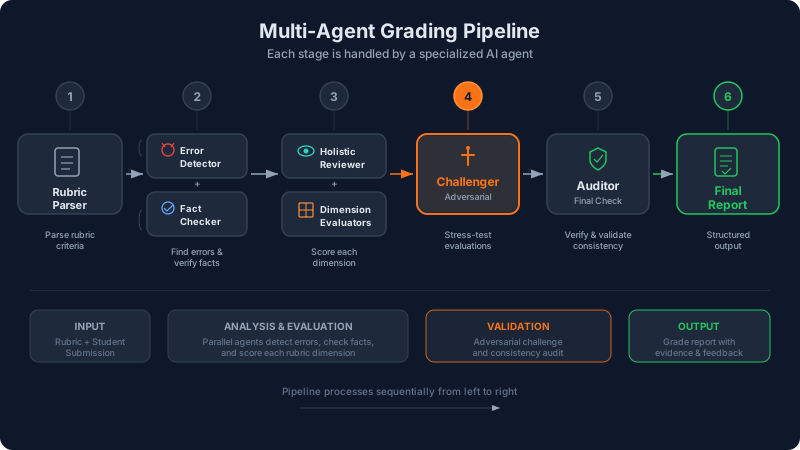
MarkInMinutes uses a multi-agent grading engine rather than a single AI model. Specialized agents each handle a distinct aspect of evaluation:
- Error Detector identifies factual, logical, and methodological errors
- Fact Checker verifies claims against known sources
- Holistic Reviewer assesses overall quality and coherence
- Evaluators score individual rubric dimensions with evidence citations
- Challenger plays devil's advocate, attacking provisional scores to test their robustness
- Auditor makes final adjustments based on bias correction, consistency checks, and calibration
This adversarial review pipeline mirrors the rigor of multi-rater human assessment panels—but at scale. Every score is backed by evidence, every evidence citation is challengeable, and every final grade has survived scrutiny from multiple perspectives.
Related Concepts
AI grading intersects with many established assessment concepts. Evidence-based grading provides the philosophical foundation—AI systems must justify scores with observable evidence, not opaque model outputs. Inter-rater reliability is both a motivation for AI grading (humans are inconsistent) and a benchmark for evaluating it (does the AI agree with expert raters?). A well-designed rubric is essential input—AI grading is only as good as the criteria it evaluates against. Constructive feedback generation is one of AI grading's most promising capabilities, turning scores into learning opportunities. And grading calibration ensures that AI scoring aligns with institutional standards and instructor expectations.
Frequently Asked Questions
Will AI replace human graders?
AI grading is most powerful when it works alongside human educators. AI brings consistency, speed, and evidence-based rigor — eliminating fatigue effects, scoring drift, and the hours spent on repetitive evaluation. Human educators bring contextual judgment, pedagogical relationships, and the ability to recognize individual student growth. The combination produces better outcomes than either could achieve alone: faster turnaround, higher consistency, and more time for instructors to focus on mentoring and teaching.
Is AI grading accurate enough for high-stakes assessment?
For well-structured rubrics with clear criteria, AI grading can match or exceed average human inter-rater agreement — and it does so consistently across every submission, without the fatigue and drift that affect human graders over long sessions. However, not all AI tools are equal. A benchmark of 72 grading runs found that ChatGPT achieved only 31% grade agreement (Cohen's Kappa: -0.067), while Claude appeared consistent on the surface but showed only 58% dimension-level stability. MarkInMinutes, using a multi-agent architecture, achieved 93.8% agreement with 94% dimension stability — demonstrating that architecture matters as much as model quality. For the highest-stakes decisions, many institutions choose to combine AI evaluation with human review, which adds an additional layer of confidence while preserving the consistency and evidence-trail benefits of AI-generated scores.
How do students feel about AI grading?
Research shows broadly positive reactions. Students generally appreciate faster feedback and consistent application of criteria. When AI-generated feedback includes specific evidence citations and actionable suggestions, students report higher transparency and trust in the process. This increase in confirmability tends to reduce the number of formally raised disputes.
Sehen Sie diese Konzepte in Aktion
MarkInMinutes wendet diese Bewertungsprinzipien automatisch an. Laden Sie eine Abgabe hoch und erhalten Sie evidenzbasiertes Feedback in Minuten.
Verwandte Begriffe
Constructive Feedback
Constructive feedback is specific, actionable commentary on student work that identifies strengths, pinpoints areas for improvement, and provides clear guidance on how to close the gap between current and desired performance.
Evidence-Based Grading
Evidence-based grading is an assessment approach where every score is justified by specific, observable evidence drawn directly from student work rather than subjective impressions.
Grading Calibration
Grading calibration is the process of aligning evaluators' scoring practices so that the same quality of work receives the same grade regardless of who assesses it.
Inter-Rater Reliability
Inter-rater reliability is the degree to which two or more independent evaluators assign the same scores to the same student work when applying the same assessment criteria.
Rubric
A rubric is a scoring guide that defines criteria and performance levels used to evaluate student work consistently and transparently.