Inter-Rater Reliability: Ensuring Consistent Grading Across Evaluators
Understand inter-rater reliability in assessment, including measurement methods like Cohen's Kappa and ICC, strategies to improve consistency, and calibration best practices.
Inter-rater reliability is the gold standard for grading fairness. When two professors independently grade the same essay and arrive at the same score, the assessment system is working. When they arrive at wildly different scores, something is broken—and the student is the one who suffers. Understanding, measuring, and improving inter-rater reliability is essential for any institution that takes assessment quality seriously.
What Is Inter-Rater Reliability?
Inter-rater reliability (IRR), also called inter-rater agreement or inter-scorer consistency, measures the degree to which independent evaluators produce the same scores when assessing the same piece of student work using the same criteria. High IRR means that a student's grade is determined by the quality of their work, not by which grader happened to evaluate it.
Inter-rater reliability is a specific form of reliability in assessment—it focuses on consistency between raters rather than consistency over time (test-retest reliability) or consistency across items (internal consistency). It is particularly important for subjective assessments like essays, portfolios, presentations, and open-ended responses, where evaluator judgment plays a significant role.
Why Inter-Rater Reliability Matters
Fairness to Students
Students in multi-section courses, team-taught modules, or programs with teaching assistants face a fundamental fairness question: would they receive the same grade regardless of which evaluator reviewed their work? Low IRR means the answer is no—and students have legitimate grounds for complaint.
Credibility of Assessment
Grades serve as credentials. Employers, graduate programs, and professional licensure bodies rely on grades as indicators of competence. If those grades vary significantly depending on who did the grading, their credibility as meaningful signals erodes.
Accreditation and Quality Assurance
Accreditation bodies increasingly require evidence of assessment quality. Demonstrating strong inter-rater reliability across program assessments is a concrete way to satisfy these requirements and show that grading practices meet professional standards.
Legal and Policy Compliance
Grade appeals and academic grievance processes often hinge on whether grading was conducted fairly and consistently. Documented IRR data provides evidence that grading standards were applied uniformly.
Measuring Inter-Rater Reliability
Several statistical methods quantify rater agreement, each suited to different assessment contexts.
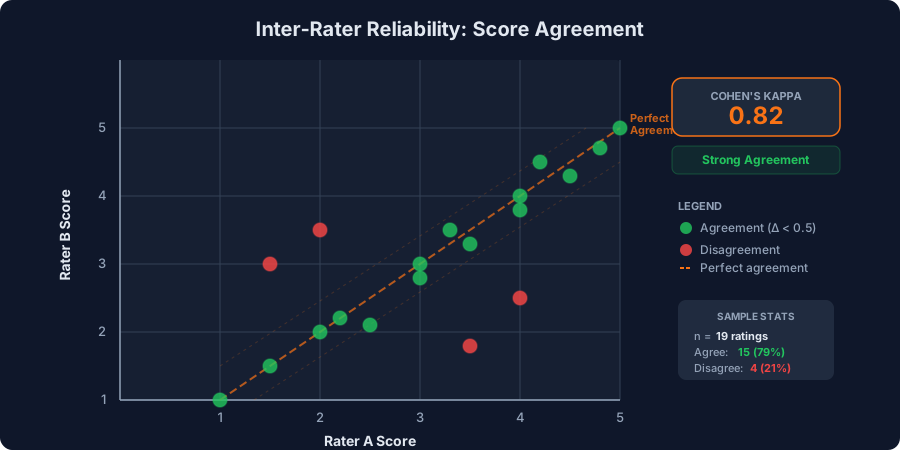
Percentage Agreement
The simplest measure: what proportion of scores were identical across raters?
- Calculation: (Number of agreements / Total ratings) x 100
- Strength: Easy to compute and interpret
- Weakness: Does not account for agreement that would occur by chance
For example, if two graders using a 4-point scale agree on 70 out of 100 papers, the percentage agreement is 70%. However, with a 4-point scale, roughly 25% agreement would be expected by chance alone.
Cohen's Kappa (κ)
Cohen's Kappa corrects for chance agreement and is the most widely used IRR statistic for two raters.
- κ = 1.0: Perfect agreement
- κ = 0.81-1.0: Almost perfect
- κ = 0.61-0.80: Substantial
- κ = 0.41-0.60: Moderate
- κ = 0.21-0.40: Fair
- κ ≤ 0.20: Slight to poor
| Agreement Level | Cohen's Kappa Range | Interpretation for Grading |
|---|---|---|
| Almost perfect | 0.81 - 1.00 | Excellent—grading is highly consistent |
| Substantial | 0.61 - 0.80 | Good—acceptable for most assessment contexts |
| Moderate | 0.41 - 0.60 | Concerning—calibration needed |
| Fair or lower | ≤ 0.40 | Poor—significant rater training required |
Consistency vs. Consensus: A Critical Distinction
When interpreting IRR statistics, it is important to distinguish between two fundamentally different types of agreement:
- Consistency (correlation-based): Raters rank students in the same relative order, even if their raw scores differ systematically. For example, Rater A might score every student exactly one point lower than Rater B. The correlation between their scores would be high, but the raw agreement would be low. This pattern signals a severity bias — one rater is systematically harsher or more lenient.
- Consensus (agreement-based): Raters assign the same (or very similar) raw scores to the same work. This is the stricter standard and the one that matters most for students, since their actual grades depend on raw scores, not relative rankings.
Why does this matter? Percentage agreement and Cohen's Kappa measure consensus. ICC can be configured to measure either consistency or consensus, depending on the model chosen. If you only measure consistency (correlation) without checking for consensus, you may miss that one rater is systematically harsh — a severity bias that calibration can correct, but that agreement statistics alone would not reveal. For a complete picture, measure both and investigate any gap between the two.
Intraclass Correlation Coefficient (ICC)
ICC is preferred when there are more than two raters or when scores are on a continuous or ordinal scale with many levels. It can be configured to measure either consistency (relative rank agreement, ignoring systematic rater differences) or absolute agreement (exact score match), making it a versatile tool for diagnosing different sources of rater disagreement.
Weighted Kappa
When scores are ordinal (as in most rubrics), some disagreements are worse than others. A one-level difference is less concerning than a three-level difference. Weighted Kappa accounts for this by assigning greater penalty to larger disagreements.
Strategies to Improve Inter-Rater Reliability
Measuring IRR is only useful if you act on the results. Several proven strategies improve consistency across evaluators.
1. Use Well-Designed Rubrics
Ambiguous rubrics are the leading cause of low IRR. Clear, specific grade descriptors at each performance level reduce interpretive variation between raters. Rubrics built according to established rubric design guidelines consistently produce higher IRR scores.
2. Conduct Calibration Sessions
Grading calibration sessions bring all evaluators together to grade the same sample submissions independently, then compare and discuss their scores. These sessions reveal where interpretations diverge and build shared understanding of the standards.
A typical calibration session:
- Select 3-5 representative student submissions spanning the quality range
- Each rater grades independently using the rubric
- Scores are compared and discussed
- Points of disagreement are resolved by clarifying descriptor language
- Raters grade a second set to verify improved alignment
3. Require Evidence Documentation
When graders must document specific evidence from student work to justify each score, their evaluations become more systematic and less impression-based. This evidence requirement naturally reduces scoring drift because graders must ground their judgments in observable facts rather than overall feelings.
4. Use Anchor Examples
Providing benchmark student work samples for each performance level gives raters a concrete reference point. Rather than interpreting descriptors in the abstract, raters can compare student work against calibrated examples.
5. Implement Moderation Processes
Moderation involves a second evaluator reviewing a sample of graded submissions to check for consistency. If significant discrepancies are found, scores are discussed and adjusted. Systematic moderation serves as an ongoing quality check throughout the grading period.
Inter-Rater Reliability in Practice
Consider a university offering introductory writing across 15 sections with 15 different instructors. Without IRR monitoring, students in different sections may face dramatically different grading standards. One instructor's B+ might be another's A-.
An IRR improvement program might look like this:
- Semester start: All instructors attend a calibration workshop using the shared rubric
- First assignment: Each instructor submits 5 graded papers to the coordinator, who checks IRR
- Mid-semester: A moderation session reviews borderline cases and recalibrates
- End of semester: IRR statistics are computed across all sections and reported to the department
Programs that implement this cycle typically see Cohen's Kappa improve from the 0.40-0.50 range (moderate) to the 0.70-0.80 range (substantial) within two semesters.
How MarkInMinutes Implements Inter-Rater Reliability
Multi-Agent Challenger/Auditor Pipeline
MarkInMinutes achieves high scoring consistency through a built-in adversarial review pipeline that simulates the rigor of multi-rater panels:
The Challenger agent acts as a devil's advocate, systematically attacking provisional scores assigned by the evaluator agents. It questions whether the cited evidence truly supports the assigned level, probes for overlooked weaknesses or strengths, and tests whether the score would hold under scrutiny.
The Auditor agent then makes final adjustments based on multiple audit types: bias correction (checking for systematic over- or under-scoring), consistency (ensuring similar evidence patterns produce similar scores across dimensions), calibration (verifying alignment with the rubric's grade descriptors), and recording whether challenger objections were accepted or rejected with justification.
This pipeline ensures that every score has survived adversarial review—achieving the functional equivalent of inter-rater moderation within a single grading pass.
In a benchmark of 72 grading runs comparing ChatGPT, Claude, and MarkInMinutes, MarkInMinutes achieved a Cohen's Kappa of 0.914 (Excellent) with 94% dimension-level stability — demonstrating that its multi-agent architecture delivers genuine structural consistency, not just surface-level agreement.
Related Concepts
Inter-rater reliability is closely connected to several other assessment quality concepts. Grading calibration is the primary mechanism for improving IRR—it brings raters together to align their standards. Evidence-based grading supports IRR by requiring graders to document the specific evidence driving their scores, reducing subjective variation. A well-constructed rubric with clear criteria is the foundation on which rater agreement is built. Precise grade descriptors reduce the interpretive ambiguity that causes raters to diverge. And AI grading systems are increasingly evaluated against IRR benchmarks—the question is whether AI-human agreement matches or exceeds human-human agreement.
Frequently Asked Questions
What is an acceptable level of inter-rater reliability?
For most educational assessment contexts, a Cohen's Kappa of 0.60 or above (substantial agreement) is considered acceptable. For high-stakes assessments such as certification exams or thesis evaluations, many institutions target 0.80 or above (almost perfect agreement). The key is that the level should be measured, documented, and actively improved.
How many raters are needed to measure inter-rater reliability?
At minimum, two raters are needed. However, using three or more raters provides a more robust measurement and allows identification of individual raters who may be outliers. For statistical methods like ICC, three or more raters are recommended.
Can inter-rater reliability be too high?
In theory, extremely high IRR (κ approaching 1.0) could indicate that the rubric is so rigid it leaves no room for professional judgment. In practice, this is rare — but it can also signal illusory consistency. In a 72-run benchmark comparing AI grading tools, Claude achieved a perfect κ of 1.000 on overall grades, but dimension-level stability was only 58%. The individual rubric scores fluctuated between runs — they just happened to cancel out. This demonstrates why IRR should be measured at the dimension level, not just the overall grade.
Sehen Sie diese Konzepte in Aktion
MarkInMinutes wendet diese Bewertungsprinzipien automatisch an. Laden Sie eine Abgabe hoch und erhalten Sie evidenzbasiertes Feedback in Minuten.
Verwandte Begriffe
AI Grading
AI grading uses artificial intelligence to evaluate student work, providing scores and feedback by analyzing submissions against defined criteria—often with human oversight to ensure fairness.
Evidence-Based Grading
Evidence-based grading is an assessment approach where every score is justified by specific, observable evidence drawn directly from student work rather than subjective impressions.
Grade Descriptors
Grade descriptors are written statements that define the characteristics and qualities of student work at each performance level on a grading scale, providing a shared reference for what distinguishes one grade from another.
Grading Calibration
Grading calibration is the process of aligning evaluators' scoring practices so that the same quality of work receives the same grade regardless of who assesses it.
Rubric
A rubric is a scoring guide that defines criteria and performance levels used to evaluate student work consistently and transparently.