Double Marking and Moderation: Ensuring Quality in Assessment
Learn what double marking and moderation are, their types (blind, open, sample-based), how moderation works in UK/EU quality assurance frameworks, and practical workflows to implement them.
A student submits a dissertation worth 40% of their degree classification. One examiner reads it and awards 62%. A second examiner, reading the same work independently, awards 71%. That nine-point gap could mean the difference between a 2:1 and a 2:2—a distinction that follows the student into their career. Double marking and moderation exist precisely to prevent this scenario, ensuring that grades reflect the quality of student work rather than the idiosyncrasies of individual assessors.
What Is Double Marking and Moderation?
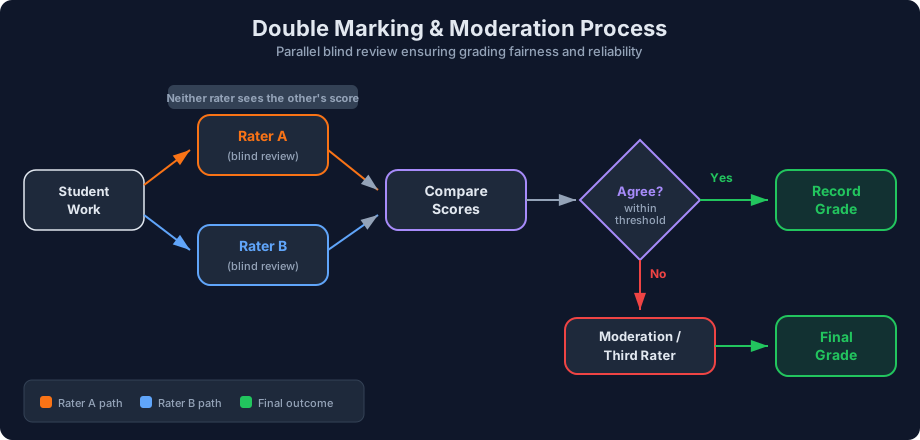
Double marking is the practice of having two or more independent evaluators assess the same piece of student work using the same criteria. Each marker assigns a grade before consulting the other, and any discrepancies are then resolved through discussion, averaging, or adjudication by a third party.
Moderation is the broader quality assurance process that ensures grading standards are applied consistently and fairly across all assessors, modules, and cohorts. While double marking is one form of moderation, the term encompasses a range of activities including pre-assessment calibration, post-assessment review, and external scrutiny.
Together, these processes form the backbone of assessment quality assurance in higher education, particularly in the UK, EU, and Australasian systems.
Why Double Marking and Moderation Matter
Protecting Student Interests
Grades are consequential. They determine degree classifications, postgraduate admissions, scholarship eligibility, and employment prospects. When a single assessor's bias, fatigue, or misinterpretation of criteria can shift a grade by a full classification band, the assessment system has a fairness problem. Double marking introduces a structural check against individual error.
Supporting Assessor Development
Moderation is not just about catching mistakes—it is a professional development mechanism. When markers compare their judgments and discuss discrepancies, they develop shared understanding of standards and calibrate their expectations. This is especially valuable for new teaching staff, graduate teaching assistants, and part-time lecturers who may have less experience applying institutional grading norms.
Meeting Quality Assurance Requirements
In the UK, the Quality Assurance Agency (QAA) expects institutions to have robust moderation processes. Similarly, EU quality frameworks under the Bologna Process and the European Standards and Guidelines (ESG) require that assessment practices are consistent, transparent, and subject to periodic review. Accreditation bodies in professional disciplines (medicine, law, engineering) often mandate specific moderation protocols.
Types of Double Marking
Different approaches to double marking balance rigor against resource cost. Choosing the right type depends on the stakes involved, class size, and institutional policy.
| Type | How It Works | Best For |
|---|---|---|
| Blind double marking | Both markers grade independently without seeing the other's scores | High-stakes assessments (dissertations, finals) |
| Open double marking | The second marker sees the first marker's scores before grading | Developmental contexts, mentoring new staff |
| Sample-based marking | A second marker grades a representative sample (e.g., 10–20%) | Large cohorts where full double marking is impractical |
| Partial double marking | Second marker reviews borderline cases or a stratified sample | Targeted quality assurance with limited resources |
Blind Double Marking
The gold standard for high-stakes work. Each examiner grades the submission without knowledge of the other's assessment. Blind marking maximizes independence and produces the most reliable measure of inter-rater reliability. However, it is resource-intensive—effectively doubling the grading workload.
Sample-Based Moderation
The pragmatic choice for large modules. A moderator reviews a stratified sample that includes submissions from each grade band (first-class, upper second, lower second, third, fail). If the sample reveals systematic issues—such as a marker being consistently lenient or harsh—the entire batch is reviewed or adjusted.
The Moderation Process
Effective moderation spans the entire assessment lifecycle, not just the post-grading check.
Pre-Assessment Moderation
Before students submit work, moderators review the assessment brief, marking criteria, and rubric to ensure they are clear, fair, and aligned with learning outcomes. This stage catches ambiguous criteria and misaligned expectations before they create grading problems.
Key activities include:
- Reviewing assessment tasks for clarity and appropriate difficulty
- Checking that grade descriptors are specific and unambiguous
- Conducting grading calibration sessions with all markers using sample work
- Agreeing on marking protocols and how borderline cases will be handled
Post-Assessment Moderation
After marking is complete, a moderator (or moderation panel) reviews the grades to check for consistency, accuracy, and adherence to standards.
Post-assessment moderation typically involves:
- Statistical analysis of grade distributions to flag unusual patterns
- Review of a stratified sample across the grade range
- Comparison of marks at grade boundaries (e.g., 58–62%, 68–72%)
- Verification that marker feedback aligns with assigned scores
- Discussion and resolution of significant discrepancies
External Moderation
External examiners—academics from other institutions—provide an independent check on standards. They review samples of assessed work, confirm that grading is appropriate, and report on whether the institution's standards are comparable to the sector.
External moderation serves a dual purpose: it validates internal processes and provides institutions with external benchmarking data on their assessment standards.
Double Marking and Moderation in Practice
Consider a university English department with 200 students submitting final essays graded by four teaching staff. A practical moderation workflow might look like this:
- Week before submission: All markers attend a calibration meeting, independently grade three sample essays, and discuss discrepancies until consensus is reached
- Marking period: Each marker grades their allocated batch using the shared rubric and records evidence-based justifications for each score
- Post-marking: The module leader selects a 15% stratified sample from each marker's batch for second marking
- Review meeting: Markers compare scores on the sample; where discrepancies exceed one grade band, the original batch is flagged for fuller review
- External examiner: Reviews a cross-section of 20 scripts across all grade bands and provides a written report
- Grade board: Final grades are confirmed, incorporating any adjustments from moderation
Cost vs. Benefit
Double marking and moderation require significant time and resource investment. The key trade-off:
| Benefit | Cost |
|---|---|
| Improved grade accuracy and fairness | Increased marking workload (50–100%) |
| Enhanced assessor calibration | Coordination and meeting time |
| Defensible grades for appeals | Administrative overhead |
| Compliance with QA frameworks | Potential delays in grade release |
| Professional development for markers | Cost of external examiner fees |
Institutions must balance thoroughness with feasibility. Full blind double marking for every assignment is rarely sustainable—but no moderation at all is indefensible for high-stakes assessment.
How MarkInMinutes Implements Double Marking and Moderation
Automated Multi-Agent Moderation Pipeline
MarkInMinutes builds double marking and moderation directly into every grading pass through its multi-agent architecture. The Evaluator agent produces the initial assessment with dimension-level scores and evidence citations. The Challenger agent then acts as an independent second marker—reviewing every score, questioning the evidence, and flagging potential over- or under-scoring. Finally, the Auditor agent performs systematic moderation: checking for bias, verifying consistency across dimensions, and ensuring calibration with the rubric's grade descriptors. This three-stage pipeline delivers the functional equivalent of blind double marking plus post-assessment moderation—automatically, for every single submission, without the resource constraints that force institutions to rely on sampling. In a 72-run grading benchmark, this architecture achieved 93.8% exact notch agreement and a Cohen's Kappa of 0.914 — meeting the "almost perfect" threshold that traditional double-marking programmes aspire to.
Related Concepts
Double marking and moderation connect to several core assessment quality practices. Inter-rater reliability is the statistical measure that double marking seeks to maximize—it quantifies how consistently multiple markers score the same work. Grading calibration is the preparatory process that aligns markers before they begin assessing, making double marking more efficient by reducing initial disagreements. A well-designed rubric with clear grade descriptors is the foundation that enables consistent marking across multiple evaluators. And evidence-based grading supports moderation by requiring markers to document the specific evidence justifying each score, making post-hoc review far more productive.
Frequently Asked Questions
Is double marking required for all assessments?
No. Most institutions reserve full double marking for high-stakes assessments such as dissertations, final-year projects, and professional competency evaluations. For lower-stakes work, sample-based moderation is the standard practice. Institutional policies vary, so check your quality assurance handbook for specific requirements.
What happens when two markers disagree significantly?
The resolution process depends on institutional policy. Common approaches include: (1) the two markers discuss and reach consensus, (2) the scores are averaged, or (3) a third independent marker adjudicates. For high-stakes assessments, third-marker adjudication is generally preferred because it avoids the compromise bias inherent in averaging.
How does moderation differ from double marking?
Double marking is one specific technique within the broader concept of moderation. Moderation encompasses everything an institution does to ensure assessment quality—including pre-assessment rubric review, marker calibration sessions, post-assessment statistical checks, external examiner oversight, and grade board review. Double marking addresses only the scoring stage; moderation addresses the entire assessment lifecycle.
Sehen Sie diese Konzepte in Aktion
MarkInMinutes wendet diese Bewertungsprinzipien automatisch an. Laden Sie eine Abgabe hoch und erhalten Sie evidenzbasiertes Feedback in Minuten.
Verwandte Begriffe
Evidence-Based Grading
Evidence-based grading is an assessment approach where every score is justified by specific, observable evidence drawn directly from student work rather than subjective impressions.
Grade Descriptors
Grade descriptors are written statements that define the characteristics and qualities of student work at each performance level on a grading scale, providing a shared reference for what distinguishes one grade from another.
Grading Calibration
Grading calibration is the process of aligning evaluators' scoring practices so that the same quality of work receives the same grade regardless of who assesses it.
Inter-Rater Reliability
Inter-rater reliability is the degree to which two or more independent evaluators assign the same scores to the same student work when applying the same assessment criteria.
Rubric
A rubric is a scoring guide that defines criteria and performance levels used to evaluate student work consistently and transparently.