Error Analysis in Student Work: Identifying Patterns and Guiding Improvement
Learn what error analysis is, how to classify student errors by type and severity, identify error patterns, and use error data to improve instruction and student learning.
Error analysis in student work is one of the most powerful diagnostic tools available to educators. Rather than simply marking answers as right or wrong, error analysis examines why students make mistakes, what patterns emerge across errors, and how those patterns can inform both feedback and instruction. For teachers and professors who want to move beyond surface-level grading toward genuinely helping students improve, error analysis provides the framework to do so.
What Is Error Analysis?
Error analysis is the systematic process of identifying, categorizing, and interpreting errors in student work. It goes beyond noting that an answer is incorrect to examining the nature of the mistake — was it a misunderstanding of a concept, a procedural slip, a factual error, or a careless mechanical mistake?
Originally developed in linguistics for analyzing second-language learner errors, error analysis has been adopted across education disciplines. In mathematics, it reveals whether a student misunderstands the concept of fractions or simply made an arithmetic mistake. In writing, it distinguishes between a student who lacks understanding of argument structure and one who understands the structure but struggles with grammar.
The core principle is that errors are not random — they are windows into student thinking. A student who consistently misapplies a rule is demonstrating a specific misunderstanding that targeted instruction can address.
Why Error Analysis Matters
Error analysis transforms grading from a summative judgment into a formative diagnostic. Instead of simply assigning a score, the educator gathers actionable intelligence about student learning:
- Targeted feedback: Knowing the type and cause of an error allows educators to give specific, actionable constructive feedback rather than generic corrections.
- Instructional adjustment: Error patterns across a class reveal which concepts or skills need reteaching, additional practice, or different instructional approaches.
- Student self-awareness: When students understand the types of errors they make, they can develop self-monitoring strategies and become more effective learners.
- Efficiency: Rather than marking every error equally, educators can prioritize feedback on the errors that matter most for learning.
Error analysis also supports evidence-based grading by ensuring that scores reflect a nuanced understanding of what students know and can do — not just a tally of right and wrong answers.
Types of Errors
Understanding error types is the foundation of effective error analysis. While specific taxonomies vary by discipline, most frameworks recognize four broad categories:
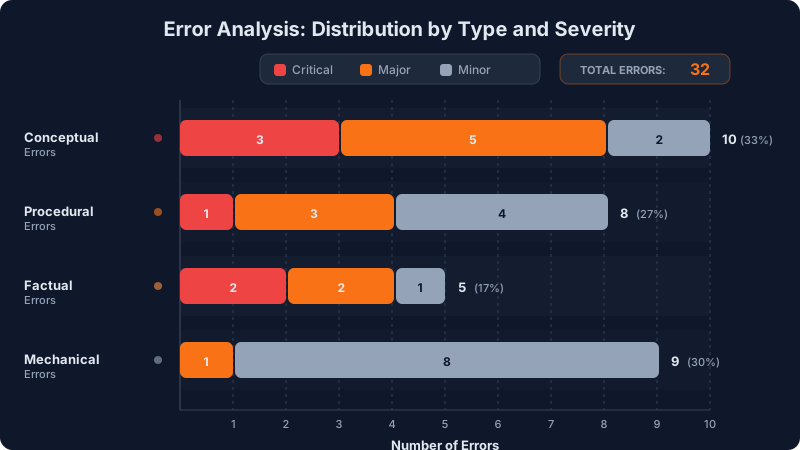
Conceptual Errors
Conceptual errors arise from a misunderstanding of underlying principles, theories, or ideas. The student has an incorrect mental model.
Examples:
- A student who believes that multiplying two numbers always produces a larger number (fails with fractions and decimals)
- A writing student who structures a persuasive essay as a narrative because they conflate "telling a story" with "making an argument"
- A science student who thinks heavier objects fall faster than lighter ones
Conceptual errors are the most important to identify because they affect everything built on that concept. They require targeted reteaching, not just correction.
Procedural Errors
Procedural errors occur when a student understands the concept but applies the wrong steps or applies the right steps in the wrong order.
Examples:
- Correctly setting up an equation but making an error in the order of operations
- Understanding what a thesis statement should do but placing it at the end of the essay rather than the introduction
- Knowing the steps of the scientific method but collecting data before forming a hypothesis
Procedural errors are usually easier to fix than conceptual ones — they require practice and clarification of the procedure, not a new understanding.
Factual Errors
Factual errors involve incorrect information — wrong dates, misattributed quotes, incorrect formulas, or inaccurate data.
Examples:
- Citing 1776 as the year the Constitution was signed
- Attributing a quote to the wrong author
- Using an incorrect chemical formula in a reaction equation
Factual errors are straightforward to identify and correct. They typically indicate gaps in knowledge rather than misunderstanding, and are addressed through review and reinforcement.
Mechanical Errors
Mechanical errors are surface-level mistakes in grammar, spelling, punctuation, formatting, or calculation that do not reflect a conceptual misunderstanding.
Examples:
- Spelling errors and typos
- Subject-verb agreement mistakes in a student who demonstrates correct usage elsewhere
- Arithmetic errors in a student who correctly sets up and explains the mathematical approach
Mechanical errors are the least diagnostically significant but can still accumulate to affect communication and readability.
Error Patterns vs. Random Mistakes
A critical distinction in error analysis is between systematic errors (patterns) and random mistakes (slips):
| Characteristic | Error Patterns | Random Mistakes |
|---|---|---|
| Frequency | Appear repeatedly across different tasks | Appear sporadically and inconsistently |
| Root cause | Misunderstanding, misconception, or incorrect procedure | Fatigue, carelessness, time pressure |
| Predictability | Predictable — the student will make the same error in similar contexts | Unpredictable — the student sometimes gets it right |
| Response | Requires targeted instruction or reteaching | Requires proofreading strategies or more careful practice |
| Severity | High — indicates a learning gap | Low — indicates a performance gap |
Identifying patterns is where error analysis becomes most valuable. A student who makes the same grammatical error in every essay has a pattern that instruction can address. A student who occasionally misplaces a comma likely just needs to proofread more carefully.
Conducting Error Analysis
Step 1: Collect and Organize Errors
Review student work and document each error. For each, note:
- The specific error (what the student wrote or did)
- The correct version (what it should have been)
- The error type (conceptual, procedural, factual, or mechanical)
Step 2: Classify Severity
Not all errors are equal. A severity classification helps prioritize feedback:
- Critical: Errors that fundamentally undermine the work's purpose or demonstrate a core misunderstanding. These must be addressed immediately.
- Major: Errors that significantly affect quality but do not completely invalidate the work. These should be addressed in the current feedback cycle.
- Minor: Errors that affect surface quality but do not indicate a learning gap. These can be noted for student self-correction.
Step 3: Identify Patterns
Look for errors that recur across the submission or across multiple submissions by the same student. Patterns indicate systematic issues that targeted instruction can resolve.
Step 4: Determine Root Causes
For each pattern, hypothesize why the student is making this error. Common root causes include:
- Prior misconceptions carried from earlier instruction
- Overgeneralization of a rule (applying it where it does not apply)
- Incomplete understanding of a concept
- Interference from first language or prior knowledge
- Lack of practice with a specific skill
Step 5: Prioritize and Respond
Use the analysis to prioritize feedback. Address conceptual errors before procedural ones, and procedural errors before mechanical ones. Frame corrections as learning opportunities, not punishments — this is where error analysis connects to constructive feedback.
Error Analysis for Instructional Improvement
When error analysis is conducted across an entire class, the aggregate data becomes a powerful instructional tool:
- Common errors: If 60% of the class makes the same conceptual error, the issue is likely instructional — the concept was not taught effectively or was not given enough practice time.
- Subgroup patterns: Errors that cluster in particular student groups (e.g., non-native speakers, transfer students) may indicate specific support needs.
- Progression tracking: Comparing error patterns on early vs. late assignments reveals whether instruction is working. If the same errors persist, the intervention needs to change.
This approach turns assessment into a feedback loop that benefits both students and instructors, aligning closely with the goals of formative vs summative assessment.
How MarkInMinutes Implements Error Analysis
MarkInMinutes includes a dedicated Error Detector that systematically identifies and classifies errors in student submissions. Each error is categorized by type (drawn from a structured error taxonomy appropriate to the assignment), severity (critical, major, or minor), and includes the original text alongside a suggested correction. Beyond individual errors, the system performs Error Pattern analysis that detects systematic issues across the submission, reporting frequency, a root cause hypothesis, severity distribution, and a remediation priority score (1-10) so educators know exactly where to focus. Factual claims are also checked with confidence scores to flag potential inaccuracies.
Related Concepts
Error analysis connects naturally to several assessment practices. Effective constructive feedback depends on understanding the type and cause of errors, not just their presence. Evidence-based grading uses error analysis data to ensure that scores reflect a nuanced understanding of student performance. The diagnostic nature of error analysis makes it a key component of formative vs summative assessment — using assessment results to improve learning rather than just measure it. A well-designed rubric provides the framework against which errors are identified, and AI grading systems can automate much of the error detection and classification process at scale.
Frequently Asked Questions
How is error analysis different from just grading?
Traditional grading assigns a score based on overall quality. Error analysis goes deeper — it examines each mistake to determine its type, severity, and root cause. A paper with ten errors might score the same as another paper with ten errors, but error analysis might reveal that the first has one repeated conceptual error (requiring reteaching) while the second has ten random typos (requiring proofreading). The remediation strategy is completely different.
Should I conduct error analysis on every assignment?
Full error analysis on every assignment for every student is not practical. Use it strategically: on major assignments, on diagnostic assessments at the start of a unit, or when a student is struggling and you need to understand why. For routine work, a lighter version — noting the most common error types across the class — is sufficient and still informative.
Can students learn to do their own error analysis?
Absolutely, and teaching students to analyze their own errors is one of the most effective metacognitive strategies available. Provide students with an error classification framework, have them categorize their own mistakes after receiving feedback, and ask them to identify patterns across assignments. This builds self-awareness and self-regulation skills that transfer across all areas of learning.
Sehen Sie diese Konzepte in Aktion
MarkInMinutes wendet diese Bewertungsprinzipien automatisch an. Laden Sie eine Abgabe hoch und erhalten Sie evidenzbasiertes Feedback in Minuten.
Verwandte Begriffe
AI Grading
AI grading uses artificial intelligence to evaluate student work, providing scores and feedback by analyzing submissions against defined criteria—often with human oversight to ensure fairness.
Constructive Feedback
Constructive feedback is specific, actionable commentary on student work that identifies strengths, pinpoints areas for improvement, and provides clear guidance on how to close the gap between current and desired performance.
Evidence-Based Grading
Evidence-based grading is an assessment approach where every score is justified by specific, observable evidence drawn directly from student work rather than subjective impressions.
Formative vs Summative Assessment
Formative assessment monitors student learning during instruction to provide ongoing feedback, while summative assessment evaluates achievement at the end of a learning period.
Rubric
A rubric is a scoring guide that defines criteria and performance levels used to evaluate student work consistently and transparently.