Scaffolding in Assessment: Supporting Students Toward Independence
Understand scaffolding in assessment, including Vygotsky's ZPD, types of assessment scaffolds (structured prompts, exemplars, rubric previews, staged submissions), the gradual release model, and fading strategies.
A first-year university student stares at the assignment brief: "Write a 3,000-word critical analysis of a peer-reviewed article in your field." She understands every word individually, but together they describe a task she has never done and does not know how to begin. Without support, she either produces something far below expectations or does not submit at all. With scaffolding—a structured prompt, an annotated exemplar, a rubric preview, and a staged submission process—she produces work that surprises both herself and her instructor. That is scaffolding: the temporary structure that allows students to build something they could not build alone.
What Is Scaffolding in Assessment?
Scaffolding in assessment refers to the intentional, temporary supports that educators provide to help students successfully engage with assessment tasks that would be too difficult to complete independently at their current level. The key word is temporary—scaffolds are designed to be removed as students develop competence, unlike permanent accommodations.
The concept originates from developmental psychologist Lev Vygotsky's Zone of Proximal Development (ZPD): the gap between what a learner can do independently and what they can do with guidance from a more knowledgeable other. Jerome Bruner later coined the term "scaffolding" to describe the structured support that enables learners to operate within this zone.
In assessment contexts, scaffolding does not mean making tasks easier. It means making challenging tasks accessible while preserving their cognitive demand. A scaffolded essay assignment is still a complex analytical task—but the student receives structured guidance on how to approach it.
Why Scaffolding in Assessment Matters
Bridges the Gap Between Expectation and Ability
Students often face assessment tasks that require skills they are still developing. A research paper demands skills in source evaluation, argumentation, citation, and academic writing simultaneously. Without scaffolding, students who lack proficiency in one area may fail the entire task—even if they understand the content deeply. Scaffolding allows students to demonstrate subject knowledge while they develop these complementary skills.
Reduces Assessment Anxiety
When students receive a high-stakes assignment without understanding what is expected or how to begin, anxiety spikes and performance drops. Scaffolds like rubric previews, exemplar work, and structured planning templates reduce uncertainty and give students a clear path forward, which lowers affective barriers to learning.
Promotes Equity
Not all students arrive with the same academic preparation. First-generation students, students from under-resourced schools, and students learning in a second language may lack familiarity with academic conventions that their peers take for granted. Scaffolding levels the playing field by making implicit expectations explicit—without lowering the standard of achievement expected.
Develops Transferable Skills
Well-designed scaffolding does not just help students complete the current task—it teaches them processes they can apply independently in the future. A student who learns to use a structured planning template for Essay 1 may not need the template by Essay 3, having internalized the planning process.
Types of Assessment Scaffolds
Effective scaffolding in assessment takes many forms. The best approach depends on the task, the students' current level, and the specific skill being developed.
Structured Prompts and Templates
Breaking a complex task into smaller, guided steps is the most common form of assessment scaffolding. Instead of "Write a critical analysis," the scaffolded version might provide:
- Identify the article's central argument (2–3 sentences)
- Summarize the methodology and evaluate its strengths and limitations
- Identify two assumptions the author makes and assess their validity
- Present your own reasoned position, supported by evidence
- Write a conclusion connecting your analysis to broader debates in the field
Each step is a scaffold that guides the student through the analytical process while preserving the intellectual challenge of the overall task.
Exemplars and Annotated Models
Providing examples of strong, adequate, and weak work—ideally with annotations explaining what makes each effective or ineffective—gives students a concrete reference point. Students often do not understand what "critical analysis" looks like until they see it.
Effective use of exemplars:
- Provide 2–3 examples spanning the quality range
- Annotate key features ("This sentence introduces a counter-argument")
- Connect annotations to rubric criteria so students see the link between the model and their evaluation standard
- Use exemplars from previous cohorts (with permission) to increase authenticity
Rubric Previews and Self-Assessment
Sharing the assessment rubric before students begin the task is itself a powerful scaffold. The rubric makes the evaluation criteria explicit, allowing students to plan their work strategically. Combining rubric preview with a self-assessment checkpoint—where students evaluate their own draft against the rubric before submission—adds a metacognitive layer that deepens learning.
Staged Submissions
Rather than a single high-stakes deadline, staged submissions break the assessment into checkpoints:
| Stage | Submission | Feedback Type |
|---|---|---|
| Stage 1 | Topic proposal and initial outline | Instructor written feedback |
| Stage 2 | Annotated bibliography or evidence plan | Peer review using rubric criteria |
| Stage 3 | First draft | Instructor feedback on 2–3 key dimensions |
| Stage 4 | Final submission | Full rubric-based grading |
Each stage provides an opportunity for formative feedback that students can act on before the summative evaluation. The staged structure also prevents the common student pattern of leaving complex work until the night before the deadline.
Graphic Organizers and Planning Tools
Visual tools—such as argument maps, comparison tables, concept webs, and flowcharts—help students organize their thinking before they begin writing or presenting. These tools are particularly effective for students who struggle with the linear format of academic writing.
The Gradual Release Model
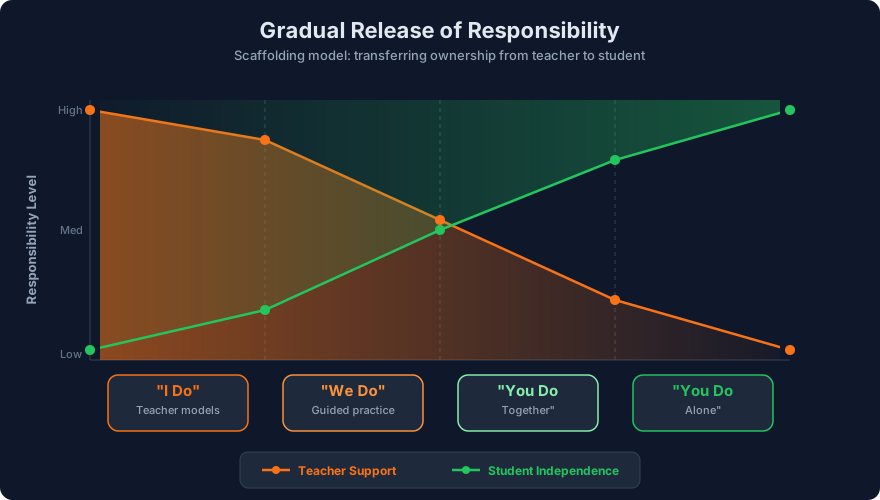
Scaffolding follows a deliberate trajectory from high support to independence. The gradual release of responsibility model, developed by Pearson and Gallagher, describes four phases:
- I do it (Modeling): The instructor demonstrates the skill or task while students observe
- We do it (Guided practice): Students attempt the task with instructor support and real-time feedback
- You do it together (Collaborative practice): Students work in groups with peer support and instructor monitoring
- You do it alone (Independent practice): Students complete the task independently—this is the summative assessment
In assessment terms, early assignments in a course carry more scaffolding (structured prompts, exemplars, staged submissions), while later assignments carry less. By the final assessment, students are expected to perform independently—having internalized the processes and strategies that earlier scaffolds made explicit.
Fading Scaffolds: When and How to Remove Support
The goal of scaffolding is its own obsolescence. Removing scaffolds too early leads to failure; removing them too late creates dependency. Effective fading requires:
- Monitoring readiness: Use diagnostic assessment and formative checks to gauge whether students can handle reduced support
- Gradual reduction: Remove one scaffold at a time rather than all at once. For example, remove the structured prompt for Essay 2 but keep the rubric preview and exemplar
- Student choice: In later assignments, offer scaffolds as optional resources rather than required steps—students who need them can still access them, while those who have internalized the process work independently
- Explicit communication: Tell students what support is being removed and why. "You used the planning template for your first paper. For this paper, I am not requiring it—but it is available if you find it helpful."
Scaffolding in Assessment in Practice
Consider a second-year history course requiring four analytical essays across a semester. The scaffolding fading schedule might look like this:
- Essay 1: Full scaffold—structured prompt with guiding questions, annotated exemplar, rubric preview, staged submission (outline → draft → final)
- Essay 2: Moderate scaffold—rubric preview, exemplar available but not annotated, single draft checkpoint before final submission
- Essay 3: Light scaffold—rubric preview only, no exemplar, single submission deadline
- Essay 4: No scaffold—assignment brief and rubric only, mirroring the independent assessment conditions students will face in their final year
This progression systematically moves students toward independence while providing a safety net during early skill development.
How MarkInMinutes Implements Scaffolding
Built-In Scaffolding Through Per-Dimension Feedback
MarkInMinutes delivers scaffolding directly within the grading process. Every submission receives detailed, per-dimension feedback that identifies exactly where the student's work meets the standard and where it falls short—with specific evidence citations from their own text. The Unified Coaching Plan generated for each submission includes Quick Wins (immediately actionable improvements), Priority Fixes (structural issues to address), and Skill Gap Analysis (longer-term developmental areas). This structured, specific feedback functions as scaffolding for the student's next attempt: rather than a vague instruction to "improve your analysis," the student receives a concrete roadmap showing what stronger analysis looks like in the context of their own work, mapped to the proficiency scale levels they are working toward.
Related Concepts
Scaffolding in assessment connects to several foundational educational concepts. Formative vs. summative assessment defines the feedback loop within which scaffolding operates—formative checkpoints are themselves a form of scaffold. Constructive feedback is the mechanism through which many scaffolds deliver their value; feedback that identifies gaps and provides actionable next steps is inherently scaffolding. Diagnostic assessment determines the starting point from which scaffolding decisions are made—you cannot design appropriate scaffolds without knowing where students are. Proficiency scales provide the progression framework that scaffolding aims to move students along. And Bloom's taxonomy helps instructors design scaffolds that systematically build from lower-order to higher-order cognitive skills.
Frequently Asked Questions
Does scaffolding make assessments too easy?
No. Scaffolding maintains the cognitive demand of a task while making it accessible. A structured prompt for a critical analysis essay does not reduce the complexity of critical analysis—it guides students through a process they have not yet mastered. The goal is challenge with support, not reduced challenge. As students develop competence, scaffolds are removed and the full difficulty of independent assessment is restored.
How do you know when to remove a scaffold?
Use formative assessment data. If most students successfully complete a scaffolded task, they are likely ready for reduced support on the next similar task. If a significant number still struggle with specific dimensions, those scaffolds should remain while others are faded. The fading process is iterative and data-driven, not calendar-driven.
Is scaffolding the same as differentiation?
Related but distinct. Differentiation adjusts the task, process, or product to meet diverse learner needs. Scaffolding provides temporary support to help all students access the same challenging task. In practice, scaffolding is one technique within a broader differentiation strategy—a student who needs more support receives more scaffolding, while a student who is ready works more independently.
Sehen Sie diese Konzepte in Aktion
MarkInMinutes wendet diese Bewertungsprinzipien automatisch an. Laden Sie eine Abgabe hoch und erhalten Sie evidenzbasiertes Feedback in Minuten.
Verwandte Begriffe
Bloom's Taxonomy
Bloom's Taxonomy is a hierarchical framework of six cognitive levels — Remember, Understand, Apply, Analyze, Evaluate, and Create — used to classify learning objectives and design assessments.
Constructive Feedback
Constructive feedback is specific, actionable commentary on student work that identifies strengths, pinpoints areas for improvement, and provides clear guidance on how to close the gap between current and desired performance.
Diagnostic Assessment
Diagnostic assessment is an evaluation conducted before or at the beginning of instruction to identify students' existing knowledge, skills, misconceptions, and readiness gaps in order to inform teaching decisions.
Formative vs Summative Assessment
Formative assessment monitors student learning during instruction to provide ongoing feedback, while summative assessment evaluates achievement at the end of a learning period.
Proficiency Scale
A proficiency scale is a structured set of performance levels that describe increasing degrees of mastery, used to evaluate student competency rather than assign percentage scores.