Self-Assessment in Education: Strategies for Student Reflection and Growth
Discover what self-assessment is, why it builds metacognition and self-regulation, and how to implement effective self-assessment strategies using rubrics, reflection journals, and goal setting.
Ask a student "How do you think you did?" after submitting an assignment, and you will get one of two responses: a confident overestimate or an anxious shrug. Neither is particularly useful. But when students are taught to systematically evaluate their own work against clear criteria — when they develop the skill of self-assessment — something powerful happens. They begin to see their own learning with clarity, set meaningful goals, and take ownership of their improvement. Self-assessment is not about students grading themselves; it is about students understanding themselves as learners.
What Is Self-Assessment?
Self-assessment is a structured process in which students evaluate their own work, performance, or learning against defined criteria or standards. Unlike informal self-reflection ("I think I did okay"), effective self-assessment requires explicit benchmarks — typically provided through a rubric, proficiency scale, or set of grading criteria — and a systematic process for comparison.
The purpose is not to generate a grade. Self-assessment is a learning strategy, not an evaluation method. It develops metacognition — the ability to think about one's own thinking — and self-regulation — the ability to monitor, adjust, and direct one's own learning behaviors. These are among the most powerful predictors of academic success.
Why Self-Assessment Matters
It Builds Metacognitive Skills
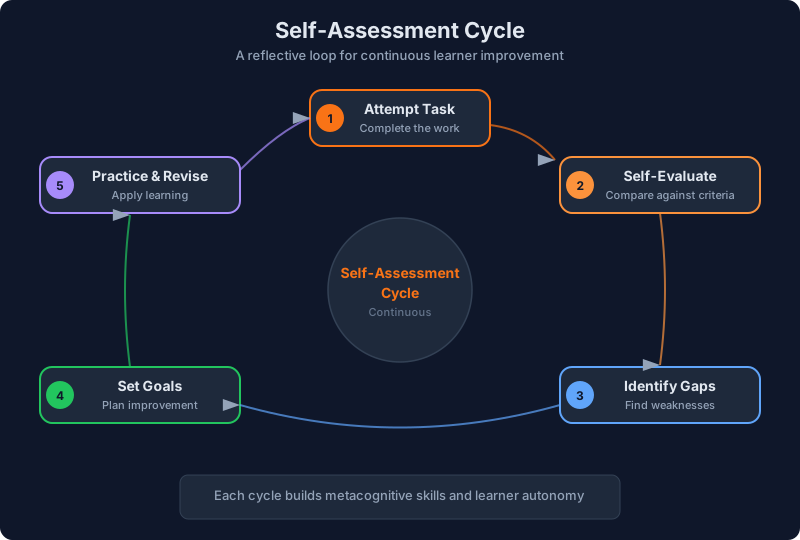
Metacognition — awareness and control of one's own cognitive processes — is strongly correlated with academic achievement across all age groups and disciplines. When students assess their own work, they practice the metacognitive skills of monitoring (Where am I now?), evaluating (How does my work compare to the standard?), and planning (What should I do next?). These skills transfer across subjects and persist long after the course ends.
It Develops Self-Regulation
Self-regulated learners set goals, monitor their progress, and adjust their strategies when something is not working. Self-assessment is the mechanism through which self-regulation operates: students cannot regulate what they cannot see. By providing a structured process for seeing their own performance clearly, self-assessment gives students the data they need to self-regulate effectively.
It Promotes Ownership of Learning
When students evaluate their own work rather than passively receiving grades, they shift from a dependent posture ("What grade did I get?") to an agentic one ("Where do I stand and what should I work on?"). This shift in orientation — from grade-seeking to learning-seeking — is associated with deeper engagement, greater persistence, and higher intrinsic motivation.
It Improves the Quality of Subsequent Work
Research consistently shows that students who engage in self-assessment before submitting their work produce higher-quality submissions. The act of comparing their work to criteria while there is still time to revise functions as a built-in quality check — catching gaps, weaknesses, and misunderstandings before they become permanent.
Self-Assessment Strategies
Rubric-Based Self-Scoring
The most direct self-assessment strategy is giving students the same rubric that will be used to grade their work and asking them to score themselves on each dimension before submission. This forces students to engage with the criteria and make explicit judgments about their performance.
Implementation steps:
- Share the rubric with students at the start of the assignment
- Teach students how to interpret each level of the proficiency scale
- After drafting their work, students score themselves on every rubric dimension
- Students write a brief justification for each self-assigned score, citing specific evidence from their work
- Students identify one or two dimensions where they scored below their target and make revisions
The justification step is critical. Without it, self-scoring becomes a superficial exercise. Requiring students to point to specific evidence in their work mirrors the evidence-based grading approach used by effective assessment systems.
Reflection Journals
Ongoing reflection journals ask students to regularly assess their learning — not just on individual assignments, but across the arc of a course. Effective journal prompts include:
- What did I learn this week that I did not know before?
- What concept am I still struggling with, and what will I do about it?
- How does this week's material connect to previous topics?
- What study strategies worked well, and what should I change?
Reflection journals develop metacognitive awareness over time and help students identify patterns in their learning behavior — patterns that are invisible without deliberate reflection.
Goal Setting and Self-Monitoring
Self-assessment is most powerful when it feeds into goal setting. After evaluating their current performance, students set specific, measurable goals for improvement:
| Weak Goal | Strong Goal |
|---|---|
| "Do better on the next essay" | "Improve my Analysis dimension score from Developing to Proficient by including evidence from at least three sources" |
| "Study more" | "Spend 30 minutes before each class reviewing notes and writing two practice problems" |
| "Get a better grade" | "Move from Level 2 to Level 3 on the rubric's Organization dimension by outlining before writing" |
Students then track their progress against these goals, creating a feedback loop that drives continuous improvement.
Calibrated Self-Assessment
A more advanced strategy involves calibrating students' self-assessment accuracy. The instructor first provides exemplars — samples of student work at each proficiency level — and asks students to score them. Students then compare their scores to the instructor's scores and discuss discrepancies. This calibration exercise trains students' evaluative judgment before they apply it to their own work.
Research shows that calibrated self-assessment produces significantly more accurate self-evaluations than uncalibrated self-assessment, particularly for lower-performing students who tend to overestimate their performance.
Research Evidence
The evidence base for self-assessment is substantial:
| Finding | Source |
|---|---|
| Self-assessment improves academic performance with a moderate effect size (d = 0.40–0.60) | Panadero, Brown & Strijbos (2016) |
| Students who self-assess produce higher-quality work on subsequent tasks | Andrade & Valtcheva (2009) |
| Self-assessment accuracy improves with practice and explicit training | Boud & Falchikov (1989) |
| Lower-performing students benefit most from self-assessment training | Brown & Harris (2013) |
| Self-assessment paired with rubrics produces stronger effects than self-assessment alone | Panadero & Jonsson (2013) |
The consistent finding is that self-assessment is not innate — it is a skill that must be taught, practiced, and supported with clear criteria.
Common Challenges and Solutions
Challenge: Students Overestimate Their Performance
Lower-performing students frequently overestimate their abilities (the Dunning-Kruger effect). Solution: Use calibration exercises with exemplars to train evaluative judgment. Provide constructive feedback that specifically addresses the gap between self-assessment and instructor assessment.
Challenge: Students Do Not Take Self-Assessment Seriously
If self-assessment has no consequences, students may treat it as a checkbox exercise. Solution: Require evidence-based justifications for self-scores. Integrate self-assessment into the formative assessment cycle so students see how it leads to targeted feedback and improvement.
Challenge: Students Lack the Vocabulary
Students may not know how to articulate what "Proficient" looks like. Solution: Provide explicit grade descriptors and discuss them in class. Use exemplars at each proficiency level to make abstract criteria concrete.
Challenge: Cultural Norms Around Self-Evaluation
In some cultural contexts, students may be uncomfortable rating their own work — either due to modesty norms or unfamiliarity with the practice. Solution: Frame self-assessment as a learning tool, not a judgment exercise. Start with low-stakes activities and build comfort gradually.
Self-Assessment in Practice
Implementing self-assessment effectively requires scaffolding:
- Start early and small: Introduce self-assessment on low-stakes tasks before using it on major assignments.
- Provide clear criteria: Always give students a rubric or criteria list to assess against. Self-assessment without criteria is just guessing.
- Model the process: Demonstrate self-assessment using a sample piece of work. Talk through your reasoning as you compare the work to each criterion.
- Compare and discuss: After students self-assess, share instructor assessments and discuss discrepancies. This calibration dialogue is where the deepest learning occurs.
- Connect to action: Always follow self-assessment with a planning step: "Now that you know where you stand, what will you do next?"
How MarkInMinutes Enables Meaningful Self-Assessment
MarkInMinutes provides the detailed, dimension-level feedback that makes self-assessment truly meaningful. When students receive scores and evidence-based commentary on each rubric dimension, they have a clear, specific benchmark against which to compare their own evaluation. Did they think their argument was Proficient, but the system identified gaps in evidence at the Developing level? That discrepancy becomes a powerful learning moment. By making assessment criteria transparent and feedback granular, MarkInMinutes creates the conditions for accurate, productive self-assessment — the kind that actually changes how students learn.
Related Concepts
Self-assessment is part of a broader ecosystem of student-centered assessment practices. Peer assessment applies similar evaluative skills to classmates' work, often strengthening self-assessment accuracy in the process. Constructive feedback provides the external input that calibrates self-assessment over time. Rubrics and proficiency scales supply the criteria that make self-assessment structured and meaningful. And the entire practice sits within the formative assessment tradition — assessment for learning, not just assessment of learning.
Frequently Asked Questions
Should self-assessment count toward the grade?
Generally, no. The purpose of self-assessment is to develop metacognitive skills, not to determine grades. If self-assessment affects grades, students are incentivized to inflate their scores rather than evaluate honestly. Some instructors award participation credit for completing the self-assessment process (not for the scores themselves), which encourages engagement without distorting the evaluative purpose.
At what age can students begin self-assessing?
Students as young as first grade can engage in simple self-assessment when given age-appropriate criteria (e.g., smiley-face scales, simple checklists). The complexity of self-assessment should increase with developmental level, but the core skill — comparing one's work to a standard — can be introduced early and refined throughout a student's academic career.
How does self-assessment relate to peer assessment?
Self-assessment and peer assessment are complementary practices. Both require students to apply evaluative criteria to student work, but self-assessment develops intrapersonal awareness while peer assessment develops interpersonal evaluative skills. Research suggests that practicing peer assessment first can improve self-assessment accuracy, because evaluating others' work is less emotionally charged and helps students internalize criteria before applying them to their own work.
Sehen Sie diese Konzepte in Aktion
MarkInMinutes wendet diese Bewertungsprinzipien automatisch an. Laden Sie eine Abgabe hoch und erhalten Sie evidenzbasiertes Feedback in Minuten.
Verwandte Begriffe
Constructive Feedback
Constructive feedback is specific, actionable commentary on student work that identifies strengths, pinpoints areas for improvement, and provides clear guidance on how to close the gap between current and desired performance.
Formative vs Summative Assessment
Formative assessment monitors student learning during instruction to provide ongoing feedback, while summative assessment evaluates achievement at the end of a learning period.
Peer Assessment
Peer assessment is a process in which students evaluate each other's work using defined criteria, developing critical thinking and feedback skills while reinforcing learning through evaluation.
Proficiency Scale
A proficiency scale is a structured set of performance levels that describe increasing degrees of mastery, used to evaluate student competency rather than assign percentage scores.
Rubric
A rubric is a scoring guide that defines criteria and performance levels used to evaluate student work consistently and transparently.