Peer Assessment: Strategies for Effective Student-to-Student Evaluation
Learn how peer assessment works, explore proven strategies for student-to-student evaluation, and discover how structured peer review improves critical thinking, feedback skills, and learning outcomes.
Peer assessment is one of the most powerful — and most underutilized — strategies in education. When students evaluate each other's work, they do not just provide feedback; they engage in higher-order thinking that deepens their own understanding. Yet peer assessment only works when it is carefully structured. Without clear criteria and explicit training, student evaluations can be superficial, biased, or demoralizing. This guide explains how to implement peer assessment effectively so that it becomes a genuine learning experience, not just a grading shortcut.
What Is Peer Assessment?
Peer assessment is a structured process in which students evaluate the quality of their peers' work against defined criteria. Unlike casual feedback ("I liked your presentation"), peer assessment uses explicit standards — typically a rubric — to guide evaluation and ensure consistency.
Peer assessment encompasses several distinct activities:
- Peer review: Students provide qualitative feedback on drafts or works-in-progress, focusing on strengths and areas for improvement
- Peer grading: Students assign scores or ratings to completed work based on a rubric or grading criteria
- Peer feedback: Students offer targeted, constructive comments designed to help the author improve
These activities can be used independently or combined. For instance, a peer review of a research paper draft might include qualitative feedback on argument structure alongside a rubric-based rating of evidence quality.
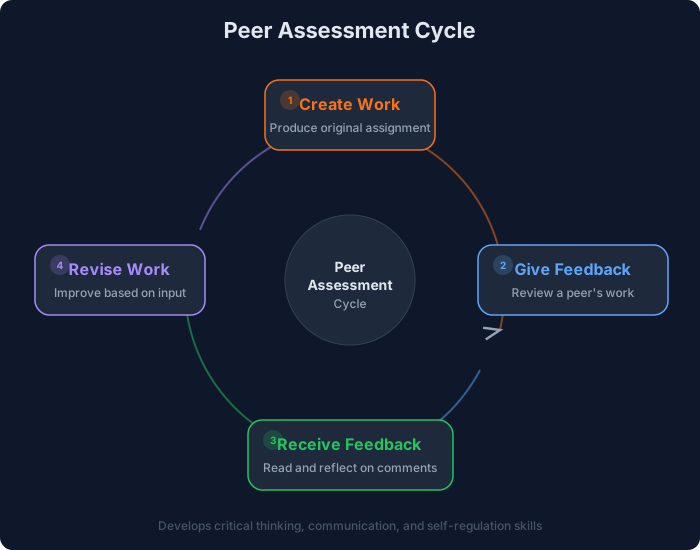
Why Peer Assessment Matters
Research consistently shows that peer assessment benefits both the evaluator and the person being evaluated.
Benefits for Evaluators
- Metacognition: Evaluating others' work forces students to articulate what quality looks like, deepening their understanding of the assessment criteria
- Critical thinking: Analyzing strengths and weaknesses in peers' work develops analytical skills that transfer to their own writing and problem-solving
- Internalized standards: Repeated exposure to evaluation criteria helps students internalize what "proficient" or "distinguished" performance means on a proficiency scale
- Exposure to diverse approaches: Reviewing multiple peers' work exposes students to different strategies and perspectives they may not have considered
Benefits for Those Being Evaluated
- Timely feedback: Peer feedback can be returned much faster than instructor feedback, especially in large classes
- Multiple perspectives: Receiving feedback from three or four peers provides richer information than a single instructor evaluation
- Reduced power dynamics: Students sometimes find it easier to act on suggestions from a peer than from an authority figure
- Revision motivation: Knowing that peers will read their work motivates students to produce higher-quality drafts
Types of Peer Assessment
| Type | Description | Best For |
|---|---|---|
| Formative peer review | Feedback on drafts before final submission | Writing-intensive courses, iterative projects |
| Summative peer grading | Scores contributing to the final grade | Group projects, presentations, participation |
| Reciprocal peer feedback | Each student both gives and receives feedback | Discussion-based courses, workshops |
| Calibrated peer review | Students practice evaluating sample work before assessing peers | Large lecture courses, online learning |
| Anonymous peer review | Identity of reviewer and/or author is concealed | Situations where social dynamics might bias feedback |
For guidance on when peer assessment is best used as formative vs. summative assessment, consider the stakes: formative peer review (low stakes, focused on improvement) generally produces better learning outcomes than summative peer grading (high stakes, contributing to grades).
Implementing Peer Assessment Effectively
Step 1: Define Clear Criteria
The foundation of effective peer assessment is a well-designed rubric with specific, observable criteria. Vague instructions like "evaluate the quality of the argument" lead to inconsistent and unhelpful feedback. Instead, provide descriptors at each level: "The thesis is specific, arguable, and supported by three or more cited sources" gives reviewers a concrete benchmark.
Step 2: Train Students
Never assume students know how to evaluate. Dedicate time to:
- Walk through the rubric, clarifying each criterion
- Model the evaluation process using sample work (not from the current class)
- Practice with calibration exercises where students independently rate the same sample, then discuss discrepancies
- Discuss the difference between constructive feedback and criticism
Calibration is the same process used to improve inter-rater reliability among professional evaluators — and it is equally important for student reviewers.
Step 3: Structure the Process
Effective peer assessment requires scaffolding:
- Provide evaluation templates with specific prompts for each criterion ("On a scale of 1–5, rate the clarity of the thesis. Explain your rating in 2–3 sentences.")
- Set deadlines for review submission to prevent last-minute, superficial feedback
- Require actionable comments: Mandate that every rating includes at least one specific suggestion for improvement
- Limit the scope: Asking students to evaluate everything at once leads to overload. Focus each round on 2–3 criteria
Step 4: Build in Accountability
Students take peer assessment more seriously when:
- Their feedback quality is itself assessed (the instructor reviews a sample of evaluations)
- Feedback is required before they can see their own scores
- Points are awarded for the quality of the review, not just for completing it
- A meta-review step allows the original author to rate the helpfulness of the feedback received
Step 5: Use Results Wisely
In most classroom contexts, peer assessment works best as one input among several. Consider weighting peer scores at 10–20% of the total grade and combining them with instructor evaluation. This respects students' contributions while acknowledging that peer ratings may be less reliable than expert assessment.
Common Pitfalls and How to Avoid Them
- Friendship bias: Students rate friends higher and strangers lower. Mitigation: use anonymous review or randomly assign partners.
- Leniency bias: Students inflate grades to avoid social conflict. Mitigation: train on calibration samples and emphasize that honest feedback is a professional skill.
- Superficial feedback: "Good job!" is not useful. Mitigation: require criterion-specific comments and model what helpful feedback looks like.
- Free-riding on group peer reviews: Some students contribute minimal effort. Mitigation: track individual review completion and quality.
- Student resistance: Some students distrust peer evaluation. Mitigation: explain the research on why evaluating others improves their own learning, and frame it as a professional skill.
Digital Tools for Peer Assessment
Several platforms streamline the peer assessment workflow, from assignment distribution to feedback collection:
| Tool | Strengths | Best For |
|---|---|---|
| Peerceptiv | Calibrated peer review with training exercises; statistical reliability analysis | Large lecture courses where review quality must be verified |
| FeedbackFruits | LMS-integrated; supports group, individual, and self-assessment workflows | Institutions using Canvas, Blackboard, or Moodle |
| Turnitin PeerMark | Built into Turnitin; familiar interface for students already using it for plagiarism checks | Courses already using Turnitin |
| Google Docs + Forms | Free; commenting for inline feedback; Forms for structured rubric scoring | Budget-conscious courses; simple review processes |
| Kritik | AI-powered evaluation of feedback quality; gamification elements | Courses that want to incentivize high-quality reviews |
When selecting a tool, prioritize features that enforce structure: built-in rubric scoring, required comment fields for each criterion, and anonymous review options. Tools that track whether students actually opened and read their feedback are particularly valuable for accountability.
Structured Peer Feedback Protocol
A structured protocol removes guesswork and increases feedback quality. Here is a tested three-step format that works across disciplines:
Step 1 — Rubric-Based Scoring (5 minutes per review) Students rate each rubric dimension using the same scale the instructor will use. This forces criterion-by-criterion attention rather than a holistic impression.
Step 2 — Evidence-Based Comments (10 minutes per review) For each dimension, the reviewer must cite a specific passage, section, or element of the work that justifies their score. Template: "For [dimension], I rated this a [level] because [specific evidence]. To reach the next level, consider [specific suggestion]."
Step 3 — Priority Recommendation (2 minutes per review) The reviewer identifies the single most important change the author should make. Forcing a single priority prevents overwhelming feedback and ensures every review produces at least one actionable takeaway.
This protocol produces reviews that take 15–20 minutes each — long enough to be substantive, short enough to be practical when each student reviews 2–3 peers.
Peer Assessment in Practice
In a 200-student introductory writing course, the instructor assigns each student to review three peers' essays using a four-dimension analytic rubric (Thesis, Evidence, Organization, Mechanics). Before the first review round, students complete a calibration exercise rating two sample essays. The instructor provides model feedback for comparison.
Each reviewer completes the rubric and writes one paragraph of constructive feedback per dimension. Authors receive their three peer reviews alongside the instructor's evaluation. The final grade weights peer input at 15% and instructor evaluation at 85%.
Over the semester, the instructor observes that students who consistently serve as reviewers produce stronger final papers — not because they received better feedback, but because the act of evaluating trained them to recognize quality in their own work.
How MarkInMinutes Supports Peer Assessment
The structured rubric format that MarkInMinutes uses for AI grading is equally effective as a peer assessment template. When students evaluate with the same dimensions, proficiency levels, and Calibration Anchors used by instructors and the AI system, they learn to apply professional-quality evaluation criteria. Sharing a MarkInMinutes grading profile with students before peer review sessions trains them to look for specific evidence of quality at each level — transforming peer assessment from an informal exercise into a rigorous learning experience aligned with how their own work will ultimately be graded.
Related Concepts
Peer assessment connects to several core assessment practices. An effective peer review depends on a well-structured rubric with clear criteria. The quality of peer evaluations is measured by the same inter-rater reliability metrics used for instructor agreement. Teaching students to deliver constructive feedback is both a learning objective and a prerequisite for successful peer assessment. Peer assessment is a natural complement to self-assessment, and both contribute most when used as formative assessment rather than high-stakes summative grading.
Further Reading
Peer assessment is one of the most effective formative strategies when paired with other approaches. For 30 concrete examples of both formative and summative assessment — including group coaching sessions during project work — see 30 Formative & Summative Assessment Examples for Every Classroom.
Frequently Asked Questions
Can peer assessment be used for high-stakes grading?
It can, but with caution. Research suggests that aggregated peer ratings (from three or more reviewers) approach the reliability of a single expert rater. For high-stakes use, combine peer scores with instructor evaluation, use calibrated rubrics, and ensure anonymous review to minimize bias.
How do I handle students who give unfair or biased peer reviews?
Build in safeguards: use anonymous review, require criterion-specific justifications for every rating, review a sample of evaluations yourself, and allow authors to flag reviews they believe are biased. Over time, calibration training reduces most bias issues.
At what age or level can peer assessment be introduced?
Peer assessment can be introduced as early as upper elementary school with simplified rubrics and heavy scaffolding. By middle school, students can handle structured peer review with moderate guidance. In higher education, peer assessment is a standard professional skill — the key is always providing appropriate training and clear criteria, regardless of level.
Sehen Sie diese Konzepte in Aktion
MarkInMinutes wendet diese Bewertungsprinzipien automatisch an. Laden Sie eine Abgabe hoch und erhalten Sie evidenzbasiertes Feedback in Minuten.
Verwandte Begriffe
Constructive Feedback
Constructive feedback is specific, actionable commentary on student work that identifies strengths, pinpoints areas for improvement, and provides clear guidance on how to close the gap between current and desired performance.
Formative vs Summative Assessment
Formative assessment monitors student learning during instruction to provide ongoing feedback, while summative assessment evaluates achievement at the end of a learning period.
Inter-Rater Reliability
Inter-rater reliability is the degree to which two or more independent evaluators assign the same scores to the same student work when applying the same assessment criteria.
Self-Assessment
Self-assessment is the process by which students evaluate their own work against defined criteria, developing metacognitive awareness, self-regulation skills, and ownership of their learning.
Rubric
A rubric is a scoring guide that defines criteria and performance levels used to evaluate student work consistently and transparently.