Mastery Learning: Bloom's Approach to Ensuring All Students Succeed
Understand Bloom's mastery learning model, its teach-assess-reteach cycle, the research evidence behind it, and how to implement mastery-based grading in your classroom or institution.
In 1968, Benjamin Bloom published a paper that challenged one of education's most deeply held assumptions: that student achievement follows a bell curve — some will excel, most will be average, and some will fail. Bloom argued that this distribution is not a natural law of learning but an artifact of instructional design. With the right conditions — clear objectives, formative feedback, and corrective instruction — the vast majority of students can achieve mastery. More than five decades later, the research bears him out, and mastery learning remains one of the most evidence-backed instructional strategies available.
What Is Mastery Learning?
Mastery learning is an instructional approach in which content is divided into discrete units, each with clearly defined learning outcomes. Students study a unit, take a formative assessment, receive feedback, and — if they have not yet reached mastery — engage in corrective instruction before being reassessed. Only when a student demonstrates proficiency on the current unit do they advance to the next one.
The defining characteristic of mastery learning is that time is the variable and learning is the constant. In a traditional classroom, all students receive the same amount of instruction and some learn more than others. In a mastery classroom, all students reach the same level of competency, but some take longer than others. This reframing shifts the instructor's role from content deliverer to learning architect.
Why Mastery Learning Matters
It Closes Achievement Gaps
Bloom's original research — and decades of meta-analyses since — show that mastery learning dramatically narrows the achievement gap between high-performing and low-performing students. In a landmark 1984 study, Bloom found that students taught with mastery learning and individual tutoring performed two standard deviations above conventionally taught peers. Even without tutoring, mastery learning alone produced gains of approximately one standard deviation.
It Builds on Sound Learning Science
The mastery cycle leverages established principles of learning: spaced practice, retrieval practice, targeted feedback, and corrective instruction. Students do not simply hear content once and move on; they engage with it repeatedly, in different ways, until understanding is solid. This aligns with research on memory consolidation and skill development.
It Replaces Sorting With Teaching
Traditional assessment systems often sort students into performance tiers: A, B, C, D, F. Mastery learning rejects sorting as the purpose of assessment. Instead, assessment is a diagnostic tool that identifies what each student has not yet mastered, guiding subsequent instruction. The goal is not to rank students but to teach them.
The Mastery Learning Cycle
The mastery learning model follows a structured, iterative cycle:
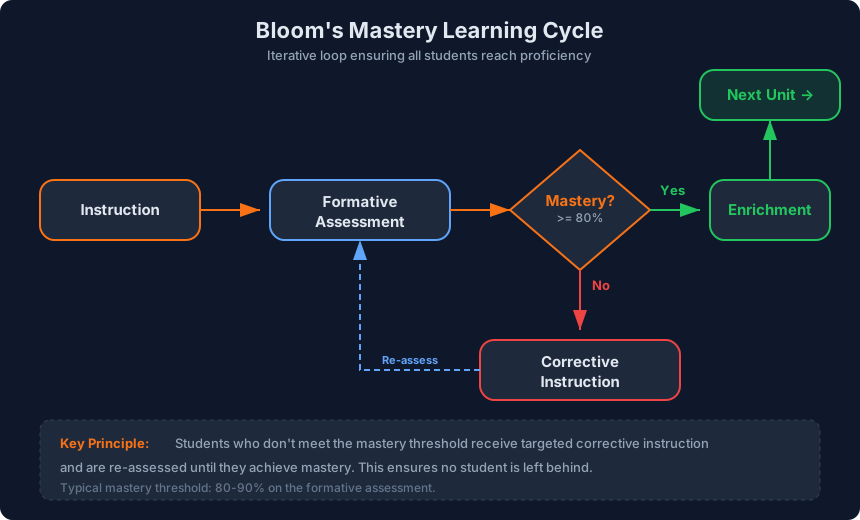
Step 1: Define Mastery Clearly
Before instruction begins, the instructor specifies exactly what students must know and be able to do. These are expressed as measurable learning outcomes, typically written using Bloom's Taxonomy action verbs. A mastery standard is also set — for example, scoring at the Proficient level or above on a proficiency scale.
Step 2: Deliver Initial Instruction
The instructor teaches the unit using high-quality instruction: lectures, readings, demonstrations, discussions, or any combination. This initial instruction phase is similar to traditional teaching.
Step 3: Administer a Formative Assessment
After instruction, students complete a formative assessment — not for a grade, but to diagnose their understanding. This assessment is typically criterion-referenced, measuring each student against the defined mastery standard rather than comparing students to each other.
Step 4: Provide Feedback and Corrective Instruction
Students who have not yet reached mastery receive specific, actionable feedback identifying which concepts or skills need further work. The instructor then provides corrective instruction — this might include alternative explanations, peer tutoring, additional practice problems, worked examples, or supplementary readings. The key is that corrective instruction is targeted, not a repetition of the original lesson.
Step 5: Reassess
After corrective instruction, students are reassessed on the same learning outcomes (using a parallel assessment, not the identical test). Students who now meet the mastery threshold advance; those who do not repeat the corrective cycle.
Step 6: Enrichment for Masters
Students who demonstrated mastery on the initial assessment engage in enrichment activities while peers complete corrective instruction. These activities deepen understanding, apply concepts to novel contexts, or explore related topics — preventing boredom and maximizing learning time.
Evidence for Effectiveness
Mastery learning is one of the most thoroughly researched instructional strategies. Key findings include:
| Study/Meta-Analysis | Finding |
|---|---|
| Bloom (1984) | Mastery learning + tutoring produced 2σ gains; mastery learning alone produced 1σ gains |
| Kulik, Kulik & Bangert-Drowns (1990) | Meta-analysis of 108 studies found consistent positive effects across grade levels and subjects |
| Guskey & Pigott (1988) | Strongest effects in science and social studies; significant effects in all subjects examined |
| Anderson (2000) | CBE programs using mastery approaches showed improved retention and graduation rates |
The evidence consistently shows that mastery learning works best when: formative assessments are frequent, corrective instruction is genuinely different from initial instruction, and the mastery standard is set at a meaningful level — high enough to represent real competency but not so high that it becomes unreachable.
Modern Implementations
Bloom's original model was designed for traditional classrooms. Today, mastery learning appears in many modern contexts:
Standards-Based Grading (SBG)
Standards-based grading is perhaps the most direct descendant of mastery learning. SBG systems report student progress against individual standards (competencies), allow reassessment, and use proficiency levels rather than percentages. The gradebook becomes a map of mastery, not a ledger of points.
Competency-Based Education (CBE)
Competency-based education extends mastery learning from a single classroom strategy to an institutional model. CBE programs allow students to advance upon demonstration of mastery, often with flexible pacing and multiple assessment pathways.
Flipped and Blended Classrooms
Technology has made the mastery cycle more practical. Students can watch recorded lectures at their own pace, complete online formative assessments with instant feedback, and use adaptive learning platforms that provide corrective instruction automatically. The instructor then uses class time for targeted intervention — a structure that maps perfectly to the mastery cycle.
Gamified Learning
Many educational games and platforms use mastery principles: students must complete a level (demonstrate proficiency) before unlocking the next. While the term "mastery learning" may not appear, the underlying mechanics — clear goals, formative feedback, iterative practice, and progression upon mastery — are identical.
Practical Steps for Implementation
- Break content into units: Divide your course into discrete, manageable units. Each unit should represent a coherent set of learning outcomes that can be assessed together.
- Set a mastery threshold: Define what "proficient" looks like using a proficiency scale or clear grade descriptors. Typically, mastery means scoring at or above the "Proficient" level.
- Design parallel assessments: Create at least two versions of each unit assessment so students can be reassessed on equivalent (but not identical) tasks.
- Plan corrective activities: For each common misconception or skill gap, prepare alternative instruction that approaches the content differently. Peer tutoring, worked examples, and targeted practice are effective corrective strategies.
- Build in enrichment: Prepare extension activities for students who demonstrate mastery quickly so they continue learning while peers complete corrective cycles.
- Use formative data to adapt: Track which competencies students struggle with most. If 80% of students fail the same item, the problem is likely instructional — not individual.
How MarkInMinutes Enables Mastery Learning Cycles
MarkInMinutes provides the detailed, dimension-level feedback that mastery learning demands. Because each rubric dimension maps to a specific competency and is scored on a proficiency scale, instructors can immediately identify which competencies a student has mastered and which need further development. This targeted feedback replaces vague overall scores with actionable diagnostics — telling students not just that they fell short, but exactly where and why. This precision makes the corrective instruction phase of the mastery cycle dramatically more effective.
Related Concepts
Mastery learning is deeply connected to several assessment frameworks. Bloom's Taxonomy provides the cognitive framework for defining learning outcomes at appropriate levels of complexity. Standards-based grading translates mastery learning into a grading and reporting system. Formative vs. summative assessment describes the two assessment functions that drive the mastery cycle: formative assessment diagnoses learning gaps, while summative assessment certifies mastery. Proficiency scales provide the measurement framework for determining whether mastery has been achieved. And competency-based education scales mastery learning from a classroom strategy to an institutional model.
Frequently Asked Questions
Doesn't mastery learning take too long?
Research shows that the initial implementation of mastery learning may require more time for the first few units as students adjust to the cycle. However, as students develop stronger foundational skills and self-regulation habits, the time needed for corrective instruction decreases in later units. The net investment is modest — and it produces students who actually retain what they have learned.
What about students who never reach mastery?
This is rare when corrective instruction is well-designed. Bloom's research found that under mastery conditions, approximately 80% of students achieved what only the top 20% achieved under conventional instruction. For the small number of students who struggle even with corrective instruction, mastery learning at least ensures they receive targeted support rather than being left behind.
Is mastery learning the same as grade retakes?
No. Mastery learning is a structured instructional strategy, not simply a policy of allowing students to retake tests. The critical difference is the corrective instruction phase: students do not simply retake the same test hoping for a better result. They receive targeted reteaching on their specific gaps, then demonstrate mastery on a parallel assessment. Without the corrective cycle, retakes are just test repetition — not mastery learning.
Sehen Sie diese Konzepte in Aktion
MarkInMinutes wendet diese Bewertungsprinzipien automatisch an. Laden Sie eine Abgabe hoch und erhalten Sie evidenzbasiertes Feedback in Minuten.
Verwandte Begriffe
Bloom's Taxonomy
Bloom's Taxonomy is a hierarchical framework of six cognitive levels — Remember, Understand, Apply, Analyze, Evaluate, and Create — used to classify learning objectives and design assessments.
Competency-Based Education
Competency-based education (CBE) is an instructional model in which students advance by demonstrating mastery of clearly defined competencies rather than by accumulating seat time or credit hours.
Formative vs Summative Assessment
Formative assessment monitors student learning during instruction to provide ongoing feedback, while summative assessment evaluates achievement at the end of a learning period.
Proficiency Scale
A proficiency scale is a structured set of performance levels that describe increasing degrees of mastery, used to evaluate student competency rather than assign percentage scores.
Standards-Based Grading
Standards-based grading (SBG) is an assessment approach that measures student achievement against defined learning standards rather than accumulating points from assignments, homework, and participation.