Proficiency Scale: Understanding Competency-Based Grading Levels
Learn what proficiency scales are, how they work in competency-based education, and why they produce fairer grades than percentages. Includes level structures and examples.
Proficiency scales are transforming how educators think about grades. Instead of reducing complex human learning to a percentage or letter grade, proficiency scales describe what students can actually do at each level of mastery. This competency-based approach is gaining traction from elementary schools to universities because it communicates meaningful information about learning — not just a number on a spreadsheet. For educators designing assessments and students trying to understand their progress, proficiency scales offer clarity that traditional grading systems often lack.
What Is a Proficiency Scale?
A proficiency scale is an ordered set of performance levels, each with descriptors that define what competency looks like at that stage of development. Unlike percentage-based grading scales that rank students along a numerical continuum, proficiency scales categorize performance into qualitatively distinct levels.
Each level on a proficiency scale answers the question: what can a student demonstrate at this stage? The focus is on observable competencies — not on points accumulated or errors counted.
A simple three-level scale might read:
- Beginning: Demonstrates limited understanding; requires significant support
- Developing: Demonstrates partial understanding; applies concepts with some guidance
- Proficient: Demonstrates solid understanding; applies concepts independently
More sophisticated scales add levels above proficiency (for students who exceed expectations) and use finer subdivisions for nuanced scoring.
Why Proficiency Scales Matter
They Communicate Meaning
A score of 73% tells a student almost nothing about what they know or can do. Does it mean they answered 73% of questions correctly? That their essay was 73% good? Proficiency levels, by contrast, carry inherent meaning: "Developing" tells a student they're making progress but haven't yet reached the target standard, with specific descriptors explaining what "Proficient" requires.
They Support Growth Mindset
Proficiency scales frame learning as a progression, not a ranking. A student at the "Developing" level isn't failing — they're on a path toward proficiency. This language shift, supported by clear grade descriptors, encourages students to see assessment as a feedback mechanism rather than a judgment.
They Enable Criterion-Referenced Assessment
Proficiency scales are inherently criterion-referenced. Students are measured against defined standards, not against each other. This eliminates the distortions of curve-based grading, where a student's grade depends on classmates' performance rather than their own mastery.
They Reduce Score Inflation and Deflation
Percentage systems are vulnerable to inflation (easy assignments that cluster at 90%+) and deflation (harsh grading that makes 70% the norm). Proficiency scales anchor grading to fixed competency benchmarks, producing more stable and comparable scores across sections, semesters, and institutions.
Common Proficiency Scale Structures
Proficiency scales typically use three to six levels. The number of levels reflects a tradeoff between granularity and usability.
Three-Level Scales
| Level | Description |
|---|---|
| Not Yet Proficient | Has not demonstrated the target competency |
| Proficient | Meets the expected standard |
| Advanced | Exceeds expectations; applies skills in novel contexts |
Best for: Quick formative checks, pass/fail-adjacent assessments, early education.
Four-Level Scales
| Level | Description |
|---|---|
| Beginning | Minimal understanding; significant gaps |
| Developing | Partial understanding; inconsistent application |
| Proficient | Solid understanding; consistent, independent application |
| Advanced | Deep understanding; transfers skills to new contexts |
Best for: Standards-based grading in K-12, progress reporting.
Five-Level Scales
| Level | Description |
|---|---|
| Novice | Foundational knowledge only; requires substantial support |
| Developing | Growing understanding; applies basics with guidance |
| Proficient | Meets expectations; works independently and accurately |
| Accomplished | Strong command; integrates concepts across contexts |
| Distinguished | Exceptional mastery; creates, evaluates, and innovates |
Best for: Higher education, professional certification, detailed analytic rubrics.
Adding Subdivisions
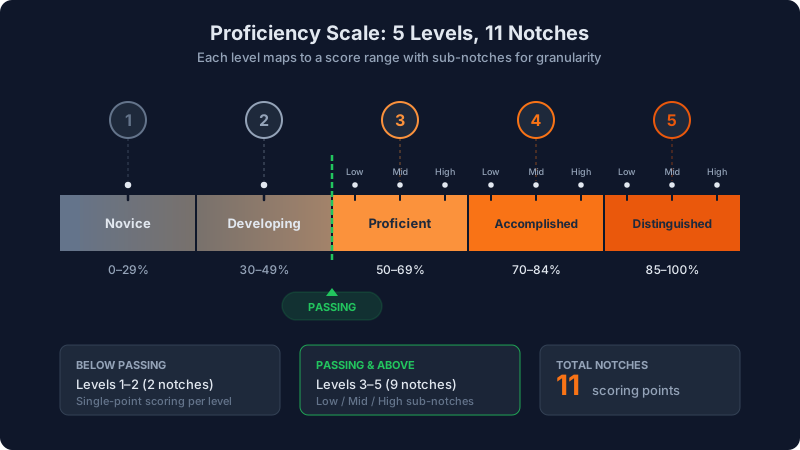
For finer granularity without adding entirely new levels, many scales introduce subdivisions — typically High, Mid, and Low within each level. A five-level scale with three subdivisions per level creates an 11-point (or more) range that provides the nuance of numerical scoring while retaining the descriptive clarity of proficiency levels.
Proficiency Scales vs. Percentage Grades
| Feature | Proficiency Scale | Percentage Grade |
|---|---|---|
| What it measures | What students can do | Points accumulated |
| Basis | Criterion-referenced standards | Often norm-referenced or point-based |
| Feedback value | High — describes competency | Low — a number without context |
| Susceptibility to inflation | Low — anchored to descriptors | High — depends on assessment difficulty |
| Cross-section comparability | High — same standards apply | Low — varies by instructor and task |
| Growth tracking | Natural — levels show progression | Difficult — 78% vs 82% isn't meaningful |
The shift from percentages to proficiency scales doesn't mean abandoning numerical rigor. Final proficiency levels can still be converted to traditional grades when required by institutional systems. A "Proficient" might map to a B+, an "Accomplished" to an A-, and so on — but the assessment itself is grounded in competency descriptions rather than point counting.
Implementing Proficiency Scales
Step 1: Define Your Levels
Choose a structure (3, 4, 5, or 6 levels) that matches your assessment context. Higher education and complex tasks generally benefit from five or more levels; formative classroom checks can work with three.
Step 2: Write Descriptors Aligned to Learning Outcomes
Each level's descriptor should connect to course learning outcomes and use observable, action-verb language drawn from Bloom's Taxonomy. The progression should reflect increasing cognitive complexity:
- Novice: Identifies, recalls, lists (Remember/Understand)
- Developing: Describes, explains, applies in familiar contexts (Apply)
- Proficient: Analyzes, compares, applies in new contexts (Analyze)
- Accomplished: Evaluates, integrates, justifies (Evaluate)
- Distinguished: Creates, synthesizes, innovates (Create)
Step 3: Calibrate With Examples
Abstract descriptors become concrete when paired with examples of student work at each level. These calibration anchors are invaluable for training graders and setting student expectations. Collect samples from previous semesters, anonymize them, and map them to your scale levels.
Step 4: Set a Passing Threshold
Decide which level represents "passing." In most systems, this is the Proficient level — the point at which students demonstrate competent, independent work. Levels below proficiency indicate that additional learning is needed; levels above indicate exceptional achievement.
Step 5: Map to Institutional Grades
If your institution requires letter grades or ECTS grades, create an explicit mapping table:
| Proficiency Level | Letter Grade | ECTS Grade |
|---|---|---|
| Distinguished | A | A |
| Accomplished | B+ / A- | B |
| Proficient | B- / B | C |
| Developing | C / D | D / E |
| Novice | F | F |
This mapping preserves the competency-based assessment internally while meeting institutional reporting requirements externally.
How MarkInMinutes Implements Proficiency Scales
Proficiency scales are the backbone of MarkInMinutes' grading architecture. The system uses a five-level scale — Novice, Developing, Proficient, Accomplished, and Distinguished — with 11 notches created through High, Mid, and Low subdivisions for the top three levels. This structure balances descriptive clarity with scoring precision. Each rubric dimension includes Calibration Anchors that define what work looks like at every notch of the scale, ensuring consistent scoring across submissions. A 72-run benchmark confirmed that this notch-level precision is reproducible: MarkInMinutes achieved 93.8% exact notch agreement across independent grading runs, while competing tools either collapsed grades into a single notch or scattered them unpredictably. The passing threshold is set at Level 3 (Proficient), and the system uses ordinal mapping to convert proficiency levels to interval-scale values for mathematically sound grade weighting calculations. Final scores map automatically to ECTS grades and institutional grading scales.
Related Concepts
Proficiency scales connect to nearly every aspect of assessment design. They operate within the broader framework of a grading scale, with grade descriptors providing the language for each level. Proficiency scales are inherently criterion-referenced, measuring students against fixed standards rather than peer performance. They form the backbone of every well-designed rubric, and the cognitive progression embedded in their levels typically mirrors Bloom's Taxonomy. When proficiency levels feed into weighted scoring, the interaction between the scale and grade weighting determines final grades — making it essential to use ordinal mapping for accurate calculations.
Frequently Asked Questions
How is a proficiency scale different from a grading scale?
A grading scale is a broad term for any system that converts scores to grades (letter grades, percentages, ECTS). A proficiency scale is a specific type of grading scale that defines performance levels based on competency descriptions. All proficiency scales are grading scales, but not all grading scales are proficiency-based — many rely on percentage cutoffs without describing what each level means.
Can proficiency scales work in higher education?
Absolutely. Many universities are adopting competency-based education (CBE) models that use proficiency scales, particularly in professional programs like nursing, engineering, and education. Proficiency scales align naturally with accreditation standards that require demonstration of specific competencies. They also pair well with analytic rubrics for complex assignments like theses, portfolios, and capstone projects.
What if my institution requires percentage grades?
Most proficiency-based systems include a conversion table that maps proficiency levels to percentage ranges or letter grades for institutional reporting. The key insight is that the assessment itself uses proficiency levels for evaluation and feedback — the conversion to percentages happens only at the reporting stage. This preserves the benefits of competency-based grading while meeting administrative requirements.
Sehen Sie diese Konzepte in Aktion
MarkInMinutes wendet diese Bewertungsprinzipien automatisch an. Laden Sie eine Abgabe hoch und erhalten Sie evidenzbasiertes Feedback in Minuten.
Verwandte Begriffe
Bloom's Taxonomy
Bloom's Taxonomy is a hierarchical framework of six cognitive levels — Remember, Understand, Apply, Analyze, Evaluate, and Create — used to classify learning objectives and design assessments.
Criterion-Referenced Assessment
Criterion-referenced assessment measures student performance against predetermined standards and learning objectives rather than comparing students to each other.
Grade Descriptors
Grade descriptors are written statements that define the characteristics and qualities of student work at each performance level on a grading scale, providing a shared reference for what distinguishes one grade from another.
Grading Scale
A grading scale is a standardized system that translates student performance into scores, letters, or levels to communicate achievement consistently.
Rubric
A rubric is a scoring guide that defines criteria and performance levels used to evaluate student work consistently and transparently.