Marking Scheme: What It Is, How to Create One, and Best Practices
Learn what a marking scheme is, the different types (point-based, level-based, model answer), how to create effective marking schemes for various question types, and best practices for ensuring fairness and consistency.
If you have ever graded a stack of exams and worried whether you were applying the same standard to the last paper as the first, you understand why marking schemes exist. A marking scheme is the bridge between an assessment task and a fair, consistent grade. It tells the marker — whether that is you, a teaching assistant, or a colleague — exactly how to award marks, what constitutes a correct or high-quality response, and where partial credit applies. In educational systems worldwide, particularly in the UK, Australia, and international examination boards, the marking scheme is the foundational tool for assessment quality.
What Is a Marking Scheme?
A marking scheme (also called a mark scheme, scoring guide, or marking criteria) is a structured document that specifies how marks should be allocated for each question, task, or component of an assessment. It defines the criteria for awarding full marks, partial marks, and zero marks, and it provides model answers or performance descriptions to guide scoring decisions.
The term "marking scheme" is most prevalent in UK, Commonwealth, and international education systems, while North American institutions more commonly use "rubric" or "scoring guide." Despite the terminology difference, the underlying concept is the same: a pre-defined framework that ensures markers apply consistent standards to every student's work.
A well-designed marking scheme serves three audiences:
- Markers — by providing clear, unambiguous scoring instructions
- Students — by making expectations transparent and scores explainable
- Institutions — by creating an auditable record of how grades were determined
Why Marking Schemes Matter
They Ensure Consistency
Without a marking scheme, grading is subjective — influenced by marker fatigue, mood, the order of papers, and unconscious bias. A marking scheme anchors every scoring decision to pre-defined criteria, dramatically improving inter-rater reliability across multiple markers.
They Enable Fair Moderation
When multiple markers grade the same assessment, a marking scheme provides the common reference point for moderation sessions. Discrepancies between markers can be identified and resolved by referring back to the scheme, not to individual opinions. This is central to double-marking and moderation processes.
They Support Transparency
Students have a right to understand how their grade was determined. A marking scheme makes the scoring logic explicit, reducing grade disputes and providing a clear basis for feedback. When a student asks "Why did I lose marks?", the marking scheme provides the answer.
They Save Time
Experienced markers know that well-structured marking schemes actually speed up grading. Instead of deliberating over every response, the marker can quickly compare student work to the scheme and allocate marks accordingly. The upfront investment in designing the scheme pays dividends during the grading process.
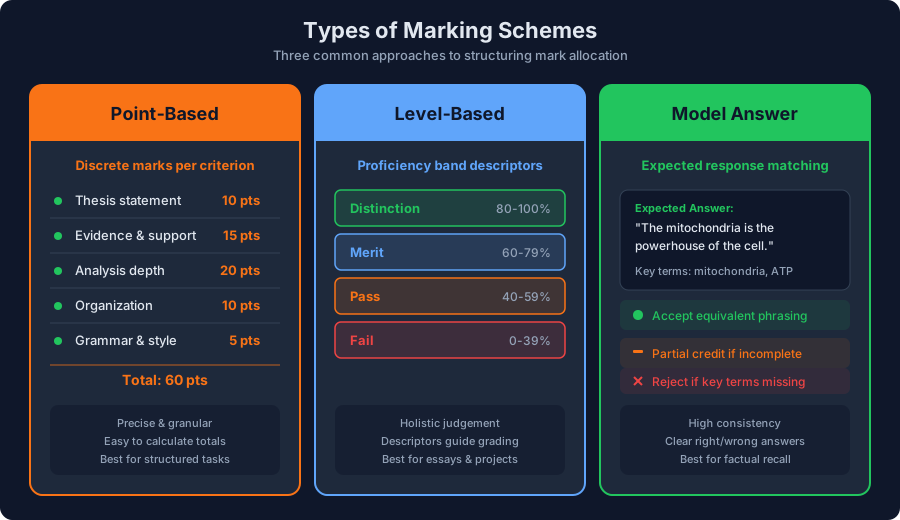
Types of Marking Schemes
Point-Based (Analytical) Marking Schemes
Point-based schemes assign specific marks to specific elements of a response. They are most common for structured questions — short answer, calculation, and problem-solving tasks — where the response can be decomposed into discrete, scorable components.
Example: Chemistry calculation (8 marks)
| Element | Marks |
|---|---|
| Correct chemical equation, balanced | 2 |
| Correct molar mass calculation | 2 |
| Correct stoichiometric ratio applied | 2 |
| Final answer with correct units and significant figures | 2 |
Point-based schemes are precise and easy to apply consistently. However, they work best when responses have identifiable right and wrong components. For open-ended tasks, they can become unwieldy or overly reductive.
Level-Based (Banded) Marking Schemes
Level-based schemes describe performance at different quality levels (bands) rather than assigning points to individual elements. They are commonly used by examination boards (e.g., Cambridge, IB, Edexcel) for extended writing, essays, and complex tasks where quality is holistic rather than additive.
Example: History essay (20 marks)
| Level | Marks | Descriptor |
|---|---|---|
| Level 4 | 16–20 | Sustained analytical argument with well-integrated evidence; evaluates multiple perspectives; reaches a substantiated conclusion |
| Level 3 | 11–15 | Clear argument with relevant evidence; some analysis and evaluation; conclusion follows from the argument |
| Level 2 | 6–10 | Descriptive account with some relevant knowledge; limited analysis; conclusion may be asserted rather than argued |
| Level 1 | 1–5 | Limited relevant knowledge; largely descriptive or narrative; no clear argument structure |
Level-based schemes align closely with proficiency scales and grade descriptors. They provide a natural framework for quality assessment but require marker training to apply consistently — particularly at the boundaries between levels.
Model Answer Marking Schemes
Model answer schemes provide a complete exemplary response and indicate which elements earn marks. They are common for mathematical, scientific, and technical assessments where there is a definitive correct approach.
Model answer schemes often include:
- The full correct solution, step by step
- Alternative acceptable approaches
- Common errors and how they affect marking (e.g., "error carried forward" — where a student's subsequent calculations are correct given their earlier mistake)
- Specific penalties for omissions (missing units, unsimplified expressions)
Marking Schemes vs. Rubrics
The relationship between marking schemes and rubrics causes frequent confusion, partly because the terms are used differently across educational cultures.
| Feature | Marking Scheme | Rubric |
|---|---|---|
| Terminology origin | UK, Commonwealth, international exams | North America, increasingly global |
| Typical format | Points per element or level bands | Grid of dimensions × proficiency levels |
| Scope | Often task-specific (one scheme per question) | Often applies to a category of tasks |
| Feedback value | Moderate — explains mark allocation | High — describes performance quality on multiple dimensions |
| Best for | Exams, structured questions, standardized tests | Essays, projects, portfolios, complex tasks |
In practice, the distinction is blurring. Modern marking schemes increasingly incorporate rubric-like elements (multiple dimensions, qualitative descriptors), and rubrics often include point allocations. The best assessment tools combine the precision of point-based marking with the descriptive richness of level-based criteria.
Designing Effective Marking Schemes
Step 1: Start With Learning Outcomes
Every mark on the scheme should connect to a specific learning outcome. If you cannot explain which outcome a mark tests, that mark should not exist. This alignment ensures content validity — the assessment measures what it should.
Step 2: Draft the Scheme Before the Assessment
The marking scheme and the assessment should be designed together, not sequentially. Drafting the scheme first reveals problems with the questions: if you cannot define what a correct or high-quality response looks like, the question needs revision.
Step 3: Specify Partial Credit Rules
For every question, define how partial credit works. Can a student earn 1 of 2 marks for an incomplete but partially correct response? What about a correct final answer derived from an incorrect method? These decisions must be made before grading begins — not on the fly during marking.
Step 4: Include Alternative Acceptable Responses
Students find creative ways to answer questions. A good marking scheme anticipates multiple valid approaches and specifies which alternatives earn full marks. This is particularly important for open-ended questions and mathematical problems with multiple solution paths.
Step 5: Pilot the Scheme
Mark a sample of student responses using the draft scheme. You will quickly discover ambiguities, missing scenarios, and elements that need clarification. Revise the scheme before full-scale marking begins.
Step 6: Calibrate Markers
If multiple people will use the scheme, conduct a calibration session. Have all markers independently score the same sample papers, then compare results and discuss discrepancies. Revise the scheme to address any persistent disagreements.
Ensuring Fairness and Consistency
- Use consistent terminology — Define key terms in the scheme so all markers interpret them identically
- Include boundary examples — Show what the borderline between adjacent levels or score points looks like
- Apply the scheme mechanically first, then holistically — Score each element according to the scheme, then check whether the total feels right for the overall quality
- Document decisions — When markers encounter unanticipated responses, record the decision and apply it to all subsequent papers
- Moderate a sample — After marking, a second marker should independently score a sample (typically 10–20%) to verify consistency
How MarkInMinutes Goes Beyond Traditional Marking Schemes
A MarkInMinutes rubric functions as an advanced marking scheme — one that combines the precision of point-based scoring with the descriptive richness of level-based assessment. Each rubric dimension maps to a specific learning outcome, scored on a proficiency scale with detailed grade descriptors at every level. Dimensions are weighted to reflect their relative importance, and scoring is evidence-based — grounded in specific, observable performance from the student's work. This goes well beyond traditional mark allocation: it provides the consistency of a marking scheme, the diagnostic power of an analytic rubric, and the transparency that students and institutions need.
Related Concepts
Marking schemes exist within a broader assessment infrastructure. Rubrics provide an alternative (and increasingly complementary) framework for scoring. Grading criteria define what is being assessed; the marking scheme defines how it is scored. Grade descriptors supply the qualitative language for level-based schemes. Analytic vs. holistic rubrics reflect the same structural choice as point-based vs. level-based marking schemes. And grade weighting determines how individual marks combine into final grades — a critical consideration when designing multi-component marking schemes.
Frequently Asked Questions
Is a marking scheme the same as a rubric?
Not exactly, though they serve similar purposes. A marking scheme is typically more task-specific (designed for a particular exam question), while a rubric is often designed for a category of tasks (e.g., all argumentative essays). Marking schemes tend to focus on mark allocation; rubrics tend to emphasize performance descriptions. In practice, many modern assessment tools blend both approaches — combining specific mark allocations with descriptive quality levels.
Should I share the marking scheme with students?
In most cases, yes. Sharing the marking scheme (or a student-facing version of it) before the assessment makes expectations transparent and helps students focus their preparation on what matters. Examination boards typically publish marking schemes after exams; classroom educators can share them in advance. The exception is when the assessment specifically tests the ability to identify relevant criteria — but this is uncommon.
How detailed should a marking scheme be?
Detailed enough that two competent markers would assign the same score to the same piece of work. If you find that your scheme leaves too many scoring decisions to individual judgment, it needs more specificity — additional acceptable responses, boundary examples, or clearer descriptors. The goal is not to eliminate all judgment, but to constrain it within well-defined parameters so that the student's grade reflects their work, not the marker's interpretation.
Sehen Sie diese Konzepte in Aktion
MarkInMinutes wendet diese Bewertungsprinzipien automatisch an. Laden Sie eine Abgabe hoch und erhalten Sie evidenzbasiertes Feedback in Minuten.
Verwandte Begriffe
Analytic vs Holistic Rubric
Analytic rubrics score each criterion separately for detailed feedback, while holistic rubrics assign a single overall score based on the total impression of student work.
Grade Descriptors
Grade descriptors are written statements that define the characteristics and qualities of student work at each performance level on a grading scale, providing a shared reference for what distinguishes one grade from another.
Grade Weighting
Grade weighting assigns different levels of importance to assessment components or rubric dimensions, so that higher-priority elements have a greater impact on the final grade.
Grading Criteria
Grading criteria are the specific standards and expectations used to evaluate student work, defining what quality looks like at each performance level.
Rubric
A rubric is a scoring guide that defines criteria and performance levels used to evaluate student work consistently and transparently.