Performance-Based Assessment: Evaluating What Students Can Do
Understand performance-based assessment, its characteristics and types (presentations, labs, simulations), design principles, rubric strategies, and how it compares to traditional testing.
A nursing student can score perfectly on a pharmacology exam and still freeze when asked to calculate a drug dosage at a patient's bedside under time pressure. A computer science student can define every sorting algorithm on a written test but struggle to debug a simple program. The gap between knowing and doing is one of the most persistent challenges in education—and performance-based assessment is designed to close it. By requiring students to demonstrate competence through action rather than recall, performance-based assessment measures what matters most: what students can actually do.
What Is Performance-Based Assessment?
Performance-based assessment (PBA) requires students to demonstrate their knowledge, skills, and abilities by performing a task, creating a product, or solving a problem in a context that approximates real-world conditions. Rather than asking students to recognize a correct answer from a list, PBA asks them to construct, produce, or demonstrate.
The defining characteristic is observable action. A student does not merely report what they know—they show what they can do. This can range from a lab experiment to a debate, from a clinical simulation to a design project, from a musical recital to a courtroom mock trial.
Performance-based assessment is inherently criterion-referenced: student performance is measured against defined standards and rubric criteria, not against other students' performances.
Why Performance-Based Assessment Matters
Measures Higher-Order Thinking
Traditional tests excel at assessing recall and comprehension—the lower levels of Bloom's taxonomy. Performance-based assessment targets the upper levels: application, analysis, synthesis, and evaluation. When a student designs an experiment, argues a case, or builds a prototype, they engage cognitive processes that multiple-choice questions cannot reach.
Validates Real-World Competence
Employers, professional licensure boards, and graduate programs care about what graduates can do, not just what they know. A medical school that only uses written exams produces graduates who have never been observed performing a clinical procedure. Performance-based assessment bridges the gap between academic knowledge and professional competence.
Increases Student Engagement
Students consistently report higher motivation and deeper engagement with performance tasks compared to traditional exams. The authenticity of the task—its connection to real-world practice—gives students a reason to care. When the assessment feels meaningful, effort and investment increase.
Reveals Process, Not Just Product
Traditional assessments typically evaluate only the final answer. Performance-based assessment can evaluate how students arrive at their answers: their methodology, reasoning process, collaboration skills, and ability to adapt when plans fail. This process-level insight is invaluable for providing targeted constructive feedback.
Characteristics of Performance-Based Assessment
Effective PBA shares several defining characteristics that distinguish it from traditional testing:
| Characteristic | Description |
|---|---|
| Observable | Students perform an action or create a product that can be directly observed and evaluated |
| Complex | Tasks require integration of multiple skills, not isolated recall of single facts |
| Criterion-referenced | Performance is judged against defined standards, not curved against peers |
| Authentic | Tasks resemble real-world challenges that professionals or practitioners face |
| Open-ended | Multiple valid approaches or solutions are possible |
| Process-oriented | Both the process and the product may be evaluated |
Types of Performance-Based Assessment
Performance-based assessment encompasses a wide range of task types. The best choice depends on the discipline, learning outcomes, and resources available.
Presentations and Oral Defenses
Students present research findings, argue a position, or defend a thesis before an audience. Oral assessments evaluate communication skills, depth of understanding, and the ability to respond to questions—competencies invisible in written exams.
Examples: Research presentations, thesis defenses, elevator pitch competitions, Socratic seminars
Laboratory and Practical Demonstrations
Common in STEM and health sciences, lab-based assessments require students to perform procedures, conduct experiments, or demonstrate technical skills under observation.
Examples: Chemistry lab practicals, clinical skills assessments (OSCE), engineering design tests, culinary arts practical exams
Simulations and Role-Plays
Students engage in structured scenarios that replicate professional situations. Simulations are particularly valuable in fields where real-world practice involves risk (medicine, aviation, crisis management).
Examples: Patient simulations in nursing, mock trials in law, business case competitions, diplomatic negotiation exercises
Design and Construction Projects
Students create tangible products that demonstrate technical skill and creative problem-solving. The product itself is the evidence of learning.
Examples: Engineering prototypes, software applications, architectural models, graphic design portfolios, documentary films
Exhibitions and Showcases
Students present a body of work to an audience that may include peers, instructors, industry professionals, or community members. The public nature of the exhibition raises the stakes and adds authenticity.
Examples: Art exhibitions, science fairs, capstone showcases, community service project presentations
Designing Performance-Based Assessments
Start with Learning Outcomes
Every performance task should map directly to one or more specific learning outcomes. If the outcome states that students will "design and conduct an experiment," then the assessment must require designing and conducting an experiment—not writing about how one would do so.
Define the Task Clearly
Students need to understand:
- What they are expected to produce or demonstrate
- What resources and constraints apply (time, materials, tools)
- What criteria will be used to evaluate their performance
- What the rubric looks like (share it in advance)
Build the Rubric Before the Task
The rubric should be designed alongside the task, not after. For complex performance tasks, analytic rubrics work best because they evaluate multiple dimensions independently—allowing nuanced feedback on different aspects of performance.
A rubric for a research presentation, for example, might include these dimensions:
- Content accuracy and depth — Are claims well-supported and factually correct?
- Organization and structure — Does the presentation follow a logical flow?
- Delivery and communication — Is the speaker clear, confident, and engaging?
- Visual aids — Do slides or materials enhance understanding?
- Response to questions — Does the student demonstrate depth beyond the prepared material?
Each dimension is scored against a proficiency scale with specific grade descriptors, ensuring consistent evaluation across students and assessors.
Account for Logistics
Performance-based assessments are more logistically demanding than written exams. Plan for scheduling (if tasks are time-bound or require individual observation), equipment and materials, space, and multiple assessors if needed for reliability.
Performance-Based vs. Traditional Assessment
| Dimension | Performance-Based | Traditional (Written Tests) |
|---|---|---|
| What it measures | Application, synthesis, creation | Recall, recognition, comprehension |
| Response type | Constructed (student produces) | Selected (student chooses) |
| Cognitive level | Higher-order (Bloom's top levels) | Often lower-order |
| Authenticity | High (resembles real-world tasks) | Low (artificial test conditions) |
| Scoring | Rubric-based, more subjective | Often objective, machine-scorable |
| Resource cost | Higher (time, materials, observers) | Lower (standardized, scalable) |
| Feedback richness | Rich, dimension-level | Limited (correct/incorrect) |
Neither type is universally superior. The strongest assessment programs combine both: traditional tests for efficient measurement of foundational knowledge, and performance tasks for evaluation of complex, applied competencies.
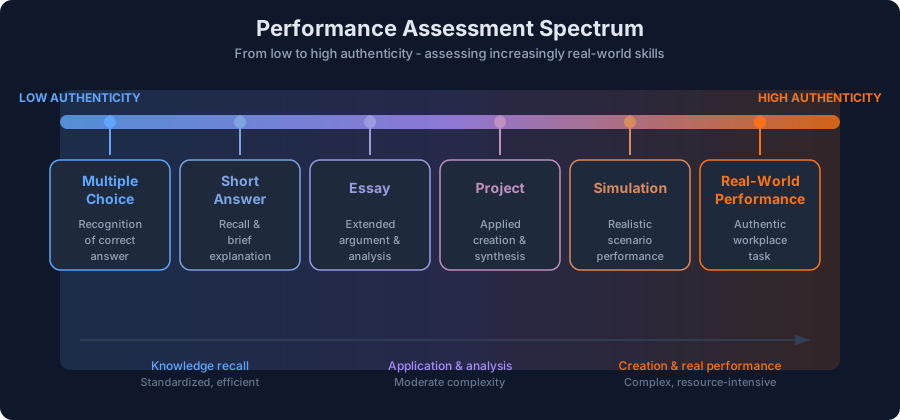
Performance-Based Assessment in Practice
Consider an undergraduate business program assessing students on strategic management. Rather than a final exam, students work in teams to:
- Analyze a real company facing a strategic challenge (case materials provided)
- Develop a strategic recommendation with financial projections, competitive analysis, and implementation timeline
- Present their recommendation to a panel including faculty and industry professionals (20 minutes)
- Defend their analysis during a 10-minute Q&A session
The rubric evaluates analytical rigor, financial reasoning, presentation quality, teamwork, and response to critical questions. Each dimension is scored independently, and the panel's scores are calibrated through a pre-session norming exercise to ensure inter-rater reliability.
How MarkInMinutes Supports Performance-Based Assessment
Multidimensional Rubric Evaluation With Evidence Citations
Performance-based assessment produces complex, multifaceted student work that resists one-dimensional scoring. MarkInMinutes is designed precisely for this challenge. Its multidimensional rubric evaluation scores each criterion independently—content quality, methodology, communication, and any other dimension the instructor defines—with evidence citations drawn directly from the student's work. For written components of performance tasks (reports, design documents, reflective analyses), each score is anchored to specific evidence, making the assessment transparent and defensible. The per-dimension feedback provides students with targeted guidance on exactly which aspects of their performance met the standard and which need development.
Related Concepts
Performance-based assessment sits within a network of related evaluation concepts. Authentic assessment is the broader philosophy that performance-based assessment operationalizes—both emphasize real-world relevance and applied competence. A well-designed rubric is essential for evaluating complex performance tasks consistently. Clear learning outcomes define what the performance task must demonstrate. Proficiency scales and grade descriptors provide the language for distinguishing levels of performance quality. And criterion-referenced assessment is the measurement philosophy underlying PBA—students are judged against standards, not against each other.
Frequently Asked Questions
How do you ensure reliability in performance-based assessment?
Use detailed analytic rubrics with specific grade descriptors for each dimension and level. Train assessors through calibration sessions using sample performances. For high-stakes assessments, use multiple assessors and check inter-rater reliability. Where feasible, record performances for review and moderation.
Is performance-based assessment practical for large classes?
It requires more planning than a scanned exam, but it is achievable. Strategies include group performance tasks (reducing the number of assessments to evaluate), peer assessment components, staged submissions (assessing parts individually over time), and rubric-based scoring that increases efficiency. Even a single well-designed performance task per course can dramatically improve the validity of assessment.
Can performance-based assessment replace traditional exams entirely?
In some disciplines, yes—particularly in professional and creative fields where applied competence is the ultimate goal. In most programs, a blended approach works best: traditional assessments verify foundational knowledge efficiently, while performance tasks assess the application and integration of that knowledge. The two types complement each other.
Sehen Sie diese Konzepte in Aktion
MarkInMinutes wendet diese Bewertungsprinzipien automatisch an. Laden Sie eine Abgabe hoch und erhalten Sie evidenzbasiertes Feedback in Minuten.
Verwandte Begriffe
Authentic Assessment
Authentic assessment evaluates students through real-world tasks that require applying knowledge and skills in meaningful, complex contexts — moving beyond recall to demonstrate genuine understanding.
Criterion-Referenced Assessment
Criterion-referenced assessment measures student performance against predetermined standards and learning objectives rather than comparing students to each other.
Learning Outcomes
Learning outcomes are specific, measurable statements describing what students should know, be able to do, or value by the end of a course, module, or program.
Proficiency Scale
A proficiency scale is a structured set of performance levels that describe increasing degrees of mastery, used to evaluate student competency rather than assign percentage scores.
Rubric
A rubric is a scoring guide that defines criteria and performance levels used to evaluate student work consistently and transparently.