Authentic Assessment: Real-World Tasks for Meaningful Learning
Discover what authentic assessment is, how it differs from traditional testing, and how to design real-world tasks that measure deep understanding and transferable skills using rubric-based evaluation.
A multiple-choice test can tell you whether a student remembers a fact. But can it tell you whether that student can apply knowledge to solve a new problem, communicate a complex idea to an audience, or navigate an ethical dilemma in a professional context? Authentic assessment is designed to answer these deeper questions. By asking students to perform real-world tasks that mirror the challenges they will face beyond the classroom, authentic assessment measures not just what students know but what they can do with what they know.
What Is Authentic Assessment?
Authentic assessment is an approach to evaluation in which students demonstrate their learning by completing complex, meaningful tasks that reflect real-world challenges. Rather than selecting answers from predetermined options or recalling isolated facts, students construct responses, create products, or perform demonstrations that require integrating knowledge, applying skills, and exercising judgment.
The concept was popularized by Grant Wiggins (who also co-developed backward design) in the early 1990s. Wiggins argued that traditional tests often assess what is easy to measure rather than what is important to learn. Authentic assessment reverses this priority: it starts with what matters — the ability to transfer learning to genuine contexts — and designs tasks accordingly.
An assessment is "authentic" when it shares key characteristics with the challenges that professionals, citizens, or scholars actually face in the relevant field.
Characteristics of Authentic Assessment
Not every project or performance task qualifies as authentic. Genuine authentic assessment has several defining features:
- Real-world relevance: The task mirrors problems or situations that exist outside the classroom. A business student creates a marketing plan for a real local company rather than answering questions about marketing theory.
- Complex thinking: The task requires analysis, synthesis, evaluation, or creation — the higher levels of Bloom's Taxonomy — rather than simple recall or recognition.
- Student choice and judgment: Students make meaningful decisions about approach, resources, or presentation, just as professionals do.
- Integration of knowledge: The task draws on multiple skills or content areas rather than isolating a single fact or procedure.
- Tangible product or performance: Students produce something — a report, presentation, design, experiment, or performance — that can be evaluated and shared.
- Defined criteria: Evaluation uses a rubric with transparent criteria known to students before they begin, rather than hidden answer keys.
- Iterative process: Often, authentic assessment allows for drafting, feedback, and revision — reflecting how real work is actually produced.
Authentic Assessment vs. Traditional Assessment
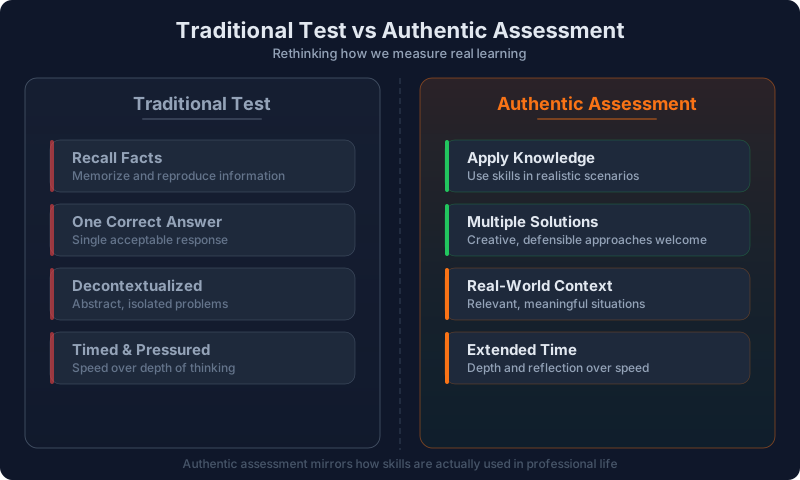
| Feature | Traditional Assessment | Authentic Assessment |
|---|---|---|
| Task type | Multiple choice, fill-in-the-blank, short answer | Projects, presentations, portfolios, case studies |
| Cognitive demand | Recall, recognition, basic application | Analysis, synthesis, evaluation, creation |
| Context | Decontextualized (isolated questions) | Contextualized (embedded in realistic scenarios) |
| Student role | Respondent (choose or recall) | Performer (construct, create, demonstrate) |
| Answer format | Single correct answer | Multiple valid approaches and solutions |
| Scoring | Objective (answer key) | Criterion-referenced (rubric-based) |
| Feedback potential | Limited (correct/incorrect) | Rich (multidimensional, actionable) |
| Transfer value | Low (knowledge stays inert) | High (knowledge is applied and practiced) |
This does not mean traditional tests have no place. Quick knowledge checks, formative quizzes, and standardized assessments serve valid purposes. The argument for authentic assessment is that it should complement — and in many cases replace — traditional testing for measuring the learning outcomes that matter most.
Examples Across Disciplines
Authentic assessment looks different in every field, but the principle is constant: students do what practitioners do.
Sciences
- Design and conduct an original experiment, analyze results, and present findings to a panel (mirroring the scientific conference process)
- Write a grant proposal for a research question, including literature review, methodology, and budget justification
- Diagnose a simulated patient case using clinical reasoning (medical and nursing education)
Humanities
- Write an op-ed arguing a position on a contemporary issue, supported by historical evidence
- Curate a museum exhibit (physical or virtual) with annotated primary source selections and interpretive framing
- Translate and annotate a literary text, justifying interpretation choices
Business and Professional Programs
- Develop a business plan for a startup, present to a panel of real investors or entrepreneurs
- Conduct a forensic audit of a simulated company's financial records and present findings
- Negotiate a contract in a simulated client meeting with role-playing counterparts
STEM and Engineering
- Design, prototype, and test a solution to a defined engineering challenge under realistic constraints
- Write and document production-quality code for a real open-source project
- Analyze a real dataset, build a predictive model, and communicate findings to a non-technical audience
Designing Authentic Assessment
Start with Outcomes
Effective authentic assessment begins with backward design: identify the desired learning results first, then create a task that provides evidence of those results. Ask: "What would a competent practitioner in this field be able to do with this knowledge?"
Define the Task
Write a clear task description that includes:
- Scenario or context: The realistic situation in which the student will work
- Role: Who the student is in this scenario (consultant, researcher, journalist, engineer)
- Audience: Who will receive or evaluate the product (client, editorial board, community)
- Product or performance: What the student will create or do
- Constraints: Realistic limitations (time, budget, resources, word count)
Build the Rubric
Because authentic tasks are open-ended, they require criterion-referenced assessment rather than an answer key. Design an analytic rubric that evaluates the dimensions most important to the task. Each dimension should have clear grade descriptors that describe what performance looks like at each level.
For a policy brief assignment, dimensions might include: Quality of Analysis, Use of Evidence, Clarity of Recommendations, Writing Mechanics, and Professional Formatting. Each dimension gets its own row in the rubric with descriptors ranging from novice to distinguished.
Scaffold the Process
Authentic tasks are complex by nature, so students need scaffolding:
- Break the task into milestones with intermediate check-ins and feedback opportunities
- Provide models and exemplars of strong work from previous semesters (anonymized)
- Offer structured peer review using the same rubric (peer assessment is itself an authentic skill)
- Allow revision: Real-world work is iterative; authentic assessment should be too
Common Challenges and Solutions
- Time-intensive to grade: Authentic products take longer to evaluate than scanning answer sheets. Solution: use a well-designed rubric, train teaching assistants, and consider peer assessment for formative rounds.
- Perceived subjectivity: Students may worry that open-ended tasks are graded arbitrarily. Solution: share the rubric before students begin, discuss it in class, and provide anchor examples. Transparent grading criteria reduce this concern.
- Equity concerns: Students with more resources (technology, prior experience, tutoring) may have advantages. Solution: provide materials and access during class time, scaffold skills explicitly, and design tasks that rely on course-taught skills rather than outside advantages.
- Difficulty ensuring academic integrity: Open-ended tasks can make plagiarism detection harder. Solution: build in process checkpoints (outline, draft, reflection log) and require students to explain their reasoning — strategies that also promote academic integrity.
Why MarkInMinutes Is Built for Authentic Assessment
Rubric-based evaluation is the natural scoring method for authentic assessment because it captures complex, multidimensional performance that cannot be reduced to a single answer key. MarkInMinutes evaluates student work against analytic rubric dimensions with Calibration Anchors at each proficiency level, providing the kind of detailed, criterion-referenced feedback that authentic tasks demand. Because the AI cites specific evidence from student submissions to justify every score, students receive rich, actionable feedback on each dimension — the same depth of evaluation that makes authentic assessment pedagogically powerful, delivered at the speed and consistency that makes it practical at scale.
Related Concepts
Authentic assessment is closely related to performance-based assessment, which shares the emphasis on student demonstration rather than selection of answers. Both approaches depend on well-designed rubrics for evaluation and align naturally with backward design and explicit learning outcomes. Authentic tasks typically target the higher levels of Bloom's Taxonomy and are evaluated through criterion-referenced assessment rather than norm-referenced methods.
Frequently Asked Questions
Is authentic assessment the same as project-based learning?
Not exactly. Project-based learning (PBL) is an instructional approach where students learn through extended projects. Authentic assessment is an evaluation approach that can exist within PBL but also within traditional instruction. A lecture-based course can use authentic assessment for its final evaluation even if daily instruction follows a conventional format.
Can authentic assessment be used in large lecture courses?
Yes, though it requires creative design. Strategies include using structured peer assessment for formative feedback rounds, designing tasks with constrained scope (e.g., a one-page policy brief instead of a full report), employing rubric-based grading to speed evaluation, and building in calibration exercises. Technology platforms that support rubric-based evaluation can also make authentic assessment scalable.
How do you ensure authentic assessment is fair and reliable?
Fairness comes from transparent criteria: share the rubric before students begin and discuss what each level looks like. Reliability comes from structured scoring: use analytic rubrics with specific descriptors, calibrate graders using anchor examples, and monitor inter-rater reliability when multiple evaluators are involved. These practices ensure that the openness of authentic tasks does not come at the cost of scoring consistency.
Sehen Sie diese Konzepte in Aktion
MarkInMinutes wendet diese Bewertungsprinzipien automatisch an. Laden Sie eine Abgabe hoch und erhalten Sie evidenzbasiertes Feedback in Minuten.
Verwandte Begriffe
Bloom's Taxonomy
Bloom's Taxonomy is a hierarchical framework of six cognitive levels — Remember, Understand, Apply, Analyze, Evaluate, and Create — used to classify learning objectives and design assessments.
Criterion-Referenced Assessment
Criterion-referenced assessment measures student performance against predetermined standards and learning objectives rather than comparing students to each other.
Learning Outcomes
Learning outcomes are specific, measurable statements describing what students should know, be able to do, or value by the end of a course, module, or program.
Performance-Based Assessment
Performance-based assessment requires students to demonstrate knowledge and skills by completing a complex, real-world task rather than selecting answers on a traditional test.
Rubric
A rubric is a scoring guide that defines criteria and performance levels used to evaluate student work consistently and transparently.