Plagiarism Detection: Tools, Methods, and Best Practices
Understand plagiarism detection — how text-matching and AI-detection tools work, their limitations, the types of plagiarism they catch, and pedagogical best practices for promoting academic integrity.
Plagiarism detection has become a standard component of academic assessment, but it is also one of the most misunderstood. Too often, institutions treat detection tools as silver bullets — submit student work, check the similarity score, and make a judgment. In reality, effective plagiarism detection requires understanding what these tools actually measure, where they fail, and why a pedagogical approach to originality produces far better outcomes than a purely punitive one.
What Is Plagiarism Detection?
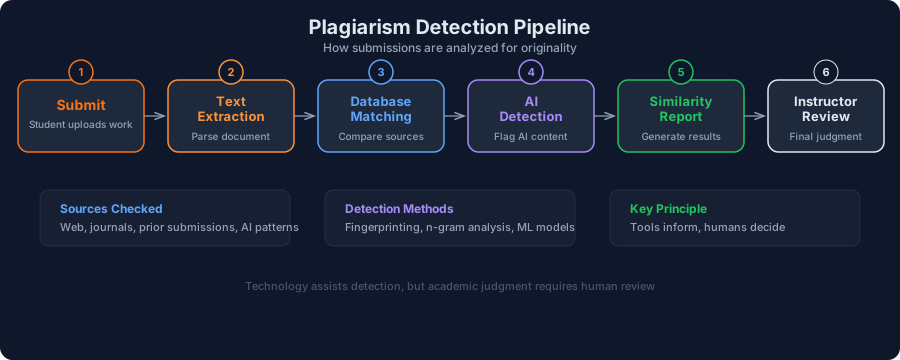
Plagiarism detection is the process of identifying content in student work that has been copied, paraphrased without attribution, or generated by someone (or something) other than the student. Modern plagiarism detection combines automated text-matching technology, AI-generated content analysis, and human expert review to assess the originality of submitted work.
It is important to distinguish between the tool and the judgment. Plagiarism detection software identifies textual similarities; it does not determine whether plagiarism has occurred. A high similarity score might indicate plagiarism, proper quotation with citation, common disciplinary language, or even the student's own previously submitted work. The determination of plagiarism requires human interpretation of the evidence.
Why Plagiarism Detection Matters
Plagiarism undermines the fundamental purpose of assessment: evaluating what a student has learned and can do. When submitted work is not genuinely the student's own, the grade becomes meaningless — it measures copying ability, not learning.
For educators, plagiarism detection:
- Protects the integrity of assessments and grades
- Identifies students who may need support with academic writing conventions
- Deters casual plagiarism through awareness of detection
- Provides evidence for academic integrity proceedings when necessary
For students, understanding plagiarism detection:
- Clarifies expectations about originality and attribution
- Encourages engagement with source material rather than surface copying
- Builds skills in synthesis, paraphrasing, and citation that transfer to professional work
- Protects the value of their honestly earned grades and credentials
For institutions, plagiarism detection:
- Maintains the credibility of degrees and transcripts
- Meets accreditation standards for academic integrity
- Reduces legal and reputational risk from degree fraud
Types of Plagiarism
Not all plagiarism is the same, and detection methods vary in their ability to catch each type.
Direct Plagiarism
Verbatim copying of text from a source without quotation marks or attribution. This is the easiest type for detection software to identify.
Mosaic Plagiarism (Patchwriting)
Borrowing phrases and ideas from multiple sources and stitching them together with minor word changes. More sophisticated than direct copying and harder for tools to catch, though modern algorithms detect paraphrase patterns effectively.
Self-Plagiarism
Submitting one's own previously graded work (or portions of it) for a new assignment without permission. While the work is original, it violates the expectation that each submission represents new effort and learning.
Contract Cheating
Hiring someone else — a friend, a tutor, or a commercial essay mill — to produce the work. This is extremely difficult for text-matching tools to detect because the work is technically original (it has never been submitted before). Detection often relies on stylistic analysis and knowledge-based verification.
AI-Generated Plagiarism
Using generative AI tools (like large language models) to produce part or all of a submission. This is the newest and fastest-growing form of academic dishonesty, and it presents unique challenges for traditional detection methods.
How Detection Tools Work
Text-Matching Technology
The most established approach, used by tools like Turnitin, iThenticate, and Copyscape. These systems compare submitted text against massive databases that include:
- Published academic literature (journals, books, conference proceedings)
- Web content (websites, blogs, open-access repositories)
- Previously submitted student papers (institutional databases)
The tool generates a similarity report showing the percentage of text that matches existing sources, with each match highlighted and linked to its source. Critically, a similarity score is not a plagiarism score — it reflects textual overlap, which may be entirely legitimate (quotations, common phrases, references, standardized methodology language).
AI-Generated Content Detection
A newer class of tools attempts to identify text produced by large language models. These detectors analyze statistical properties of text — perplexity (how predictable the word choices are), burstiness (variation in sentence complexity), and other linguistic patterns — to estimate the likelihood that content is human-written versus machine-generated.
Important limitations: AI detection tools have documented false positive rates, particularly for non-native English writers whose linguistic patterns may resemble AI-generated text. No current tool can definitively prove AI authorship, and the technology is in a constant arms race with improving AI models.
Stylometric Analysis
Advanced detection compares the writing style of a submission against a student's known writing profile. Changes in vocabulary complexity, sentence structure, and rhetorical patterns can flag potential ghostwriting or contract cheating. This method requires a baseline of authentic student work for comparison.
Limitations of Plagiarism Detection
Similarity Is Not Plagiarism
A 30% similarity score might indicate plagiarism, or it might indicate thorough citation practices, common technical terminology, or shared assignment language. Conversely, a 0% similarity score does not guarantee originality — contract cheating and AI-generated content may produce entirely "original" text that is not the student's work.
Cultural and Linguistic Bias
Students from collectivist educational traditions may have different norms around attribution and shared knowledge. Non-native English speakers may rely more heavily on source language and patchwriting as legitimate learning strategies. Detection tools do not account for these differences, and educators must apply cultural competence in interpretation.
Database Coverage Gaps
Text-matching tools can only match against content in their databases. Sources not indexed — books not digitized, content behind paywalls not included, work in other languages — will not trigger matches. This creates false negatives that may disproportionately affect certain disciplines or source types.
The AI Detection Arms Race
As AI-generated text becomes more sophisticated, detection tools face an increasingly difficult task. Paraphrasing tools, humanizer software, and prompt engineering techniques can reduce the detectability of AI-generated content. Relying solely on AI detection creates a fragile system that may not keep pace with advancing technology.
Pedagogical Approaches to Promoting Originality
The most effective defense against plagiarism is not better detection — it is better assignment design and teaching.
Design Plagiarism-Resistant Assignments
- Require personal reflection — Connect material to personal experience or unique case studies
- Use scaffolded submissions — Require outlines, drafts, and annotated bibliographies before the final paper
- Assign process documentation — Have students submit research logs showing their inquiry process
- Make assignments specific — Generic prompts invite generic (copied or AI-generated) responses
Teach Source Integration Skills
Many students plagiarize not from dishonesty but from a lack of understanding about proper paraphrasing, quotation, and citation. Explicit instruction in these skills — with practice and feedback — reduces unintentional plagiarism significantly.
Create a Culture of Integrity
Frame academic integrity as a professional value, not just a rule. When students understand that genuine engagement with material develops their thinking and career readiness, the motivation to plagiarize decreases. Constructive feedback that recognizes original thinking reinforces the value of authentic work.
How MarkInMinutes Promotes Originality
Evidence-Based Grading Inherently Promotes Original Work
MarkInMinutes approaches the plagiarism problem from a fundamentally different angle. Instead of running text-matching algorithms, the platform uses evidence-based grading — every score on every rubric dimension must be supported by direct citations and quotations from the student's actual work. This creates a grading system that inherently requires genuine engagement: a student who submits generic or copied content will receive scores that reflect the lack of original analysis, synthesis, and critical thinking in their evidence. The AI grader evaluates the quality and depth of ideas, not just the surface originality of text, making it a natural complement to traditional detection tools.
Related Concepts
Plagiarism detection is one component of a broader academic integrity framework. AI grading systems can complement detection by evaluating the depth and originality of thinking in student work. Evidence-based grading requires that scoring be supported by direct evidence from submissions, naturally incentivizing original engagement. Constructive feedback that highlights original thinking reinforces academic integrity values. And well-designed rubrics with clear criteria for original analysis set transparent expectations that reduce both the temptation and the opportunity for plagiarism.
Frequently Asked Questions
Are plagiarism detection tools accurate?
Text-matching tools are highly accurate at identifying verbatim and near-verbatim copying from indexed sources. However, they do not detect contract cheating, AI-generated content (unless paired with AI detectors), or plagiarism from sources not in their databases. AI-generated content detectors are less reliable, with documented false positive rates ranging from 5% to 20% depending on the tool and text characteristics.
Should I tell students I use plagiarism detection?
Yes. Transparency about detection is both ethically appropriate and pedagogically effective. Research shows that awareness of detection deters casual plagiarism. More importantly, explaining how the tools work helps students understand what constitutes proper attribution — which is a learning outcome in itself.
What should I do when detection flags a submission?
Never rely on a similarity score alone. Review the similarity report in detail: check whether flagged text is properly quoted and cited, assess the nature of the matches (common phrases vs. substantive copying), and consider the context. If concerns remain, have a conversation with the student before making accusations. Many apparent plagiarism cases turn out to be poor citation practices that can be remediated through instruction.
Sehen Sie diese Konzepte in Aktion
MarkInMinutes wendet diese Bewertungsprinzipien automatisch an. Laden Sie eine Abgabe hoch und erhalten Sie evidenzbasiertes Feedback in Minuten.
Verwandte Begriffe
Academic Integrity
Academic integrity is the commitment to honest, ethical behavior in all academic work — encompassing policies, cultural norms, and assessment practices that prevent misconduct and foster genuine learning.
AI Grading
AI grading uses artificial intelligence to evaluate student work, providing scores and feedback by analyzing submissions against defined criteria—often with human oversight to ensure fairness.
Constructive Feedback
Constructive feedback is specific, actionable commentary on student work that identifies strengths, pinpoints areas for improvement, and provides clear guidance on how to close the gap between current and desired performance.
Evidence-Based Grading
Evidence-based grading is an assessment approach where every score is justified by specific, observable evidence drawn directly from student work rather than subjective impressions.
Rubric
A rubric is a scoring guide that defines criteria and performance levels used to evaluate student work consistently and transparently.