Academic Integrity: Policies, Prevention, and Promotion in Education
Explore what academic integrity means, the types of academic misconduct, how institutions prevent dishonesty, and how assessment design and transparent grading promote a culture of integrity.
Academic integrity is the foundation on which the entire educational enterprise rests. When students submit work that is not genuinely their own, when data is fabricated, or when evaluation processes are compromised, the value of every degree and credential is diminished. Yet reducing academic integrity to "catching cheaters" misses the point. The most effective institutions do not just detect and punish misconduct — they design environments where honest work is the natural, supported, and rewarded path. This guide explores what academic integrity means, why violations occur, and how thoughtful assessment design can prevent dishonesty more effectively than surveillance alone.
What Is Academic Integrity?
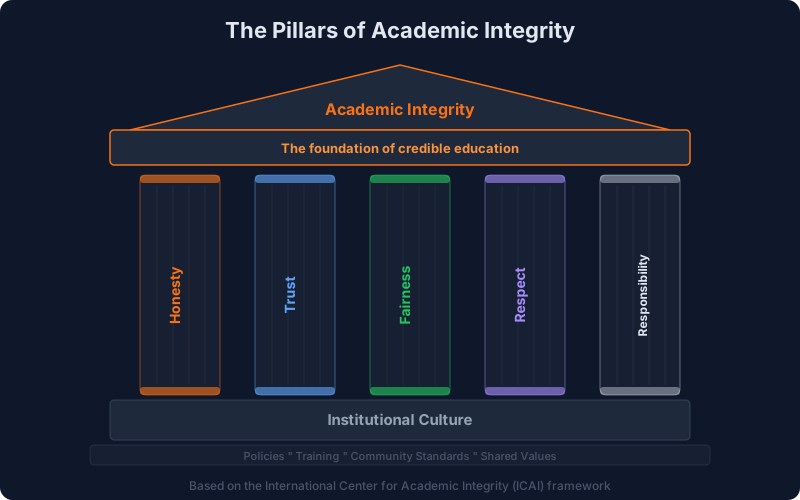
Academic integrity is the commitment to six fundamental values in all scholarly work: honesty, trust, fairness, respect, responsibility, and courage. These values, articulated by the International Center for Academic Integrity (ICAI), form the ethical foundation for teaching, learning, research, and assessment.
In practice, academic integrity means:
- Students submit work that is genuinely their own (or properly attribute collaboration)
- Researchers report data accurately and credit sources
- Instructors evaluate work fairly and consistently
- Institutions create and enforce clear policies while supporting ethical behavior
Academic integrity is not merely a set of rules; it is a culture. Institutions where integrity thrives are those where honesty is valued, expectations are transparent, and the assessment system itself discourages dishonesty by design.
Types of Academic Misconduct
Understanding the spectrum of violations helps institutions address root causes rather than just symptoms.
| Type | Description | Example |
|---|---|---|
| Plagiarism | Presenting someone else's words, ideas, or work as one's own without proper attribution | Copying paragraphs from a website without citation; paraphrasing a source without credit |
| Contract cheating | Outsourcing academic work to a third party (essay mills, tutors, peers) | Purchasing a completed essay from an online service |
| Unauthorized collaboration | Working with others when individual work is required | Sharing answers on a take-home exam designated as independent |
| Fabrication | Inventing data, sources, or citations | Creating fake experimental results; citing a source that does not exist |
| Falsification | Manipulating data, evidence, or records | Altering research data to support a hypothesis; changing a grade in a learning management system |
| Self-plagiarism | Resubmitting one's own previous work for a new assignment without permission | Submitting the same essay to two different courses |
| Exam misconduct | Using unauthorized materials, communication, or impersonation during exams | Using hidden notes during a closed-book exam; having someone else take a test |
| AI misuse | Using AI-generated content without authorization or attribution | Submitting an AI-written essay as one's own work in a course that prohibits AI assistance |
The rise of generative AI has added a complex new dimension to academic integrity. Institutions are still developing policies that distinguish between appropriate AI use (as a learning tool) and prohibited AI use (as a substitute for student thinking). Clear assessment design and explicit policies are more important than ever.
Why Students Violate Academic Integrity
Research identifies several drivers of academic dishonesty — and most are not about moral character:
- Perceived pressure: High-stakes grading systems where a single exam determines the course grade create enormous pressure to succeed by any means
- Unclear expectations: When students do not understand what constitutes plagiarism or improper collaboration, violations may be unintentional
- Opportunity: Poorly designed assessments that rely on easily Googleable answers or recycled questions make cheating easy
- Low perceived risk: If students believe enforcement is inconsistent or consequences are minor, the deterrent effect disappears
- Lack of engagement: Assignments that feel meaningless or disconnected from learning goals provide little intrinsic motivation to do honest work
- Cultural differences: International students may come from educational systems with different norms around collaboration, attribution, and text reuse
Understanding these drivers shifts the conversation from "how do we catch cheaters?" to "how do we design an environment where cheating is unnecessary and unappealing?"
Prevention Through Assessment Design
The most effective academic integrity strategy is not detection — it is prevention through thoughtful assessment design. When assessments are engaging, meaningful, and transparent, the motivation to cheat drops significantly.
Design Assessments That Are Hard to Fake
- Use authentic assessment: Tasks that require applying knowledge to unique, contextualized problems are much harder to outsource than generic essay prompts
- Require personal reflection: Asking students to connect course content to their own experiences or to reflect on their learning process produces unique responses
- Scaffold the process: Break large assignments into stages (topic proposal, annotated bibliography, draft, final submission) so that the instructor sees the work develop over time. It is very difficult to fake an iterative process.
- Rotate and customize prompts: Change assignment topics each semester and personalize where possible (e.g., "analyze a company you have worked for" rather than "analyze Apple's strategy")
Make Expectations Transparent
- Share rubrics in advance: When students know exactly what criteria will be used and what each proficiency level looks like, the perceived need to cheat decreases because expectations are no longer a mystery
- Define collaboration boundaries explicitly: For every assignment, state whether collaboration is encouraged, permitted with attribution, or prohibited
- Provide AI use policies: Specify whether AI tools may be used, and if so, how (e.g., "You may use AI for brainstorming but must write all submitted text yourself and cite any AI-assisted work")
- Discuss academic integrity as a learning topic: Integrate integrity conversations into the course rather than relegating them to a syllabus footnote
Reduce Pressure
- Distribute assessment across the semester: A single high-stakes exam incentivizes desperation. Multiple lower-stakes assessments reduce the consequences of any one poor performance
- Allow revision and resubmission: When students know they can improve their work based on constructive feedback, the pressure to be perfect on the first attempt (and to cheat to achieve it) decreases
- Use formative assessment: Low-stakes quizzes, check-ins, and peer reviews help students gauge their progress without the anxiety that drives dishonesty
Detection and Enforcement
While prevention should be the primary strategy, detection remains necessary. Effective approaches include:
- Plagiarism detection software: Tools like Turnitin compare submissions against databases of academic work, web content, and previously submitted papers. These tools are most effective when students know they will be used — the deterrent effect matters as much as the detection.
- AI detection tools: Emerging tools attempt to identify AI-generated text, though accuracy remains imperfect. They work best as a flag for further investigation, not as definitive proof.
- Process-based evidence: Requiring outlines, drafts, and revision histories makes it possible to verify that the student actually produced the work. Evidence-based grading approaches that require cited passages from student submissions create a natural audit trail.
- Oral defenses: Asking students to explain and discuss their submitted work in a brief interview is one of the most reliable — and hardest to defeat — integrity checks.
Fair Enforcement Principles
- Apply consequences consistently regardless of student status or performance history
- Distinguish between intentional misconduct and unintentional violations (especially for first-year students learning citation norms)
- Provide due process: students should have the opportunity to respond to allegations before consequences are imposed
- Focus sanctions on learning where possible — requiring a student to redo the assignment correctly may be more productive than a zero
Building a Culture of Integrity
Policies and detection tools are necessary but insufficient. Lasting academic integrity requires a culture where honesty is the norm, not just the rule.
- Model integrity as instructors: Cite sources in lectures, acknowledge when you do not know an answer, and be transparent about grading decisions
- Celebrate honest work: Recognize students who produce excellent original work, not just those who achieve high grades
- Engage students in developing norms: When students help create the class collaboration policy or discuss case studies about integrity dilemmas, they internalize the values rather than viewing them as externally imposed restrictions
- Connect integrity to professional identity: In every field, integrity matters. Helping students see academic honesty as practice for professional ethics makes it relevant rather than abstract
How MarkInMinutes Promotes Academic Integrity
MarkInMinutes supports academic integrity through two key design features. First, evidence-based grading requires the AI to cite specific passages from student submissions to justify every dimension score — creating a transparent link between the student's actual work and their evaluation. This makes it immediately visible when submitted work lacks the depth or originality expected. Second, transparent rubrics with clear Calibration Anchors at every proficiency level remove ambiguity about expectations. When students understand precisely what "Distinguished" performance looks like in each dimension, the perceived need to take shortcuts diminishes because the path to success is clear, specific, and achievable through genuine effort.
Related Concepts
Academic integrity intersects with several assessment and grading topics. Plagiarism detection is one of the most visible tools for enforcement. Evidence-based grading creates natural integrity safeguards by tying evaluations to specific student work. Constructive feedback reduces integrity violations by giving students the support to improve rather than the desperation to cheat. Well-designed rubrics make expectations transparent, and AI grading systems raise new questions about how technology intersects with academic honesty on both the student and institutional side.
Frequently Asked Questions
How should institutions handle AI-generated student work?
The most effective approach is a clear, course-level policy that specifies what AI use is permitted. Blanket bans are difficult to enforce and may not serve students well in fields where AI tools are professionally relevant. Instead, design assessments that require original thinking AI cannot replicate (personal reflection, application to unique contexts, oral defense) and require transparency about any AI assistance used.
What is the difference between academic integrity and academic honesty?
Academic honesty refers specifically to truthfulness — not lying, cheating, or plagiarizing. Academic integrity is a broader concept that encompasses honesty but also includes fairness, responsibility, respect, trust, and courage. An institution can have honest students but still lack integrity if its systems are unfair, opaque, or inconsistently enforced.
Does strict enforcement actually reduce cheating?
Research shows that enforcement alone has limited effectiveness. Students who perceive a high probability of being caught are somewhat less likely to cheat, but the strongest predictors of honest behavior are intrinsic motivation, clear expectations, engaging assessment design, and a campus culture that values integrity. The most effective institutions combine fair enforcement with proactive prevention through assessment design and cultural investment.
Sehen Sie diese Konzepte in Aktion
MarkInMinutes wendet diese Bewertungsprinzipien automatisch an. Laden Sie eine Abgabe hoch und erhalten Sie evidenzbasiertes Feedback in Minuten.
Verwandte Begriffe
AI Grading
AI grading uses artificial intelligence to evaluate student work, providing scores and feedback by analyzing submissions against defined criteria—often with human oversight to ensure fairness.
Constructive Feedback
Constructive feedback is specific, actionable commentary on student work that identifies strengths, pinpoints areas for improvement, and provides clear guidance on how to close the gap between current and desired performance.
Evidence-Based Grading
Evidence-based grading is an assessment approach where every score is justified by specific, observable evidence drawn directly from student work rather than subjective impressions.
Plagiarism Detection
Plagiarism detection is the process of identifying unoriginal or improperly attributed content in student work using text-matching algorithms, AI-generated content detectors, and manual review.
Rubric
A rubric is a scoring guide that defines criteria and performance levels used to evaluate student work consistently and transparently.