ECTS Grading System: How European Credit Grades Work
Understand the ECTS grading system, how European credits and grades work under the Bologna Process, and how ECTS grades convert to national scales.
ECTS grades are the common language of European higher education. Whether a student studies in Helsinki, Barcelona, or Berlin, the European Credit Transfer and Accumulation System provides a shared framework for expressing academic achievement and transferring credits. For educators working in or with European institutions, understanding ECTS is not optional — it is essential for fair grading and student mobility.
What Is the ECTS Grading System?
The ECTS (European Credit Transfer and Accumulation System) is a framework developed under the Bologna Process to standardize how academic workload and student achievement are measured across European higher education institutions. It has two interconnected components:
- ECTS Credits: Measure the volume of learning based on workload. One academic year equals 60 ECTS credits, with each credit representing approximately 25–30 hours of total student work (lectures, self-study, exams).
- ECTS Grades: Provide a standardized way to express student performance that supplements (but does not replace) local grading scales.
The system was introduced in 1989 as a pilot program and became the backbone of European credit transfer following the 1999 Bologna Declaration, which aimed to create a European Higher Education Area (EHEA) with compatible degree structures across 49 countries.
Why the ECTS Grading System Matters
ECTS matters because European higher education is inherently cross-border. Over 350,000 students participate in Erasmus+ exchanges each year, and millions more apply to institutions outside their home country. Without a common grading framework, a German "2.0" and a French "14/20" and an Italian "27/30" would be nearly impossible to compare fairly.
For universities, ECTS:
- Enables recognition of study periods completed abroad
- Supports joint and double degree programs across countries
- Provides a transparent basis for graduate admissions decisions
- Satisfies Bologna Process compliance requirements
For students, ECTS:
- Guarantees that credits earned at one institution are recognized at another
- Makes transcripts understandable across national borders
- Simplifies applications to international master's and doctoral programs
- Protects against unfair grade conversion during exchanges
How ECTS Grades Work
The ECTS Grade Scale
The ECTS grading scale uses letters A through F, with A through E as passing grades and F as failing:
| ECTS Grade | Definition | Performance Level |
|---|---|---|
| A | Excellent | Outstanding performance with only minor errors |
| B | Very Good | Above average, with some errors |
| C | Good | Generally sound work with notable errors |
| D | Satisfactory | Fair, with significant shortcomings |
| E | Sufficient | Performance meets minimum criteria |
| F | Fail | Considerable further work required |
Statistical vs. Absolute Interpretation
The original ECTS grading guidelines (pre-2009) defined grades statistically:
- A: Top 10% of passing students
- B: Next 25%
- C: Next 30%
- D: Next 25%
- E: Bottom 10% of passing students
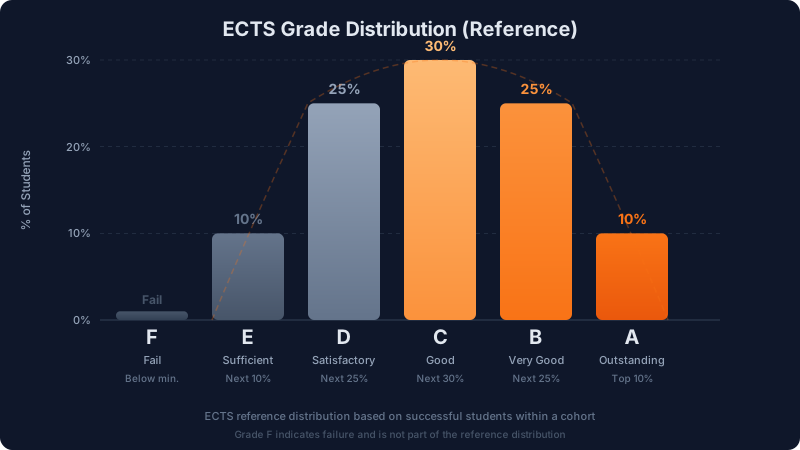
This statistical approach assumed a normal distribution and required large cohorts to function fairly. A class of 15 students could not reliably produce meaningful percentile bands.
The revised ECTS Users' Guide (2015) marked a significant departure from this statistical model. It explicitly recommends replacing the fixed A–E percentile bands with Grade Distribution Tables — institution-specific data showing what percentage of students actually received each local grade. The guide acknowledged that the original statistical scale could produce misleading comparisons across institutions with different grading cultures and cohort sizes.
In practice, the A–F letter scale is still widely used, but the definitions found in most university documentation are institutional adaptations rather than the strict statistical curve originally defined in 1989. This shift aligned ECTS more closely with criterion-referenced assessment principles and grade descriptors — qualitative descriptions of what each grade level represents — rather than relative ranking within a cohort.
ECTS Credits Explained
ECTS credits quantify the total learning effort required for a course or program component:
| Study Component | Typical ECTS Credits |
|---|---|
| One semester course | 5–10 ECTS |
| Bachelor's degree (3 years) | 180 ECTS |
| Master's degree (2 years) | 120 ECTS |
| One academic year | 60 ECTS |
| Bachelor's thesis | 10–15 ECTS |
Credits are awarded on an all-or-nothing basis: a student either earns the credits (by passing) or does not. There is no partial credit — this differs fundamentally from systems where course credits are weighted by grade.
ECTS in Practice
Converting National Grades to ECTS
Converting between national grading scales and ECTS grades is one of the most challenging tasks in academic administration. There is no single universal formula. Instead, institutions typically use one of these approaches:
Grade distribution tables: Each institution publishes how its local grades map to ECTS grades, based on the actual distribution of grades awarded. The standard German grading scale defines the following ranges:
| German Grade | Standard Definition | Typical ECTS Mapping |
|---|---|---|
| 1.0–1.5 | Sehr gut (Very Good) | A |
| 1.6–2.5 | Gut (Good) | B |
| 2.6–3.5 | Befriedigend (Satisfactory) | C–D |
| 3.6–4.0 | Ausreichend (Sufficient) | E |
| 4.1–5.0 | Nicht bestanden (Fail) | F |
Note that the mapping from German grades to ECTS letters varies by institution. Some universities publish finer-grained conversion tables that split "Gut" into an upper and lower band (e.g., 1.6–2.0 = B, 2.1–2.5 = C). These are institutional adaptations, not the standard German grade definitions themselves. Always consult the specific institution's published equivalency table rather than assuming a universal formula.
Grading tables on transcripts: The recommended best practice is for institutions to include their grade distribution alongside each student's transcript, allowing the receiving institution to interpret grades in the context of the awarding institution's grading culture.
Common Conversion Pitfalls
- Assuming linear equivalence: A "B" in the US does not automatically equal a "B" in ECTS.
- Ignoring institutional context: Grading strictness varies enormously, even within the same country.
- Applying one-size-fits-all formulas: The modified Bavarian formula (widely used in Germany) is only an approximation and may not be appropriate for all contexts.
- Forgetting that ECTS grades supplement, not replace: ECTS grades appear alongside local grades, not instead of them.
The Role of the Diploma Supplement
Every graduate in the EHEA receives a Diploma Supplement — a standardized document that accompanies their degree and explains the national higher education system, grading scale, and the student's achievements. This document is crucial for making ECTS grades interpretable across borders.
How MarkInMinutes Implements ECTS Grades
Automatic ECTS Grade Conversion
MarkInMinutes evaluates student work using a 5-level proficiency scale with 11 scoring notches, then automatically converts the resulting proficiency scores to ECTS grades (A through F) and German marks (1.0–5.0). This means instructors at European institutions get grades in the format their systems require while benefiting from the precision of criterion-referenced, evidence-based grading. The conversion is transparent and documented, so the rationale behind each ECTS grade can be traced back to specific performance criteria.
Related Concepts
The ECTS grading system exists within a broader ecosystem of assessment frameworks. Understanding different grading scales provides essential context for why ECTS was needed as a bridge between national systems. Grade descriptors supply the qualitative definitions behind each ECTS letter, while a proficiency scale defines observable performance levels that map to these grades. The move toward descriptor-based ECTS grading reflects a broader shift toward criterion-referenced assessment, where grades measure what students know rather than how they rank against peers.
Frequently Asked Questions
Are ECTS grades used everywhere in Europe?
ECTS credits are used universally across the 49 Bologna Process signatory countries. ECTS grades, however, are used less consistently. Many institutions report local grades alongside ECTS credit values and rely on grade distribution tables for cross-border comparison rather than formally assigning ECTS letter grades.
How many ECTS credits is a full-time semester?
A full-time semester is typically 30 ECTS credits, with a full academic year totaling 60 ECTS. Each credit represents approximately 25–30 hours of student workload, including lectures, independent study, assignments, and examinations.
Can I convert my GPA to an ECTS grade?
There is no official GPA-to-ECTS conversion formula because the systems measure different things (cumulative average vs. individual course performance). Some institutions publish their own equivalency guidelines, but these are approximations. For official recognition, contact the receiving institution's international admissions or credit transfer office directly.
See These Concepts in Action
MarkInMinutes applies these grading principles automatically. Upload a submission and get evidence-based feedback in minutes.
Related Terms
Criterion-Referenced Assessment
Criterion-referenced assessment measures student performance against predetermined standards and learning objectives rather than comparing students to each other.
Grade Descriptors
Grade descriptors are written statements that define the characteristics and qualities of student work at each performance level on a grading scale, providing a shared reference for what distinguishes one grade from another.
Grading Scale
A grading scale is a standardized system that translates student performance into scores, letters, or levels to communicate achievement consistently.
Proficiency Scale
A proficiency scale is a structured set of performance levels that describe increasing degrees of mastery, used to evaluate student competency rather than assign percentage scores.