Portfolio Assessment: Using Collections of Student Work for Deeper Evaluation
Discover what portfolio assessment is, its types (showcase, growth, evaluation), design principles for effective portfolios, rubric strategies, and how e-portfolios enhance learning evaluation.
A single exam captures what a student knows on one day, under one set of conditions, about one slice of a curriculum. A portfolio captures something richer: the arc of a student's learning over weeks, months, or years. It reveals not just what they can produce, but how they think, how they revise, and how they grow. For educators who believe that learning is a process rather than a performance, portfolio assessment is one of the most powerful evaluation tools available.
What Is Portfolio Assessment?
Portfolio assessment is an evaluation approach in which students collect, select, and reflect on multiple pieces of work produced over a defined period. Unlike single-point assessments (exams, papers, presentations), portfolios provide a longitudinal view of student learning that captures development, depth, and the ability to self-evaluate.
A portfolio is not simply a folder of assignments. Effective portfolio assessment requires intentional design: clear learning outcomes, structured selection criteria, reflective components, and well-defined evaluation rubrics. The portfolio becomes both a product (a curated collection) and a process (the act of selecting, reflecting, and presenting one's learning journey).
Why Portfolio Assessment Matters
Longitudinal View of Learning
Traditional assessments are snapshots. Portfolios are time-lapse documentaries. They reveal learning trajectories—showing where a student started, how they responded to feedback, and where they ended up. This longitudinal perspective is especially valuable for assessing complex competencies like writing, critical thinking, and professional development that develop gradually.
Student Agency and Metacognition
Portfolio assessment gives students ownership of their evaluation. When students select which artifacts to include and write reflections explaining their choices, they practice metacognition—thinking about their own thinking. Research consistently shows that metacognitive skills are among the strongest predictors of academic success and lifelong learning capacity.
Authentic and Inclusive Assessment
Portfolios accommodate diverse evidence of learning. A student who struggles with timed exams might demonstrate exceptional understanding through a research project, a creative piece, or a reflective essay. By accepting multiple forms of evidence, portfolio assessment is more inclusive and more closely aligned with authentic assessment principles.
Types of Portfolios
Different portfolio types serve different assessment purposes. Choosing the right type depends on whether the goal is celebration, growth tracking, or formal evaluation.
| Portfolio Type | Purpose | Contents | Audience |
|---|---|---|---|
| Showcase portfolio | Display best work | Student-selected exemplary artifacts | External (employers, admissions) |
| Growth portfolio | Document development | Early drafts, revisions, final versions | Student and instructor |
| Evaluation portfolio | Assess achievement | Required artifacts mapped to standards | Institution, accreditation body |
| Process portfolio | Capture learning journey | Work-in-progress, reflections, feedback logs | Student and instructor |
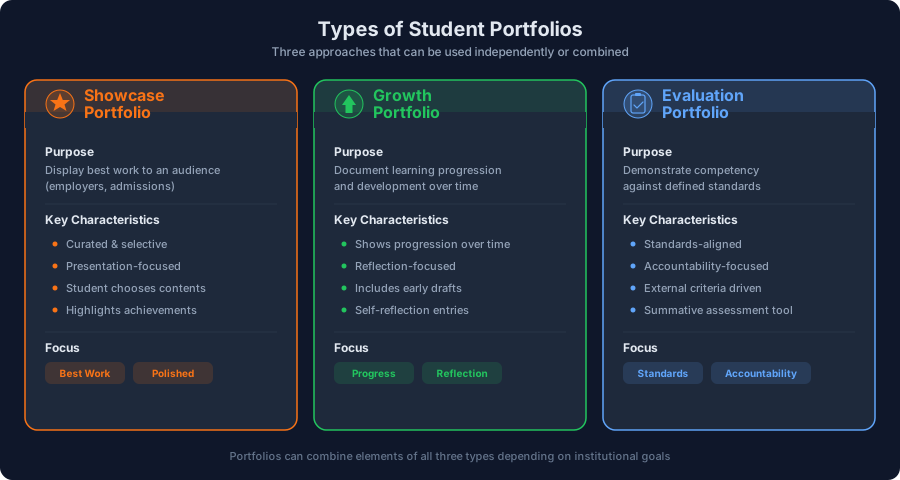
Showcase Portfolios
Students curate their strongest work to demonstrate competence to an external audience. Common in creative fields (art, design, writing), professional programs (teacher education, nursing), and career preparation courses. The emphasis is on quality over completeness.
Growth Portfolios
The most pedagogically powerful type. Growth portfolios include early attempts alongside revised and final versions, making the learning process visible. A growth portfolio might contain a rough first draft, instructor feedback, a peer review, and the polished final piece—documenting not just the product but the journey of improvement.
Evaluation Portfolios
Structured around specific learning outcomes or competency standards, evaluation portfolios require students to provide evidence that they have met each standard. These portfolios are commonly used in competency-based education programs and for accreditation purposes.
Designing Effective Portfolio Assessments
Define Purpose and Learning Outcomes
Every portfolio should be built around clearly defined learning outcomes. Students need to understand what the portfolio should demonstrate, how artifacts will be evaluated, and what constitutes sufficient evidence. Ambiguity in purpose leads to unfocused collections and frustrated students.
Specify Artifact Requirements
Balance structure with flexibility. A well-designed portfolio might require:
- 3–5 artifacts demonstrating specific competencies
- At least one artifact showing revision in response to feedback
- A reflective introduction explaining the portfolio's narrative
- An artifact of the student's choice (supports agency and personalization)
Build in Reflection
Reflection transforms a portfolio from a binder of assignments into a learning tool. Effective reflective prompts ask students to:
- Explain why they selected each artifact
- Identify what they learned from the process of creating it
- Connect artifacts to course learning outcomes
- Describe how they would approach similar tasks differently in the future
Design the Rubric
Portfolio rubrics must assess both individual artifacts and the portfolio as a whole. A strong portfolio rubric typically includes dimensions for:
- Quality of individual artifacts — Do selected pieces meet the expected standard?
- Range and completeness — Does the collection provide sufficient evidence across all outcomes?
- Reflection quality — Are reflections substantive, specific, and self-aware?
- Growth and development — Does the portfolio demonstrate learning over time?
- Organization and presentation — Is the portfolio coherent, professional, and navigable?
Digital and E-Portfolios
Digital portfolios (e-portfolios) have transformed portfolio assessment from a logistical challenge into a scalable practice. Platforms like Mahara, Digication, PebblePad, and even simple tools like Google Sites allow students to create multimedia portfolios that include documents, videos, audio recordings, images, and hyperlinks.
Advantages of E-Portfolios
- Multimedia evidence: Students can include video presentations, audio reflections, and interactive artifacts alongside traditional written work
- Accessibility: Portfolios are available anywhere, anytime, to authorized reviewers
- Longevity: Students can maintain and update portfolios beyond graduation
- Feedback integration: Instructors can comment directly on artifacts, and students can respond within the same platform
- Analytics: Digital platforms can track engagement, revision frequency, and completion rates
Challenges
- Technology barriers: Not all students have equal digital literacy or access
- Platform dependency: Institutional platform changes can disrupt portfolio continuity
- Assessment workload: Rich multimedia portfolios take longer to review than traditional assignments
- Privacy: Student work shared digitally requires careful attention to consent and data protection
Portfolio Assessment in Practice
Consider a teacher education program using evaluation portfolios across a four-year degree. Students build their portfolio progressively, adding artifacts that demonstrate competence against professional teaching standards:
- Year 1: Lesson plan drafts, classroom observation reflections, philosophy of education statement
- Year 2: Teaching videos (microteaching), revised lesson plans incorporating feedback, self-assessment against standards
- Year 3: Practicum evidence (supervisor evaluations, student work samples, differentiated instruction plans)
- Year 4: Capstone teaching portfolio with curated artifacts, comprehensive reflection, and professional development plan
Each artifact is evaluated individually using dimension-specific rubrics, while the overall portfolio is assessed holistically for coherence, growth, and standards coverage.
How MarkInMinutes Supports Portfolio Assessment
Dimension-Level Rubric Scoring for Portfolio Artifacts
MarkInMinutes enhances portfolio assessment through its multidimensional rubric evaluation system. Each portfolio artifact can be assessed individually against specific rubric dimensions, with evidence citations drawn directly from the student's work. This creates a transparent, auditable record of how each piece of evidence maps to each evaluation criterion. When applied across multiple artifacts in a portfolio, the result is a detailed picture of student growth—dimension by dimension—that goes far beyond a single holistic score. The structured feedback generated for each artifact also serves as built-in formative guidance, helping students understand exactly where their work meets the standard and where it falls short.
Related Concepts
Portfolio assessment connects naturally to several other assessment approaches. Authentic assessment shares the emphasis on real-world, complex tasks over artificial test conditions. Well-designed rubrics are essential for evaluating portfolios consistently across multiple artifacts and students. The distinction between formative and summative assessment is embedded in portfolio design—growth portfolios are inherently formative, while evaluation portfolios serve summative purposes. Self-assessment is a core component of portfolio reflection, building the metacognitive skills that make portfolios pedagogically powerful. And all portfolio artifacts should connect back to clearly defined learning outcomes to ensure the collection tells a coherent story of achievement.
Frequently Asked Questions
How do you grade a portfolio fairly?
Use a multi-level rubric that evaluates both individual artifacts and the portfolio as a whole. Establish clear criteria before students begin, provide exemplar portfolios from previous cohorts (with permission), and consider using a calibration process among multiple assessors. The combination of artifact-level and portfolio-level scoring prevents any single piece from disproportionately influencing the overall grade.
Are portfolios suitable for large classes?
Yes, with design modifications. For large classes, limit the number of required artifacts (3–5 rather than 10+), use structured templates to standardize format, and consider peer review for formative feedback stages. E-portfolio platforms also reduce the logistical burden of collecting, storing, and returning physical work.
What is the difference between a portfolio and a collection of assignments?
Intentionality. A collection of assignments is everything a student has submitted. A portfolio is a curated selection with a narrative arc, reflective commentary, and explicit connections to learning outcomes. The selection and reflection processes are what transform a stack of papers into a meaningful assessment of learning.
See These Concepts in Action
MarkInMinutes applies these grading principles automatically. Upload a submission and get evidence-based feedback in minutes.
Related Terms
Authentic Assessment
Authentic assessment evaluates students through real-world tasks that require applying knowledge and skills in meaningful, complex contexts — moving beyond recall to demonstrate genuine understanding.
Formative vs Summative Assessment
Formative assessment monitors student learning during instruction to provide ongoing feedback, while summative assessment evaluates achievement at the end of a learning period.
Learning Outcomes
Learning outcomes are specific, measurable statements describing what students should know, be able to do, or value by the end of a course, module, or program.
Self-Assessment
Self-assessment is the process by which students evaluate their own work against defined criteria, developing metacognitive awareness, self-regulation skills, and ownership of their learning.
Rubric
A rubric is a scoring guide that defines criteria and performance levels used to evaluate student work consistently and transparently.