Bloom's Taxonomy: A Complete Guide for Educators and Assessment Design
Master Bloom's Taxonomy and its six cognitive levels — from Remember to Create. Learn how to use it for assessment design, rubric writing, and learning objectives.
Bloom's Taxonomy is arguably the most influential framework in educational assessment design. Originally published in 1956 and revised in 2001, it provides educators with a structured way to think about what students should know, how deeply they should understand it, and how to design assessments that measure the right cognitive skills. If you have ever written a learning objective or chosen action verbs for an exam question, you have used Bloom's Taxonomy — whether you realized it or not.
What Is Bloom's Taxonomy?
Bloom's Taxonomy is a hierarchical classification of cognitive skills arranged from the simplest (remembering facts) to the most complex (creating original work). Developed by educational psychologist Benjamin Bloom and a committee of colleagues, the original framework defined six levels of cognitive complexity in the domain of knowledge.
The revised taxonomy (Anderson and Krathwohl, 2001) updated the original framework with two key changes: it renamed the levels using verb forms (to emphasize that cognition is an active process) and swapped the top two levels, placing "Create" above "Evaluate."
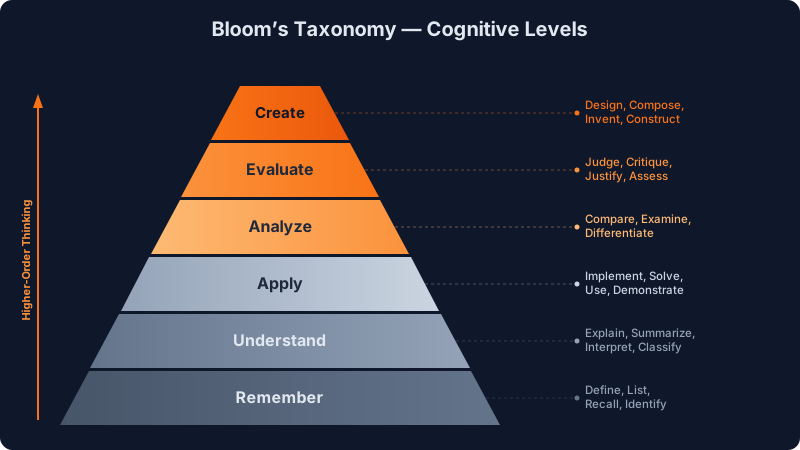
The six levels, from lowest to highest cognitive demand:
- Remember — Retrieve relevant knowledge from long-term memory
- Understand — Construct meaning from instructional messages
- Apply — Carry out or use a procedure in a given situation
- Analyze — Break material into parts, determine relationships
- Evaluate — Make judgments based on criteria and standards
- Create — Put elements together to form a coherent or functional whole
Each level builds on the ones below it. A student who can analyze an argument must first remember the content, understand its meaning, and know how to apply relevant frameworks.
Why Bloom's Taxonomy Matters
Bloom's Taxonomy matters because it prevents one of the most common assessment mistakes: testing students only at the lowest cognitive levels. A multiple-choice exam that asks students to recall definitions tests "Remember" — but if the course objectives require students to evaluate competing theories, that exam is misaligned.
For educators, Bloom's Taxonomy:
- Provides a shared vocabulary for discussing learning expectations
- Guides the writing of measurable learning objectives
- Ensures assessment alignment between what is taught and what is tested
- Supports the design of grading criteria that target appropriate cognitive levels
- Helps build rubrics with clear performance distinctions
For students, Bloom's Taxonomy:
- Clarifies what depth of understanding is expected
- Helps prioritize study strategies (memorization vs. analysis vs. synthesis)
- Makes assessment expectations transparent and predictable
The Six Cognitive Levels in Detail
Remember
Retrieving, recognizing, and recalling relevant knowledge from long-term memory.
Action verbs: Define, list, recall, identify, name, recognize, state, match
Assessment examples: Multiple-choice factual questions, fill-in-the-blank, labeling diagrams, vocabulary matching
Understand
Constructing meaning from oral, written, and graphic messages through interpreting, classifying, summarizing, comparing, and explaining.
Action verbs: Explain, summarize, paraphrase, classify, compare, describe, discuss, interpret
Assessment examples: "Explain the concept of X in your own words," summarize an article, compare two approaches
Apply
Carrying out or using a procedure in a familiar or new situation.
Action verbs: Apply, demonstrate, solve, use, implement, execute, calculate, illustrate
Assessment examples: Solve a problem using a formula, apply a framework to a case study, implement an algorithm
Analyze
Breaking material into constituent parts and determining how parts relate to one another and to an overall structure or purpose.
Action verbs: Analyze, differentiate, distinguish, examine, deconstruct, organize, compare, contrast
Assessment examples: Analyze a data set for patterns, compare theoretical frameworks, deconstruct an argument's logic
Evaluate
Making judgments based on criteria and standards through checking and critiquing.
Action verbs: Evaluate, assess, critique, judge, justify, defend, argue, prioritize
Assessment examples: Peer review, critique a research methodology, defend a thesis position, evaluate the quality of evidence
Create
Putting elements together to form a coherent or functional whole; reorganizing elements into a new pattern or structure.
Action verbs: Design, construct, develop, formulate, compose, produce, propose, synthesize
Assessment examples: Write an original research paper, design an experiment, create a business plan, compose a policy proposal
Bloom's Taxonomy in Practice
Writing Learning Objectives with Bloom's
Every well-written learning objective contains three elements: a condition, an action verb (from Bloom's), and a criterion. The action verb determines the cognitive level being targeted.
| Weak Objective | Improved Objective (with Bloom's verb) | Level |
|---|---|---|
| "Students will know about cell division" | "Students will explain the stages of mitosis and their significance" | Understand |
| "Learn about marketing strategies" | "Students will evaluate the effectiveness of three digital marketing strategies using ROI data" | Evaluate |
| "Understand research methods" | "Students will design a research methodology appropriate for a given social science question" | Create |
Aligning Assessments to Bloom's Levels
A common pitfall is designing course objectives at higher Bloom's levels but assessing at lower ones. If your objective says students should "analyze," your assessment must require analysis — not just recall.
| If Your Objective Targets... | Your Assessment Should Require... |
|---|---|
| Remember/Understand | Quizzes, definitions, short answer |
| Apply/Analyze | Case studies, problem sets, lab reports |
| Evaluate/Create | Research papers, portfolios, project-based work |
This alignment between objectives and assessments is the core principle of assessment alignment.
Using Bloom's to Design Rubric Criteria
Bloom's verbs provide a natural foundation for writing rubric grading criteria. A proficiency scale can mirror cognitive progression — lower levels for applying knowledge correctly, higher levels for synthesizing and creating original insights.
For example, a research paper rubric might define its "Analysis" dimension as:
- Distinguished: Synthesizes multiple theoretical frameworks to construct an original argument
- Proficient: Analyzes evidence using an appropriate framework with clear reasoning
- Developing: Describes evidence but analysis remains superficial
- Novice: Lists evidence without meaningful analysis
See Rubric Design Guidelines for a complete framework.
How MarkInMinutes Implements Bloom's Taxonomy
Cognitive Progression Built Into Every Grading Profile
MarkInMinutes embeds Bloom's cognitive hierarchy directly into its proficiency scale. The platform's cognitive progression — from Compliance (following instructions) through Integration (connecting ideas) to Synthesis (generating original insight) — maps to Bloom's higher-order levels (Apply, Analyze, Evaluate, Create). Calibration anchors for each proficiency level use Bloom's action verbs to define what performance looks like, ensuring that grading criteria target the right depth of thinking. This means every grading profile is inherently aligned with sound pedagogical principles.
Related Concepts
Bloom's Taxonomy intersects with nearly every aspect of assessment design. Well-defined grading criteria should specify which Bloom's level they target. Rubric design guidelines use Bloom's verbs to write clear performance descriptors. Assessment alignment is fundamentally about matching the Bloom's level of your learning objectives to the Bloom's level of your assessments. A well-constructed proficiency scale often mirrors Bloom's cognitive hierarchy, with lower levels capturing basic recall and application, and higher levels requiring evaluation and creation. The choice between analytic and holistic rubrics can also depend on whether you need to assess multiple Bloom's levels independently.
Frequently Asked Questions
Is Bloom's Taxonomy a strict hierarchy?
The revised taxonomy (2001) acknowledges that cognitive processes are not always strictly sequential. A student might create something novel (Create) that requires application but not deep evaluation. However, in most educational contexts, the hierarchy holds as a useful approximation: higher levels generally presume competence at lower levels.
How many Bloom's levels should an assignment target?
Most well-designed assignments target two to four Bloom's levels. An introductory course might focus on Remember through Apply, while an advanced seminar should target Analyze through Create. The key is matching the levels to your stated learning objectives — not trying to hit all six in every assignment.
Can Bloom's Taxonomy be used for non-cognitive skills?
The original taxonomy included three domains: cognitive (knowledge), affective (attitudes and values), and psychomotor (physical skills). The six-level framework most educators use applies specifically to the cognitive domain. Separate taxonomies exist for affective and psychomotor learning, though they are less widely adopted.
Sehen Sie diese Konzepte in Aktion
MarkInMinutes wendet diese Bewertungsprinzipien automatisch an. Laden Sie eine Abgabe hoch und erhalten Sie evidenzbasiertes Feedback in Minuten.
Verwandte Begriffe
Analytic vs Holistic Rubric
Analytic rubrics score each criterion separately for detailed feedback, while holistic rubrics assign a single overall score based on the total impression of student work.
Assessment Alignment
Assessment alignment is the degree to which assessments accurately measure the learning objectives they are intended to evaluate, ensuring coherence between what is taught and what is tested.
Grading Criteria
Grading criteria are the specific standards and expectations used to evaluate student work, defining what quality looks like at each performance level.
Proficiency Scale
A proficiency scale is a structured set of performance levels that describe increasing degrees of mastery, used to evaluate student competency rather than assign percentage scores.
Rubric Design Guidelines
Rubric design guidelines are evidence-based best practices for creating assessment rubrics that are clear, fair, aligned with learning outcomes, and practical to use.