What Is a Rubric? The Complete Guide to Assessment Rubrics
Learn what a rubric is, explore the main types (analytic, holistic, single-point), and discover how rubrics improve grading consistency, transparency, and student learning.
Rubrics are one of the most widely used assessment tools in education, yet many educators still rely on vague marking schemes that leave students guessing about expectations. A well-designed rubric transforms grading from a subjective judgment call into a structured, transparent process that benefits both the person doing the grading and the person receiving the grade.
What Is a Rubric?
A rubric is a scoring guide that articulates the expectations for an assignment by listing the grading criteria, defining quality levels for each criterion, and providing descriptive indicators of what performance looks like at each level. Rubrics create a shared language between instructors and students about what "excellent," "proficient," or "needs improvement" actually means in context.
At its core, every rubric answers three questions:
- What is being evaluated? (the criteria or dimensions)
- How well must it be done? (the performance levels)
- What does each level look like? (the descriptors or anchors)
Rubrics are used across all education levels — from elementary school writing assignments to doctoral dissertation defenses — and across disciplines including STEM, humanities, arts, and professional programs.
Why Rubrics Matter
Rubrics matter because grading without clear criteria is inherently inconsistent. Research consistently shows that when multiple instructors grade the same paper without a rubric, scores can vary by a full letter grade or more. This inconsistency — known as poor inter-rater reliability — undermines the credibility of assessment.
For educators, rubrics:
- Reduce grading time by providing a decision framework
- Improve consistency across multiple graders or sections
- Make grade justifications easier during student appeals
- Align assessment with learning objectives (assessment alignment)
For students, rubrics:
- Clarify expectations before they begin working
- Enable meaningful self-assessment and peer review
- Provide specific, actionable feedback rather than a bare score
- Reduce anxiety about "what the professor wants"
Types of Rubrics
There are three primary rubric formats, each suited to different assessment contexts.
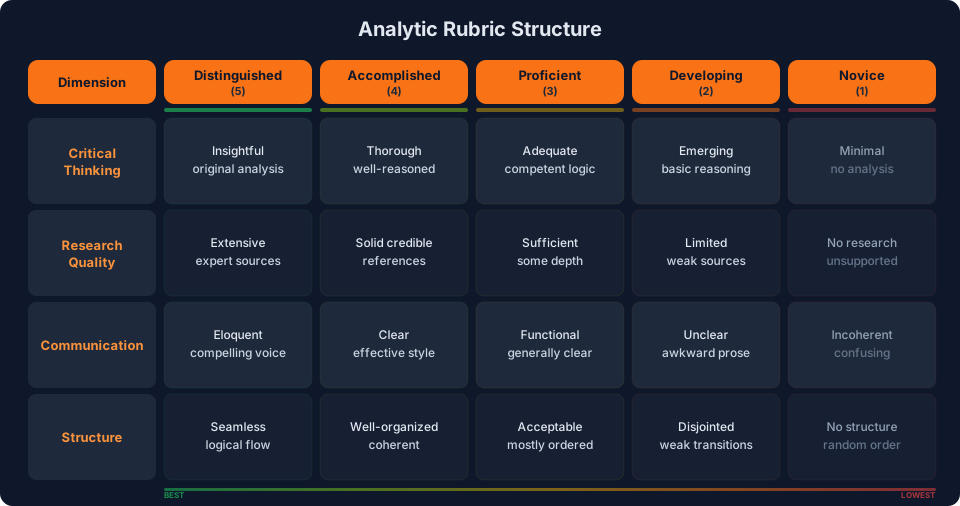
Analytic Rubrics
An analytic rubric breaks the assessment into separate dimensions (criteria) and scores each one independently. For example, a writing rubric might evaluate "Thesis," "Evidence," "Organization," and "Mechanics" as four separate dimensions, each with its own proficiency scale.
| Dimension | Excellent (4) | Proficient (3) | Developing (2) | Beginning (1) |
|---|---|---|---|---|
| Thesis | Clear, arguable, specific | Clear and arguable | Vague or too broad | Missing or unclear |
| Evidence | Multiple credible sources, integrated smoothly | Adequate sources, mostly integrated | Few sources, poorly integrated | No supporting evidence |
| Organization | Logical flow, effective transitions | Generally logical, some transitions | Choppy or unclear structure | No discernible structure |
Best for: Assignments where you want detailed, dimension-specific feedback. Ideal for formative assessment and coaching.
Holistic Rubrics
A holistic rubric assigns a single score based on the overall quality of the work. Instead of scoring individual criteria separately, the grader reads the complete work and matches it to a level description.
Best for: Large-volume grading where speed matters, or creative assignments where components are deeply intertwined. Common in standardized testing.
Single-Point Rubrics
A single-point rubric describes only the proficient-level criteria in the center column, with open space on either side for the instructor to note what exceeds or falls below expectations.
Best for: Encouraging descriptive feedback rather than checkbox grading. Especially useful when you want students to focus on the target standard rather than gaming a points system.
For a detailed comparison, see Analytic vs Holistic Rubric.
Rubrics in Practice
Building a Rubric From Scratch
Creating an effective rubric involves several deliberate steps:
- Identify the learning objectives — What should students demonstrate? Align criteria with Bloom's Taxonomy levels where possible.
- Define 3–6 dimensions — Too few dimensions oversimplify; too many create grading fatigue. Focus on the aspects that matter most for learning.
- Choose a grading scale — Decide how many levels (typically 3–5) and label them clearly.
- Write descriptors — Describe observable, measurable behaviors at each level. Avoid vague words like "good" or "adequate" without context.
- Assign weights — Not all dimensions are equally important. A research paper might weight "Analysis" at 40% and "Formatting" at 10%.
- Pilot and calibrate — Test the rubric on sample work and calibrate with co-graders to ensure consistent interpretation.
For comprehensive best practices, see our Rubric Design Guidelines.
Common Rubric Mistakes
- Vague descriptors: "Good analysis" tells students nothing. Specify what "good" looks like.
- Too many levels: Seven or more levels make distinctions nearly impossible to apply consistently.
- Missing anchor examples: Without sample work at each level, graders interpret descriptors differently.
- Ignoring alignment: If the rubric criteria don't match the assignment prompt and learning objectives, the rubric grades the wrong things.
How MarkInMinutes Implements Rubrics
Rubrics at the Core of MarkInMinutes
Every grading profile in MarkInMinutes is fundamentally a rubric — built with clearly defined dimensions, weighted criteria, and calibration anchors at each proficiency level. When you create or generate a grading profile, you are designing an analytic rubric with a 5-level proficiency scale (Novice through Distinguished) and up to 11 scoring notches for granular differentiation. Each dimension includes Key Indicators and Calibration Anchors that serve as the descriptors a traditional rubric requires, ensuring consistent, evidence-based grading across every submission. This means you get the rigor of a research-grade analytic rubric without spending hours building one from scratch.
Related Concepts
Rubrics connect to nearly every major assessment concept. Grading criteria are the building blocks of any rubric — the specific dimensions you choose to evaluate. The choice between analytic and holistic rubric formats determines how detailed your feedback will be. Effective rubrics rely on a well-defined proficiency scale and thoughtful grade weighting to ensure each dimension contributes appropriately to the final score. For step-by-step guidance on constructing rubrics, explore our rubric design guidelines.
Further Reading
For a complete walkthrough of building rubrics from scratch — including choosing dimensions, writing level descriptors, assigning weights, and piloting — see How to Create a Rubric: Step-by-Step Guide with Examples.
Frequently Asked Questions
What is the difference between a rubric and a marking scheme?
A marking scheme typically lists correct answers or point allocations, while a rubric describes quality levels across multiple criteria. Rubrics are more descriptive and guide judgment, making them especially valuable for open-ended assignments like essays, projects, and presentations where there is no single correct answer.
How many criteria should a rubric have?
Most effective rubrics contain between three and six criteria (dimensions). Fewer than three may oversimplify the assessment, while more than six can create cognitive overload for both graders and students. Focus on the criteria that most directly align with your learning objectives.
Can rubrics be used for formative assessment?
Absolutely. While rubrics are often associated with summative assessment, they are equally powerful as formative tools. Sharing the rubric before an assignment helps students self-assess drafts, and using it during peer review teaches students to evaluate quality against defined standards rather than personal opinion.
Sehen Sie diese Konzepte in Aktion
MarkInMinutes wendet diese Bewertungsprinzipien automatisch an. Laden Sie eine Abgabe hoch und erhalten Sie evidenzbasiertes Feedback in Minuten.
Verwandte Begriffe
Analytic vs Holistic Rubric
Analytic rubrics score each criterion separately for detailed feedback, while holistic rubrics assign a single overall score based on the total impression of student work.
Grade Weighting
Grade weighting assigns different levels of importance to assessment components or rubric dimensions, so that higher-priority elements have a greater impact on the final grade.
Grading Criteria
Grading criteria are the specific standards and expectations used to evaluate student work, defining what quality looks like at each performance level.
Proficiency Scale
A proficiency scale is a structured set of performance levels that describe increasing degrees of mastery, used to evaluate student competency rather than assign percentage scores.
Rubric Design Guidelines
Rubric design guidelines are evidence-based best practices for creating assessment rubrics that are clear, fair, aligned with learning outcomes, and practical to use.