Constructive Feedback in Education: Strategies That Actually Improve Student Work
Discover constructive feedback strategies for education, including proven frameworks, actionable techniques, and timing best practices that drive real student improvement.
Constructive feedback is the bridge between assessment and learning. While grades tell students where they stand, constructive feedback tells them how to move forward. For educators at every level, mastering the art and science of feedback is one of the highest-leverage skills they can develop—research consistently ranks quality feedback among the top influences on student achievement.
What Is Constructive Feedback?
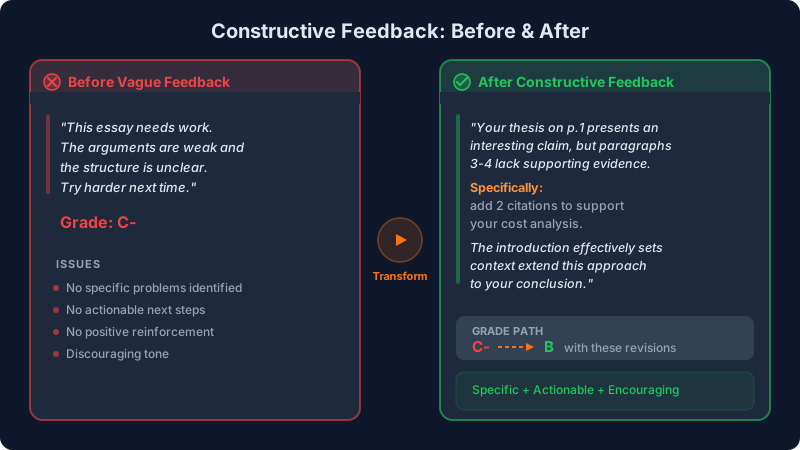
Constructive feedback is specific, evidence-based commentary on student work that serves three purposes: it acknowledges what the student did well, identifies areas that need improvement, and provides concrete guidance on how to improve. Unlike generic praise ("Good job!") or vague criticism ("Needs more work"), constructive feedback references specific elements of the student's submission and connects them to defined expectations.
Constructive feedback differs from destructive feedback in both content and effect. Destructive feedback focuses on the person rather than the work, uses vague language, lacks actionable suggestions, and often leaves students feeling helpless rather than motivated. Constructive feedback, by contrast, is work-focused, specific, actionable, and respectful.
| Destructive Feedback | Constructive Feedback |
|---|---|
| "This is poorly written." | "The argument in paragraph 3 would be stronger if you connected your evidence to your thesis statement. For example, after citing the Smith study, add a sentence explaining how it supports your main claim." |
| "You clearly didn't understand the material." | "Your definition of osmosis on page 2 conflates it with diffusion. Review section 4.2 of the textbook for the key distinction, then revise your explanation." |
| "Not enough effort." | "Your analysis covers two of the four required perspectives. Adding the economic and ethical perspectives with at least one supporting source each would strengthen your argument significantly." |
Why Constructive Feedback Matters
Closing the Performance Gap
Assessment without feedback is a mirror that shows students where they are but offers no path forward. Constructive feedback turns assessment into a learning tool by explicitly mapping the gap between current performance and the target described in the rubric or proficiency scale.
Building Student Self-Regulation
When students receive consistent, specific feedback, they begin to internalize the evaluation criteria and apply them independently. Over time, this builds metacognitive skills—students learn to ask themselves the same questions their instructor would ask of their work.
Supporting Formative Assessment Goals
Constructive feedback is the engine of formative assessment. While summative assessment measures achievement at a point in time, formative assessment with constructive feedback guides ongoing improvement throughout the learning process.
Proven Feedback Frameworks
Several established frameworks help educators structure constructive feedback effectively.
SBI (Situation-Behavior-Impact)
Originally developed for workplace feedback, SBI translates well to education:
- Situation: Identify the specific context ("In your methodology section...")
- Behavior: Describe the observable action ("...you described your sample selection process without mentioning inclusion or exclusion criteria...")
- Impact: Explain the effect ("...which makes it difficult for the reader to evaluate whether your sample is representative.")
Medal and Mission
This approach pairs recognition with forward direction:
- Medal: What the student did well (with specific evidence)
- Mission: One clear, actionable next step for improvement
The simplicity of medal-and-mission makes it particularly effective for younger students or for time-constrained feedback situations.
Rubric-Referenced Feedback
This approach anchors feedback directly to the grading criteria in the rubric. For each dimension, the instructor:
- States the performance level achieved
- Cites evidence from the work that placed it at that level
- Describes what would be needed to reach the next level
This method is especially powerful because it connects feedback to the same criteria students received before the assignment, creating a coherent assessment cycle.
Actionable Feedback Techniques
Beyond frameworks, several practical techniques make feedback more effective.
Be Specific and Reference Evidence
Vague feedback is effectively useless. Every feedback comment should reference a specific part of the student's work. This aligns with evidence-based grading principles—feedback grounded in observable evidence is both more credible and more useful.
Prioritize—Don't Overwhelm
Research shows that students can meaningfully act on 2-3 pieces of feedback per assignment. Identifying every issue in a submission may feel thorough, but it overwhelms students and dilutes impact. Focus on the highest-leverage improvements.
Use Before/After Examples
Showing students a concrete example of how to improve a specific passage is dramatically more effective than describing the improvement abstractly. A before/after comparison makes the path forward visible and actionable.
Balance Strengths and Improvements
Feedback that only identifies problems signals to students that nothing they did was right, even when much of their work is strong. Starting with a genuine, specific strength builds receptivity for the improvement suggestions that follow.
Make Feedback Forward-Looking
The most useful feedback focuses on what to do next, not just what went wrong. Phrases like "In your next draft..." or "For the final submission, consider..." orient students toward improvement rather than dwelling on shortcomings.
The Feedback Quality Spectrum
Click each level to see the difference between feedback that helps and feedback that doesn't.
Before/After Feedback Examples by Subject
Humanities (Essay)
| Before (Vague) | After (Constructive) |
|---|---|
| "Your thesis is weak." | "Your thesis on page 1 ('Social media has changed communication') states a fact rather than making an arguable claim. Try reframing it as a position: 'Social media has fundamentally weakened the depth of interpersonal communication by prioritizing brevity over substance.' This gives you something to defend." |
| "Needs more analysis." | "In paragraph 4, you quote the Johnson (2024) study but move immediately to the next point. Add 2–3 sentences explaining how Johnson's findings support your argument about declining attention spans. What does this evidence mean for your thesis?" |
STEM (Lab Report)
| Before (Vague) | After (Constructive) |
|---|---|
| "Your methodology section is incomplete." | "Your methodology describes the apparatus and procedure but does not mention your sample size (how many trials?), control variables, or how you addressed potential sources of error. Adding these three elements would allow another researcher to replicate your experiment." |
| "Check your calculations." | "Your velocity calculation on page 3 uses distance/time² instead of distance/time. This propagated through Table 2 and Figure 1. Recalculate from equation (2) with v = d/t and your results should align with the expected range of 3.2–3.8 m/s." |
Business (Case Study)
| Before (Vague) | After (Constructive) |
|---|---|
| "Your recommendation isn't convincing." | "Your recommendation to expand into the European market is supported by revenue potential, but you haven't addressed the regulatory barriers (GDPR compliance, local employment law) or the competitor landscape in your target countries. Adding a risk analysis section with mitigation strategies would significantly strengthen your argument." |
Creative Work (Presentation)
| Before (Vague) | After (Constructive) |
|---|---|
| "Too much text on slides." | "Slides 4, 7, and 9 each contain 80+ words. Audiences read slides faster than presenters speak, which means they stop listening while reading. Try the 6×6 rule: no more than 6 bullet points per slide, no more than 6 words per bullet. Move the detailed data to a handout or appendix slide." |
Feedback Sentence Starters
When writing feedback, these sentence templates help ensure specificity and actionability:
Acknowledging strengths:
- "Your strongest element is [specific aspect] because [evidence from their work]..."
- "The way you [specific action, e.g., 'connected the Smith study to your hypothesis'] demonstrates [skill]..."
- "Your [dimension, e.g., 'evidence integration'] is at the Accomplished level because [evidence]..."
Identifying improvements:
- "In [specific location], your [element] would be strengthened by [specific action]..."
- "The gap between your current work and the next level is [specific description]. To close it, try [action]..."
- "One area where you could push further is [dimension]. Right now, [what you see]. At the next level, [what it would look like]..."
Forward-looking guidance:
- "For your revision, prioritize [specific change] — it will have the largest impact on [dimension]..."
- "In your next assignment, consider [strategy] to build on the strength you showed in [area]..."
- "The single most impactful change you could make is [action], because [reason]..."
Timing and Delivery
When to Give Feedback
Feedback delivered within days of submission is dramatically more effective than feedback returned weeks later. Students need to still remember their thinking process and decision-making to contextualize the feedback they receive.
Written vs. Verbal
Written feedback creates a permanent reference students can revisit. Verbal feedback (in conferences or office hours) allows for dialogue and clarification. The most effective approach often combines both: written feedback on the submission plus an optional follow-up conversation.
Feedback on Drafts vs. Final Submissions
Feedback on drafts (formative feedback) has the highest impact because students can immediately apply it. Feedback on final submissions still matters—it informs future work—but the learning opportunity is less direct.
Constructive Feedback in Practice
Consider an error analysis scenario: a student's lab report contains a calculation error that cascades through their results. Constructive feedback would:
- Identify the specific error: "Your conversion factor on page 3 (line 4) uses 1000 instead of 100, which affects all subsequent calculations."
- Explain the impact: "This propagated through your results table and led to conclusions that don't align with expected outcomes."
- Provide a path forward: "Recalculate starting from equation 3 with the correct conversion factor. Your methodology and interpretation logic are sound—once the numbers are corrected, your conclusions should follow naturally."
This approach respects the student's effort, pinpoints the issue precisely, and gives them a clear recovery path.
How MarkInMinutes Implements Constructive Feedback
Structured Coaching Plans
MarkInMinutes generates structured coaching plans with two distinct layers designed to maximize learning impact:
SubmissionFixes provides immediate tactical improvements—specific before/after examples showing exactly how to revise particular passages. These include quick wins the student can implement right away and priority fixes ordered by impact on the grade.
StrategicGrowth focuses on long-term skill development. It identifies underlying skill gaps, maps learning pathways for each gap, and creates a grade progression roadmap showing what the student needs to develop to reach the next proficiency level.
Together, these layers ensure that every student receives both the immediate, actionable feedback they need for this assignment and the strategic guidance they need for lasting improvement.
Related Concepts
Constructive feedback connects to the broader assessment ecosystem in several important ways. Formative vs. summative assessment defines the context in which feedback operates—formative contexts maximize feedback's learning impact. Evidence-based grading provides the raw material for feedback; scores justified by evidence naturally produce more specific, useful comments. Error analysis in student work identifies what needs to be addressed in feedback. A clear rubric gives feedback a shared reference point that both instructor and student understand. And a well-defined proficiency scale helps frame feedback in terms of growth—showing students not just where they are, but what the next level of performance looks like.
Further Reading
Constructive feedback is the engine of formative assessment. For practical examples of how to build formative feedback into your assessment cycle — including group coaching sessions — see 30 Formative & Summative Assessment Examples for Every Classroom.
Frequently Asked Questions
How do I give constructive feedback when the work is very poor?
Start by identifying anything done correctly, even if it is basic (e.g., "You followed the required formatting and submitted on time"). Then focus on the 2-3 most fundamental improvements that would have the highest impact. Avoid listing every issue—prioritize the foundations the student needs to build on first.
How much feedback is the right amount?
Quality matters far more than quantity. Two or three specific, actionable comments per rubric dimension are more effective than a page of general observations. Students can realistically act on 5-8 targeted feedback points per assignment.
Should I give feedback on strengths or only on areas for improvement?
Both. Feedback on strengths tells students what to keep doing and builds confidence. It also makes them more receptive to improvement suggestions. A ratio of roughly equal attention to strengths and improvements works well for most students.
Sehen Sie diese Konzepte in Aktion
MarkInMinutes wendet diese Bewertungsprinzipien automatisch an. Laden Sie eine Abgabe hoch und erhalten Sie evidenzbasiertes Feedback in Minuten.
Verwandte Begriffe
Error Analysis in Student Work
Error analysis in student work is the systematic process of identifying, classifying, and interpreting student mistakes to understand learning gaps and guide targeted instruction.
Evidence-Based Grading
Evidence-based grading is an assessment approach where every score is justified by specific, observable evidence drawn directly from student work rather than subjective impressions.
Formative vs Summative Assessment
Formative assessment monitors student learning during instruction to provide ongoing feedback, while summative assessment evaluates achievement at the end of a learning period.
Proficiency Scale
A proficiency scale is a structured set of performance levels that describe increasing degrees of mastery, used to evaluate student competency rather than assign percentage scores.
Rubric
A rubric is a scoring guide that defines criteria and performance levels used to evaluate student work consistently and transparently.