Formative vs Summative Assessment: Key Differences and When to Use Each
Understand the key differences between formative and summative assessment, learn when to use each type, and discover how combining both improves student learning outcomes.
Formative and summative assessment are two fundamental approaches to evaluating student learning, yet they serve entirely different purposes. Confusing the two — or relying exclusively on one — is one of the most common mistakes educators make. Understanding when and how to use each type is essential for creating assessment systems that not only measure learning but actively improve it.
What Is Formative vs Summative Assessment?
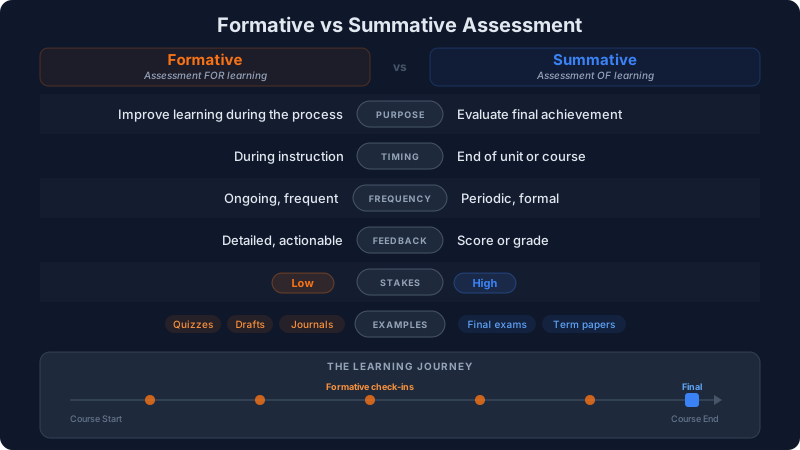
Formative assessment is any assessment activity designed to monitor student learning during the instructional process. Its primary purpose is to provide feedback that students and instructors can use to improve ongoing teaching and learning. Formative assessment is low-stakes, frequent, and forward-looking.
Summative assessment is any assessment designed to evaluate student learning at the end of an instructional unit, course, or program. Its primary purpose is to measure achievement against defined standards and assign a grade or certification. Summative assessment is high-stakes, infrequent, and backward-looking.
The metaphor often used: formative assessment is the check-up during the journey, while summative assessment is the final destination stamp.
| Characteristic | Formative | Summative |
|---|---|---|
| Purpose | Improve learning | Measure achievement |
| Timing | During instruction | After instruction |
| Stakes | Low (often ungraded) | High (affects final grade) |
| Frequency | Ongoing, frequent | Periodic, infrequent |
| Feedback | Detailed, actionable | Summary judgment (grade) |
| Audience | Student and teacher | Student, institution, external |
| Examples | Drafts, quizzes, polls, peer review | Final exams, term papers, capstones |
Why Formative and Summative Assessment Matter
The distinction between formative and summative assessment matters because using one type where the other is needed produces poor outcomes. A final exam cannot guide learning improvement (it comes too late), and a low-stakes draft review cannot certify competence (it lacks rigor).
For educators, understanding both types:
- Prevents over-reliance on summative grading as the only measure of learning
- Creates opportunities for early intervention when students struggle
- Improves the quality of constructive feedback throughout a course
- Ensures assessment alignment between teaching activities and evaluation methods
For students, balanced assessment:
- Provides actionable guidance before high-stakes evaluations
- Reduces test anxiety by normalizing frequent, low-stakes feedback
- Builds metacognitive skills through self-assessment and reflection
- Creates a clearer path from current performance to mastery
Key Differences Between Formative and Summative Assessment
Purpose and Intent
Formative assessment asks: "How is the student progressing, and what should change?" It is diagnostic and prescriptive. The goal is to identify gaps and adjust instruction or study strategies in real time.
Summative assessment asks: "Did the student meet the learning objectives?" It is evaluative and certifying. The goal is to determine the level of achievement at a defined endpoint.
Feedback Quality
Formative feedback is specific, timely, and forward-looking. It identifies what the student did well, what needs improvement, and how to improve. Effective formative feedback references specific grading criteria and offers concrete next steps.
Summative feedback is typically summary in nature — a grade, score, or brief comment. While instructors can (and should) provide detailed feedback on summative work, the timing limits its impact: the learning window has closed.
Grading Implications
Formative assessments are generally not graded or carry minimal weight. Attaching high stakes to formative work undermines its purpose — students shift from "learning mode" to "performance mode," focusing on getting the right answer rather than understanding the process.
Summative assessments carry significant grade weight and contribute to final course grades, GPA, and academic standing.
Formative and Summative Assessment in Practice
Examples of Formative Assessment
- Think-pair-share: Students discuss a concept with a partner before sharing with the class
- Exit tickets: One-minute written reflections at the end of a lesson
- Draft submissions: Students submit work-in-progress for feedback before the final version
- Peer review: Students evaluate each other's work against a rubric, building both assessment literacy and content understanding
- In-class polls: Real-time comprehension checks using digital tools
- Learning journals: Ongoing reflective writing about the learning process
Examples of Summative Assessment
- Final examinations: Comprehensive tests covering an entire course's content
- Term papers and research projects: Major writing assignments evaluated against defined grading criteria
- Capstone projects: Culminating demonstrations of program-level learning
- Portfolio assessments: Curated collections of student work demonstrating growth and achievement
- Standardized tests: External evaluations used for certification or program accountability
- Thesis and dissertation defenses: Oral examinations of original research
Combining Formative and Summative Assessment
The most effective assessment systems integrate both types intentionally. Here is a practical model for a semester-long course:
| Week | Assessment Type | Activity | Purpose |
|---|---|---|---|
| 1–3 | Formative | Pre-assessment quiz + learning journal | Diagnose starting knowledge |
| 4–6 | Formative | Draft submission with peer review | Improve work before grading |
| 7 | Summative | Midterm essay (graded) | Measure mid-course achievement |
| 8–10 | Formative | In-class case study discussions | Deepen analytical skills |
| 11–12 | Formative | Presentation dry runs with rubric-based feedback | Prepare for final |
| 13–14 | Summative | Final project + presentation (graded) | Certify course-level mastery |
The key principle: formative assessments prepare students for summative success. When students receive structured feedback on drafts before submitting final papers, both learning and grades improve.
Common Mistakes
- Grading every formative task: This converts formative assessment into low-weight summative assessment, eliminating the psychological safety students need to take risks and learn from mistakes.
- Providing only summative assessment: Students receive grades without guidance on how to improve, leading to frustration and repeated errors.
- Feedback that arrives too late: Returning summative work with detailed comments weeks after submission wastes instructor effort — students have mentally moved on.
- Misaligning assessment types with objectives: Using a multiple-choice quiz (summative-style) to assess creative thinking (Bloom's higher-order levels) is a mismatch.
How MarkInMinutes Implements Both Assessment Types
Summative Grading With Built-In Formative Coaching
MarkInMinutes bridges the gap between summative and formative assessment. While the platform performs rigorous summative grading — scoring each dimension of a rubric with evidence-based justifications — it simultaneously generates a formative Unified Coaching Plan for every submission. This coaching plan includes Quick Wins (immediately actionable improvements), Priority Fixes (structural issues to address), and Skill Gap Analysis (longer-term developmental areas). The result is that every graded assignment becomes both a final evaluation and a personalized learning roadmap, giving students the forward-looking feedback that traditional summative grading lacks.
Related Concepts
Formative and summative assessment connect to several foundational grading concepts. Constructive feedback is the mechanism through which formative assessment achieves its impact — without quality feedback, formative tasks become busywork. Evidence-based grading strengthens summative assessment by requiring concrete evidence for every score, making final grades defensible and transparent. Both assessment types depend on well-designed rubrics and clearly defined grading criteria to communicate expectations. And assessment alignment ensures that both formative and summative tasks map to the course's stated learning objectives.
Further Reading
For 30 concrete examples of both formative and summative assessment — organized by type and subject, including group coaching sessions, peer review, and AI-enhanced feedback — see 30 Formative & Summative Assessment Examples for Every Classroom.
Frequently Asked Questions
Can an assessment be both formative and summative?
Yes, in practice many assessments serve dual purposes. A midterm exam is summative (it generates a grade) but can also be formative if the instructor provides detailed feedback and students have future assignments where they can apply what they learned. The key is whether the feedback loop exists and the student has opportunity to act on it.
How much of a course grade should come from formative vs. summative assessment?
There is no universal rule, but a common guideline is that summative assessments should constitute 70–80% of the final grade, with the remaining 20–30% allocated to participation, drafts, or other formative-adjacent activities. The exact balance depends on the course level, discipline, and institutional policies. Some competency-based programs use no traditional grades for formative work at all.
What is the biggest mistake educators make with formative assessment?
The most common mistake is treating formative assessment as "mini summative assessment" — grading every quiz, draft, and discussion post. When formative work carries grade weight, students prioritize performance over learning, and instructors lose the diagnostic information that makes formative assessment valuable. Keep formative assessment low-stakes and focused on feedback, not scoring.
See These Concepts in Action
MarkInMinutes applies these grading principles automatically. Upload a submission and get evidence-based feedback in minutes.
Related Terms
Assessment Alignment
Assessment alignment is the degree to which assessments accurately measure the learning objectives they are intended to evaluate, ensuring coherence between what is taught and what is tested.
Constructive Feedback
Constructive feedback is specific, actionable commentary on student work that identifies strengths, pinpoints areas for improvement, and provides clear guidance on how to close the gap between current and desired performance.
Evidence-Based Grading
Evidence-based grading is an assessment approach where every score is justified by specific, observable evidence drawn directly from student work rather than subjective impressions.
Grading Criteria
Grading criteria are the specific standards and expectations used to evaluate student work, defining what quality looks like at each performance level.
Rubric
A rubric is a scoring guide that defines criteria and performance levels used to evaluate student work consistently and transparently.